Houseplant · Aspleniaceae
Bird's Nest Fern
Asplenium nidus
Supply warmth, steady moisture, and humid air, and this shade-adapted fern unfurls glossy fronds for years.
Bright indirect
Every 5–9 days
55–75°F · 13–24°C
USDA 11–12
Overview
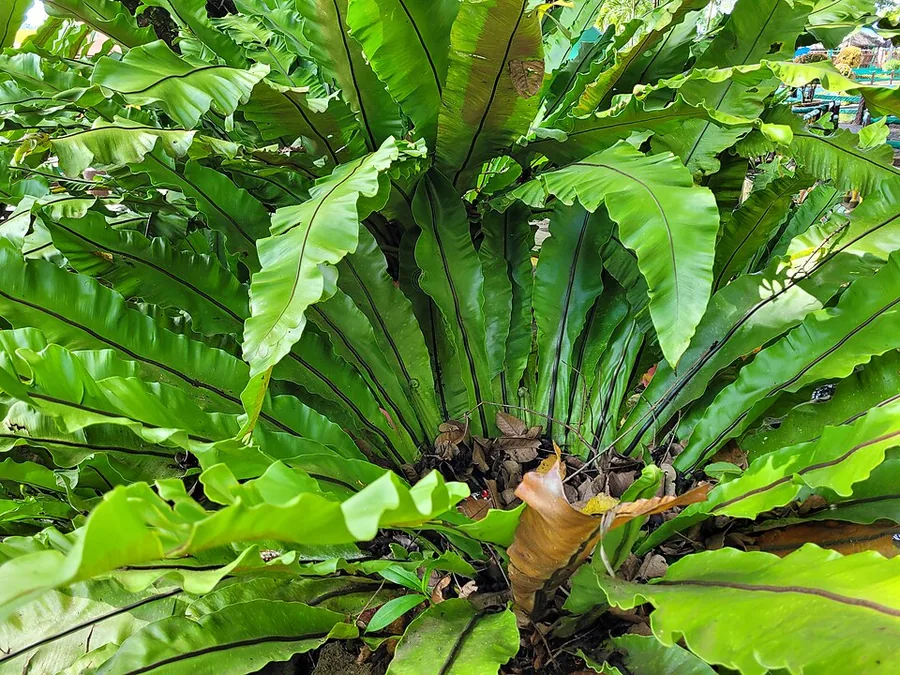
The common name follows the growth habit: glossy fronds radiate from a central rosette that catches debris and resembles a nest. In habitat the species grows as an epiphyte, anchoring on tree trunks and branches rather than in soil, and that ecology dictates its cultural needs. The warm, humid, shaded conditions of a forest understory are what it is adapted to, so reproducing them is the whole of good care.
The foliage departs from the lacy, finely divided form most associate with ferns. Fronds are broad, simple, and undivided, with a bright apple-green surface, and new growth emerges from the center of the rosette, which makes the crown the critical structure to protect. Growth is slow, but the plant is a perennial that persists for years and progressively widens into a substantial specimen.
These requirements make it specific rather than difficult. An evenly moist medium, humid air, and diffuse light cover nearly all of its needs. Two conditions it will not tolerate are standing water in the crown and exposure to direct sun, and both follow directly from its epiphytic, understory origins.
Care
The short version: bright indirect light, an evenly moist but not saturated medium watered around the crown rather than into it, warm interior temperatures, and humidity held at the high end.
Light
Provide bright, indirect light, such as the exposure near an east or north window. The species tolerates medium light and even deep shade, but direct sun exceeds what its shade-adapted fronds can dissipate and scorches them pale.
Water
Maintain the medium evenly moist but never waterlogged, watering roughly every 5 to 9 days as the upper layer begins to dry. Apply water to the soil and never into the central nest, because moisture trapped there sits against the crown and drives rot.
Soil
Use a rich, peaty fern mix that retains moisture while draining freely. A slightly acidic pH between 5.0 and 6.0 corresponds to the organic, aerated bark substrate the species occupies as an epiphyte.
Temperature
Hold interior temperatures between 55°F and 75°F (13°C to 24°C), which matches its warm origins. Cold drafts and abrupt chills stress the tissue and brown the frond margins quickly.
Humidity
Humidity is the limiting factor for this species, which requires high humidity of 60% to 80%. A bathroom, kitchen, pebble tray, or humidifier supplies it, whereas ambient room air falls short and leaves the tips desiccated.
Feeding
Fertilize only during the spring and summer growth phase, about once a month, with a balanced liquid feed diluted well. The fronds are sensitive to salts, so a weak concentration is safer than a strong one.
Pruning
Pruning is minimal by nature. Remove old, browned, or damaged outer fronds at their base with clean shears, but never cut into the central rosette, the meristematic zone from which new fronds arise.
Repotting
Repot only every 2 to 3 years, or when roots emerge from the drainage holes and the rosette becomes congested. Disturb the plant as little as possible during the operation, since the fronds bruise readily.
Size & spacing
Indoors the plant attains roughly 18 to 35 inches (45 to 90 cm) in height with a comparable spread of 24 to 35 inches (60 to 90 cm). Allow the arching fronds clear space to extend so they fan out without abrading against nearby objects.
Troubleshooting
Nearly every disorder in this fern resolves to one of a few causes: water held in the crown, low humidity, or excess light. The fronds register which factor is responsible, so interpret the signs below against what the plant is showing before adjusting anything.
Soft, browning tissue at the core of the rosette
A mushy, darkening center is crown rot, which develops because the rosette is shaped to funnel and hold water, and standing moisture there suffocates and decays the crown tissue. Overwatering or a mix that drains poorly keeps that water in place longer. Direct watering to the medium, excise the affected tissue, and raise air movement around the crown so the surface dries.
Fix:
- Stop watering into the central nest and water the potting mix instead
- Improve drainage and reduce watering frequency
- Remove affected tissue and increase air circulation
Bleached, yellowing fronds toward the light source
A shade-adapted understory fern, this plant has no defense against intense radiation, so excessive direct sun bleaches the fronds, and the damage concentrates on the face turned toward the window. Move it into bright indirect light or light shade, where a north-facing exposure or filtered light delivers enough energy without overloading the fronds.
Fix:
- Move to bright indirect light or light shade
- Provide a north-facing window or filtered light
Honeydew, white masses, or brown bumps on the fronds
Sticky residue is excreted honeydew, the tell-tale of sap-feeding scale insects or mealybugs working the fronds. Because the fronds are thin and easily damaged, mechanical removal by hand or with a damp cloth is the controlled approach, paired with isolating the plant to break the infestation. Withhold chemical insecticides, since the same fragility that rules out abrasion makes these fronds prone to phytotoxic burn.
Fix:
- Wipe pests off gently by hand or with a damp cloth
- Isolate the affected plant
- Avoid chemical insecticides, which can damage the delicate fronds
Desiccated brown tips and margins on the fronds
Tips and margins go first because they sit farthest from the water supply, so when humidity drops the thin frond edges lose moisture faster than the plant replaces it. Cold drafts and direct heat both accelerate that water loss. This species evolved under high humidity of 60% to 80%, so a pebble tray or humidifier restores it, and relocating the plant away from vents and drafty windows removes the stressor; trim spent tips for appearance.
Fix:
- Raise humidity with a pebble tray or humidifier
- Move the plant away from heat vents, radiators, and drafty windows
- Trim badly browned frond tips
Toxicity
For households with animals the verdict is straightforward: the bird's nest fern is non-toxic across the board. The ASPCA records it as safe for cats and dogs, and no poisoning risk is documented for other animals or for people. The only practical caution is mechanical, since the fronds are fragile and tear readily under curious paws.
Safe for
People · Cats · Dogs · Horses · Rabbits · Livestock · Birds
Cats None
The ASPCA classifies this fern as non-toxic to cats, so an exploratory bite carries no poisoning risk.
Dogs None
No toxic compounds are present that would affect dogs, so ingestion of a frond is harmless.
Horses Safe
The species contains nothing known to be toxic to horses.
Rabbits Safe
Rabbits face no toxic hazard, though the thin fronds will not withstand sustained browsing.
Livestock Safe
Grazing livestock encounter no known poisoning risk from this fern.
Birds Safe
Pet birds can perch on and sample the foliage without toxic consequence.
People Safe
The plant is non-toxic to people, children included, with no documented poisoning risk.
Fronds are delicate and best handled minimally, but the plant poses no known poisoning risk to pets.
Varieties
Several named cultivars are distinguished chiefly by frond morphology, specifically how the margins ripple, wave, or how broadly the fronds spread. These are the selections most often offered in the trade.
'Crispy Wave'
Upright fronds bear heavily ruffled, rippling margins that read as a crested, wavy profile.
'Antiquum'
Broad, strap-shaped fronds with gently undulating margins make this the reference nest form of the species.
'Osaka'
Narrow, strap-like fronds along a crinkled, rippled margin give this cultivar a finer overall texture.
'Victoria'
Long, tongue-shaped fronds taper toward increasingly pronounced wavy margins along their length.
How to propagate
Propagating this fern is a demanding undertaking rather than a quick exercise. It increases by spores rather than the straightforward divisions or cuttings used for many houseplants, which is why most growers acquire a new plant instead.
DivisionDemanding
Spring · Several months to over a year
Realistically this is not an easy plant to multiply at home. As a true fern it reproduces from spores rather than seed, and spore culture is slow and exacting, requiring controlled humidity and sterile media to suppress contamination. The rosette habit of the species also resists clean division, and even a viable propagule needs anywhere from several months to over a year to establish.
Myths
You should keep the central nest of the fern filled with water.
In cultivation this is the surest way to kill the plant. The rosette holds standing water against the crown tissue, and that is precisely the condition that triggers crown rot, the single disorder capable of destroying the entire fern. Water the potting mix instead and keep the crown dry.
Bird's nest fern is toxic to pets like many common houseplants.
The ASPCA classifies it as non-toxic to both cats and dogs. A curious pet can nibble a frond without harm, which places this among the safer fern choices for a household that keeps animals.