Ornamental · Poaceae
Creeping Bentgrass
Agrostis stolonifera
A fine, carpet-fine turf that reads like a putting green because it needs the management of one.
Full sun
Every 1–3 days
USDA 3–7
0–1 in · 0–2 cm
Overview
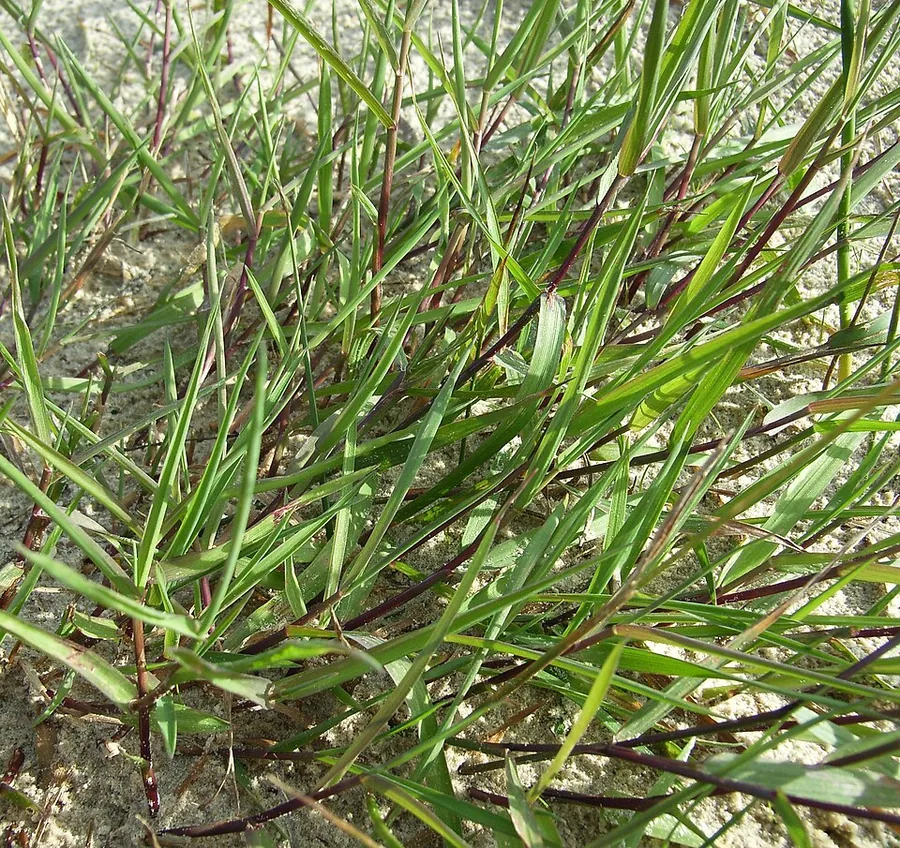
Creeping bentgrass is the low, fine-bladed grass that gives golf greens their smooth roll. A cool-season species, it travels sideways on surface stolons that root as they spread, weaving a dense, soft canopy that takes a very short cut. Left uncut it throws up airy purple to lavender seed heads in midsummer.
Its character is defined by upkeep. This demanding grass wants short, frequent mowing, cool moist soil, and constant attention, since close cutting is what holds the canopy tight, and it deteriorates quickly without them. Mow it tall or skip a pass and it puffs up, accumulates thatch, and thins, which is why a managed green suits it far better than a yard.
The vigor that builds a tight green becomes a liability beyond it. Those creeping stolons let it break into neighboring lawns, where it surfaces as flat, light-green patches that resist digging and resist herbicide unless you sacrifice the grass around them.
Care
The short version: full sun, soil kept cool and continuously moist, very short and frequent cutting, a light steady nitrogen program, and close watching for fungal disease whenever the air turns warm and humid.
Light
Give it full sun. It accepts no meaningful shade, and a green held in shade thins, loses vigor, and grows markedly more disease-prone as the canopy weakens.
Water
Hold the soil cool and continuously moist, irrigating about every 1 to 3 days and more often in heat. It carries little drought tolerance, so a dry summer stretch stresses it fast.
Soil
Plant it into fertile, moist, well-drained loam or silt kept slightly acidic, around a pH of 5.5 to 6.5. It handles a high water table and short spells of flooding better than most turfgrasses.
Temperature
Being cool-season, it is genuinely cold-hardy, enduring lows near -40°F (-40°C) and ceilings around 86°F (30°C). Summer heat is the real threat, since high temperatures stress this cool-season grass and open it to disease.
Humidity
It performs in high humidity yet pays a price, because damp, still air is precisely what fungal turf diseases exploit. Moving air across the canopy counts as much as the moisture does.
Feeding
Feed it lightly and steadily across the growing season with a balanced turf nitrogen, about 2 to 3 lbs of nitrogen per 1000 sq ft a year, paired with regular topdressing. Surplus nitrogen does nothing but feed disease.
Pruning
Cut it short and often, down to roughly 1/8 to 1/4 inch on a green, ideally with a reel mower. Let the height climb or skip a pass and the canopy puffs, mats, and scalps the next time the blade comes down.
Repotting
none
Size & spacing
Under a tight cut the canopy stands barely 0 to 1 inch (0 to 2 cm), while a single plant runs outward on stolons to span 1 to 3 feet (30 to 91 cm). That lateral creep both fills the stand and carries it into ground you never seeded.
When to plant
Because it is a cool-season grass, it establishes when the weather supports cool, moist root development. Sow seed or set sod and stolons in late summer to early fall, or in spring, and watch for the airy seed heads in midsummer wherever it goes uncut.
Northern hemisphere
Southern hemisphere
Typical months for a temperate climate: start earlier in warm zones, later where spring frosts linger.
- Plant: Seed or sod/stolons in late summer to early fall, or spring, when cool-season conditions favor establishment
- Harvest: Midsummer (purple to lavender panicles when left unmowed)
Hardiness
USDA hardiness zones: 3–7
Temperature: down to -40°C
Troubleshooting
Bentgrass signals trouble quickly, typically as thinning canopy, disease patches, or escape into surrounding grass. Catch the early symptoms below and act before a small patch becomes a renovation.
Round dead or off-color patches when it turns hot and muggy
Few turfgrasses draw fungal disease like this one: dollar spot, brown patch, Pythium blight, anthracnose, take-all patch, and snow mold all find it. The trigger is heat plus humidity plus leaf wetness that lingers on a closely cut canopy, which lets pathogens move fast. Diagnose the organism first, then open up airflow, irrigate early so blades dry, back off the nitrogen that feeds the fungi, and apply a labeled fungicide when pressure runs high.
Fix:
- Identify the specific disease before treating
- Improve air movement and avoid prolonged leaf wetness
- Avoid excess nitrogen and irrigate early in the day
- Apply appropriate labeled fungicides during high-risk periods
Stand keeps thinning even under heavy management
This species holds a dense canopy only under greens-level inputs, because close, frequent cutting is what keeps the stand tight; an everyday lawn schedule starves it of that and the turf weakens. Raise the height or miss a mowing and the canopy goes puffy, lays down thatch, then scalps when the reel finally drops. Either commit to short repeated cuts, even moisture, and routine aeration, or plant a less demanding cool-season grass.
Fix:
- Commit to frequent close mowing with a reel mower
- Irrigate to keep the soil cool and moist
- Topdress and core-aerate regularly to manage thatch and mat
- Maintain a steady light fertility program
Fine pale patches creeping through an established lawn
Those low, fine-bladed patches are bentgrass behaving as a weed, advancing through bluegrass, ryegrass, and fescue on surface stolons that root as they go. The same stolons that build a putting surface drive the escape, and nothing selective takes it out, so dig small patches with every root and stolon, or solarize and reseed. Bigger infestations call for a non-selective herbicide and full renovation.
Fix:
- Dig out small patches, removing all shallow roots and stolons, then reseed
- Solarize affected areas with clear plastic before reseeding
- For larger areas, use a non-selective herbicide on the patch and renovate, since no herbicide selectively removes bentgrass from cool-season lawns
Toxicity
Reassuring for homes with pets and children: creeping bentgrass is not poisonous. It is a standard cool-season turfgrass with no toxic compounds, and its only real nuisance is the grass pollen released through spring and summer.
Safe for
People · Cats · Dogs · Horses · Rabbits · Livestock · Birds
Cats None
Carries no toxins for cats. A grazing cat may bring up a bit of swallowed blade now and then, but the grass itself causes no poisoning.
Dogs None
Free of toxic compounds, so dogs can play on and chew the turf safely. Occasional vomiting after eating grass is routine, not a poisoning.
Horses Safe
Safe to graze. It is a fine cool-season grass carrying no toxic constituents.
Rabbits Safe
Entirely safe for rabbits to crop as part of ordinary grazing.
Livestock Safe
Cattle, goats, and sheep graze it without hazard, though the short close-cropped canopy yields little forage bulk.
Birds Safe
Poses no threat to birds that take the seed or rest within the turf.
People Safe
Safe to touch and stand near. Its one drawback is grass pollen, which can set off hay fever through spring and summer.
Grass pollen can trigger seasonal allergies, and pets that nibble grass may vomit, but the plant itself is not poisonous.
Varieties
Bentgrass sorts into a handful of named cultivars plus a couple of close relatives. These are the ones you are most likely to walk across on a green or encounter in a cultivar trial.
Penncross
An older standard that runs more open in habit than the newer selections, which leaves it more exposed to dollar spot and to annual bluegrass moving in.
Penn A-1
A modern selection that closes into a finer, denser canopy than Penncross.
L-93
A heavily used improved cultivar valued for canopy density and its performance on putting greens.
Colonial bentgrass (Agrostis capillaris)
A related, finer-bladed species that creeps far less aggressively than creeping bentgrass.
Velvet bentgrass (Agrostis canina)
A related, exceptionally fine bentgrass with strong dollar spot tolerance that has trouble holding on long-term in trials.
How to propagate
Creeping bentgrass establishes two ways, from seed or vegetatively from the stolons that drive its creep. Each takes hold readily where conditions stay cool and moist.
SeedModerate
Late summer to early fall, or spring · Several weeks to a few months for a dense stand
Most plantings begin with extremely fine seed, dropped in late summer to early fall or in spring while the weather holds cool. That seed depends on constant moisture to germinate and knit together, and a tight carpet fills in over several weeks to a few months.
DivisionEasy
Cool, moist parts of the growing season · Several weeks to root and spread
It also goes in vegetatively from sod or stolons during the cool, damp parts of the season. Those pieces root quickly and run outward on their stolons, taking hold and spreading within a few weeks.
Myths
Plant bentgrass at home and you get a putting-green lawn.
That surface comes only with daily greens-level work: short mowing, heavy watering, topdressing, aeration, and aggressive disease control, all of it beyond what a home lawn can keep up. In most cool-season yards it turns up as an invader rather than a turf anyone deliberately sows.