Shrub · Fabaceae
Wisteria
Wisteria sinensis
Give it full sun, a heavy support, and two hard prunings a year, and wisteria drips with flowers each spring.
Full sun
Every 5–10 days
1095–2555 days
USDA 5–9
Overview
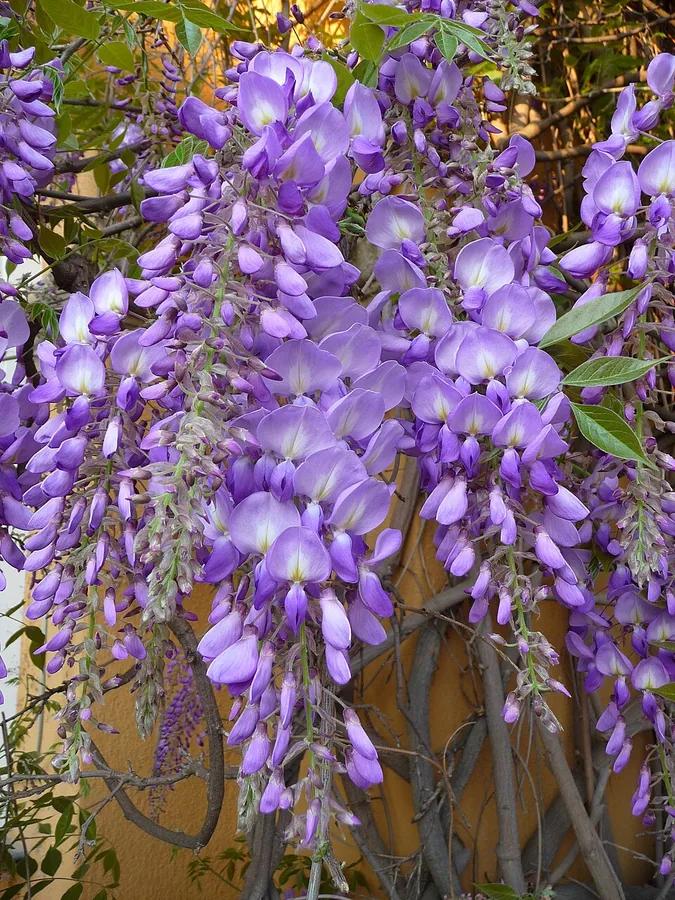
Few climbers rival wisteria in full bloom, when long racemes of blue-violet flowers hang in curtains over an arbor. It is a woody, twining member of the pea family, and the vigor that makes the display so heavy is the same trait that demands active management. A mature specimen behaves more like a small tree than a light climber, and its scale should shape every decision about siting.
Two Asian species account for most garden plantings. Chinese wisteria twines counterclockwise and opens its flowers close to synchronously, whereas Japanese wisteria twines clockwise and opens its racemes in sequence from base to tip. Both are handsome but invasive across much of the eastern US, which is precisely why the native American and Kentucky wisterias merit close consideration.
Wisteria rewards patience and disciplined management. A young plant may remain juvenile for years before flowering, and once established it will girdle trees and overload gutters if left unchecked. Provide full sun, a strong dedicated support, and hard pruning twice a year, and a healthy specimen will perform for decades.
Care
The short version: site wisteria in full sun on a very strong support set well clear of trees and the house, and keep the soil lean with little or no feeding. Water deeply through establishment, then prune hard in both summer and winter to contain the vigor and induce flowering.
Light
Wisteria flowers most freely in full sun, since floral bud formation depends on abundant direct light, and a site lit all day fills the vine with bloom. It tolerates partial shade, but insufficient light is one of the principal reasons a vigorous plant fails to flower.
Water
Hold the soil moist but well drained during establishment and water deeply through dry spells, when the shallow feeder roots are most vulnerable. Once established the plant is fairly drought tolerant, so let the top inch or so dry between waterings rather than keeping it saturated.
Soil
Wisteria is broadly adaptable, performing on clay, loam, or sand and on wet or dry ground alike. The optimum is moist, well-drained loam at a pH between 6.0 and 7.0, which supports steady growth without encouraging excess.
Temperature
This is a genuinely cold-hardy vine, rated for roughly -20°F to 100°F (-29°C to 38°C). The chief climatic risk is a late spring frost, which can kill flower buds at the point they are most exposed, just before they open.
Humidity
Ambient outdoor humidity is entirely adequate, so no humidity target applies. What matters far more to the plant's health is air and light penetration through the canopy, achieved by thinning its dense growth.
Feeding
Feed sparingly, if at all, because the plant's own nitrogen fixation as a legume already meets much of its need. Excess nitrogen diverts resources into foliage at the expense of flowers, so limit any spring feed to a low-nitrogen formulation.
Pruning
Prune hard twice a year to restrain the vine and channel energy into flowering spurs. In summer cut the long whippy shoots back to five or six leaves, then in winter shorten the same shoots to two or three buds and remove anything girdling its support.
Repotting
Wisteria is a ground plant rather than a container subject, so conventional repotting does not apply. On an established plant, root pruning can shift a persistently vegetative vine toward flowering, and few or no blooms despite vigorous foliage is the indication for it.
Size & spacing
Allow generous space, because the vine reaches 10 to 25 feet (3 to 7.5 m) in height and spreads 4 to 30 feet (1.2 to 9 m) wide at maturity. Site it on a dedicated heavy support well clear of trees, walls, and neighboring plants.
When to plant
Wisteria is a long-lived woody vine, so the operative timing concerns planting rather than an annual sowing. Establish new plants in spring or fall, then allow for a lag, because flowering can be several years away and, once it begins, occurs in mid-to-late spring.
Northern hemisphere
Southern hemisphere
Typical months for a temperate climate: start earlier in warm zones, later where spring frosts linger.
- Plant: Spring or fall
- Harvest: Mid-to-late spring (April-May)
Hardiness
USDA hardiness zones: 5–9
Temperature: down to -29°C
Troubleshooting
The great majority of wisteria problems trace to one of two conditions: a plant that will not flower or one whose vigor exceeds its situation. Read the symptom, evaluate the plant's age and site, and intervene before the vine overwhelms its support. The three cases below account for most of what growers encounter.
Girdling stems that constrict trees and overload structures
Wisteria is a heavy woody twiner capable of reaching over 60 feet, so it readily overtakes any support it is given. As the stems thicken they wind and constrict the trunks they climb, cutting off the flow beneath the bark, while the accumulated mass bows or breaks trellises, gutters, and downspouts. Match that vigor with a heavy dedicated arbor set well clear of the house, prune hard twice a year to cap the load, and sever anything twining onto a structure you did not intend.
Fix:
- Provide a very strong, sturdy dedicated support (heavy arbor or metal structure)
- Prune hard twice a year and cut away any stems twining around trees, gutters, or downspouts
- Remove the plant entirely if it is engulfing trees or buildings
Naturalized escapes displacing native canopy
The Asian species are invasive across the eastern and southeastern US because they recruit by three routes at once: seed, runners, and stems that root at every point of soil contact. That combination lets an escaped population build dense thickets and progressively shade out or overload the native trees it climbs. Cut the escaped vines at the root and remove each flush of resprouts through the season, and where natural areas adjoin the garden, substitute native American wisteria to remove the propagule source.
Fix:
- Cut vines close to the root and repeatedly remove resprouts through the season
- Apply an appropriate systemic herbicide to cut stems in spring or summer where permitted
- Replace with a native, non-invasive alternative such as American wisteria (Wisteria frutescens)
Vegetative vigor without floral bud set
A wisteria that grows hard but withholds bloom is most often still in its juvenile phase, and seedlings routinely need 3 to 7 years or more to reach reproductive maturity and set their first racemes. Surplus nitrogen keeps the plant vegetative, shade starves the buds of the light they need to form, and a late spring frost can abort buds already set. The remedy addresses each mechanism: relocate the vine to full sun, withhold fertilizer, and prune twice a year to concentrate energy into short flowering spurs.
Fix:
- Be patient and let the plant mature; grafted or already-blooming nursery plants flower sooner than seedlings
- Stop applying nitrogen fertilizer
- Move or train the vine into a full-sun position
- Prune correctly twice a year (summer and winter) to build flowering spurs
Toxicity
Every part of wisteria is toxic, and the velvety seed pods and bean-like seeds carry the greatest hazard. They contain a lectin called wisterin along with toxic glycosides, and because the pods resemble edible beans they have repeatedly poisoned children. Keep the seeds and pods away from pets, livestock, and children, and clear fallen pods from the ground.
Toxic to
Cats · Dogs · Horses · Rabbits · Livestock · Birds · People
Cats Moderate
Ingestion of the pods or seeds, which hold the highest toxin load, provokes vomiting in cats that is sometimes blood-tinged, followed by diarrhea, lethargy, and progressive dehydration.
Dogs Moderate
Dogs are drawn to the bean-like pods, and ingestion drives pronounced vomiting that may be bloody, loose stools, hypersalivation, and marked depression, with dehydration developing as the gastrointestinal upset persists.
Horses Moderate
Because the toxin is distributed through the whole plant rather than the seeds alone, a horse that consumes any part becomes inappetent and dull, with vomiting, diarrhea, and drooling.
Rabbits Toxic
Wisterin and the associated glycosides render every part unsafe for rabbits, so even a small quantity can induce drooling, abdominal pain, and loose droppings; exclusion is the only reliable safeguard.
Livestock Toxic
Cattle, goats, and sheep that graze the foliage, pods, or seeds can develop severe gastrointestinal upset, drooling, and dehydration, which is why the plant should be fenced out of any pasture.
Birds Toxic
The seeds and pods are toxic to birds, and because the pods mimic the beans a bird would ordinarily forage, accidental ingestion produces vomiting, weakness, and dehydration.
People Caution
The velvety pods closely resemble edible bean pods and have poisoned children who ate the seeds, and as few as two seeds can precipitate severe vomiting, abdominal pain, bloody diarrhea, drooling, and dehydration, so children must be kept well away.
The pods resemble edible beans and have poisoned children; keep seeds and pods away from kids and pets.
Helpline numbers

United States
ASPCA Animal Poison Control: (888) 426-4435 (fee applies)
Poison Control: (800) 222-1222



Canada
Poison Centres: 1-844-764-7669
Varieties
The practical choice in wisteria is between the showy but invasive Asian species and the better-behaved natives. These four represent the plants a grower is most likely to encounter.
Wisteria sinensis (Chinese wisteria)
Recognized by its counterclockwise twining and near-synchronous, pre-leaf display of fragrant blue-violet to purple, pink, or white racemes 6 to 12 inches long, though it is invasive across the eastern US.
Wisteria floribunda 'Macrobotrys' (Japanese wisteria)
Distinguished by clockwise twining and exceptionally long red-violet racemes, reported up to 2 to 4 feet, that open sequentially from base to tip; cold hardy yet also invasive in the eastern US.
Wisteria frutescens 'Amethyst Falls' (American wisteria)
A markedly less aggressive native that sets compact 4 to 6 inch lavender-purple racemes in May on new wood, which is why it commonly flowers while still young.
Wisteria macrostachya 'Blue Moon' (Kentucky wisteria)
A notably cold-hardy native selection with silvery-blue racemes capable of reblooming through the season, offering a non-invasive option for northern gardens.
How to propagate
Wisteria can be increased by layering, summer cuttings, or seed, but only the two vegetative methods yield a plant that flowers true to its parent.
LayeringEasy
Spring to summer · Several months to a year to root
Layering is the most dependable method because the stem stays attached to the parent while it forms roots. Peg a low, flexible shoot into the soil in spring or summer and allow several months to a full year for rooting. The resulting plant is genetically identical to its parent and reproduces its flowering traits exactly.
Stem cuttingsModerate
Summer (softwood/semi-ripe) · Several weeks to root
Softwood or semi-ripe cuttings taken from the current season's growth in summer will root within a few weeks. Because the method is clonal, it preserves the cultivar, and the raised plant flowers identically to the stock plant it came from.
SeedModerate
Spring · Many years to first bloom
Seed germinates readily in spring but is the least useful route for prompt bloom, since seedlings are genetically variable and often need 7 or more years to flower. The seeds also carry the toxin, so handle them carefully and keep them away from children and pets.
Myths
Feeding wisteria plenty of fertilizer makes it bloom.
High-nitrogen fertilizer drives the plant vegetative and suppresses flowering, so most wisteria actually blooms better when left unfed. Adequate sun, correct twice-yearly pruning, and reproductive maturity are the real determinants of bloom.
All wisterias are invasive, so none are worth planting.
Only the Asian species, W. sinensis and W. floribunda, naturalize aggressively in the eastern US. Native American wisteria (W. frutescens) and Kentucky wisteria (W. macrostachya) are far less aggressive and deliver the same pendent racemes without threatening surrounding woodland.