Herb · Fabaceae
Fenugreek
Trigonella foenum-graecum
Direct sown into cool soil, fenugreek delivers fresh methi leaves within a month.
Full sun
Every 3–5 days
50–86°F · 10–30°C
90–120 days
Overview
Fenugreek is a fast-cycling annual legume valued as a dual-purpose crop, supplying both the aromatic methi leaves used as a herb and the golden, mildly bitter seeds used as a spice. The species sits in Fabaceae, the legume family, and has a cultivation history of several thousand years across the Mediterranean and South Asia. Sown under cool conditions, it completes the seed-to-harvest cycle quickly.
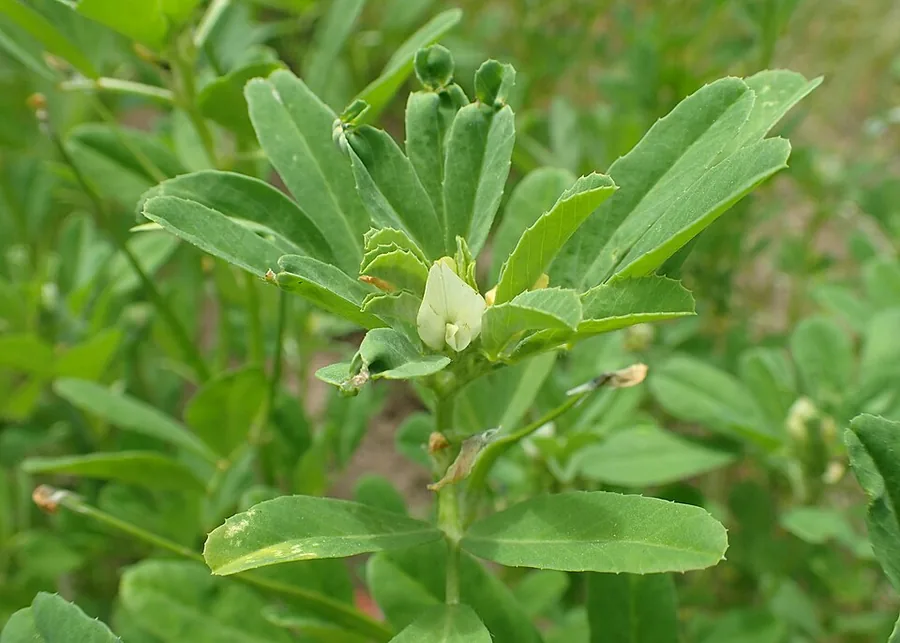
Its legume biology explains the light feeding regime. Root nodules host bacteria that fix atmospheric nitrogen, so the plant supplies most of its own nitrogen and adds residual fertility to the soil for a following crop. Growth stays compact, reaching only knee height at most, with trifoliate clover-like leaves and pale flowers that develop into slender, curved seed pods.
One physiological trait governs the whole growing strategy: fenugreek is heat-sensitive and prone to bolting. Warm temperatures shift the plant from vegetative growth into reproductive growth, so it flowers and sets seed before leaf yield accumulates. Sowing into cool conditions keeps it vegetative long enough to take both the herb and the spice.
Care
The short version: site fenugreek in full sun and well-drained loam, direct sow it under cool conditions, hold the soil evenly moist without saturation, and feed sparingly, because as a legume it fixes most of its own nitrogen.
Light
Site fenugreek in full sun, six hours or more daily, since high light drives both leaf density and seed set. It tolerates partial shade, and light afternoon shade has a practical use in warm spells, lowering canopy temperature enough to delay bolting.
Water
Maintain the soil lightly and evenly moist through active growth, on roughly a 3 to 5 day interval. Avoid waterlogging, because saturated soil excludes oxygen at the roots and triggers rot. As the seed pods fill and dry, reduce irrigation in step with the plant's declining demand.
Soil
Use well-drained, fertile loam at a pH of 6.0 to 7.0. Drainage outweighs fertility here, since the plant fixes its own nitrogen, and the priority is to avoid the saturated conditions that cause root loss. An open, friable structure also lets the taproot descend unobstructed.
Temperature
Fenugreek performs across 50°F to 86°F (10°C to 30°C) but favors the cooler portion of that band. Above roughly 80°F (27°C), the plant shifts toward flowering, which is why the cool shoulder seasons give the longest vegetative phase.
Humidity
Ambient outdoor humidity near 40% to 60% suffices, so it needs no adjustment. Air movement matters more, because still, humid air within a crowded canopy creates the leaf-surface conditions that favor powdery mildew.
Feeding
Feed minimally. The nitrogen-fixing nodules cover the plant's nitrogen needs, so a single low-nitrogen application at planting is adequate, with phosphorus or potassium added only on genuinely poor soils. Surplus nitrogen pushes vegetative growth disproportionately and offers no net benefit.
Pruning
Pinch the growing tips to break apical dominance and induce a bushier, more leafy habit, and harvest outer leaves regularly to sustain new growth. In a leaf-only crop, remove flower stalks as they form to redirect resources from reproduction back into foliage.
Repotting
Repotting does not apply. Fenugreek is an annual completing its cycle in one season from seed, so renewal comes from resowing rather than transplanting. In containers, roots emerging from the drainage holes or stalled growth indicate the plant has exhausted the available volume.
Size & spacing
Mature plants are compact at 12 to 24 inches (30 to 60 cm) tall with a spread of only 6 to 12 inches (15 to 30 cm). Thin seedlings to that spacing to maintain canopy airflow, which limits the humidity that supports mildew.
When to plant
Because warmth triggers bolting, sowing date controls the whole crop with fenugreek. Direct sow into warm soil after the last spring frost, and sow a second time in late summer for a cool-season fall crop. Leaf harvest arrives in three to six weeks, with seed pods maturing later in the season.
Northern hemisphere
Southern hemisphere
Typical months for a temperate climate: start earlier in warm zones, later where spring frosts linger.
- Sow: Not recommended; fenugreek forms a taproot and resents transplanting, so direct sow.
- Plant: Direct sow after last frost when soil is at least 60°F (15°C); sow in spring or late summer for a cool-season crop.
- Harvest: Leaves ready 20 to 40 days after sowing; small white to pale-yellow flowers, then seed pods harvested at about 90 to 120 days when pods turn yellow.
Hardiness
USDA hardiness zones: 6–9
Temperature: down to -23°C
Troubleshooting
The common fenugreek disorders reduce to two environmental causes: excess soil moisture and excess heat. Both express early on the leaves or seedlings, so reading those symptoms allows intervention before the problem progresses. Identify the pattern below, then correct the underlying condition.
Lower leaves yellowing with concurrent wilting
The cause is almost always waterlogging rather than a nutrient deficit. When soil fails to drain, oxygen is excluded at the root zone, the roots die back to a brown, soft state, and root rot follows. Reduce irrigation, improve drainage, and eliminate any standing water around the base.
Fix:
- Improve soil drainage
- Reduce watering frequency
- Avoid standing water around roots
A white, powdery film advancing across the leaves
This is powdery mildew, a fungus favored by warm, humid air held within a crowded, poorly ventilated canopy. The colonies wipe off but recolonize until conditions change, so increase spacing for airflow, remove the most affected leaves, and water at the base to keep foliage surfaces dry.
Fix:
- Increase plant spacing and airflow
- Remove affected foliage
- Avoid overhead watering
Seedlings collapsing at the soil line or emerging poorly
Cold, wet soil supports damping-off, a fungal infection that girdles young stems at the soil line until they topple. The correction is soil warmth rather than additional water, so pre-soak the seed, sow shallowly at about 1 cm deep, and delay sowing until the soil reaches 60°F (15°C).
Fix:
- Sow in warm (60°F or above) well-drained soil
- Avoid overwatering
- Do not sow seed too deep
Premature flowering and seed set with sparse foliage
Heat is the trigger. Past roughly 80°F (27°C), fenugreek switches from vegetative to reproductive growth and stops producing tender leaves, the response termed bolting. Sow in the cool of early spring or late summer, apply light afternoon shade during heat events, and harvest leaves before flower stalks elongate.
Fix:
- Harvest leaves before bolting begins
- Sow during the cool season (early spring or late summer)
Toxicity
Fenugreek carries a very low toxicity profile. The leaves and seeds are routine human food, the FDA classifies it as a GRAS spice, and it has a long record as livestock fodder. The single consideration is the concentrated seed supplement, which can produce a hypoglycemic effect in large amounts.
Safe for
People · Cats · Dogs · Horses · Rabbits · Livestock · Birds
Cats None
Safe around cats. A cat that consumes a large quantity of leaves may show mild flatulence or a soft stool, both of which resolve without intervention.
Dogs None
No real hazard from the plant. A large mouthful of leaves can cause mild gas, and the concentrated seed supplement is the item to keep inaccessible, since it can depress blood sugar.
Horses Safe
Suitable for horses. The species is a recognized forage legume, and the foliage is grazed without adverse effect.
Rabbits Safe
Edible for rabbits with no harm from the fresh leaves. Introduce any new green gradually to allow the gut flora to adjust.
Livestock Safe
A long-established fodder for cattle, sheep, and goats. The entire plant is safe to graze or to cut for hay.
Birds Safe
Both the leaves and the sprouted seeds are safe for poultry and pet birds to consume.
People Safe
A culinary staple from leaf to seed. Note that a high seed intake can lower blood sugar, a relevant point for anyone managing diabetes.
Leaves and seeds are non-toxic, but seeds eaten in large amounts can lower blood sugar, and concentrated extracts or essential oils should be avoided in pets.
Varieties
Fenugreek cultivars divide along their end use, into seed-oriented and leaf-oriented selections. A few recur in the trade, and selection follows whether the spice or the fresh herb is the objective.
Common seed fenugreek
A tall, upright selection grown chiefly for its golden-brown aromatic seeds, the form marketed whole or ground as a spice.
Pusa Early Bunching
An Indian cultivar selected for rapid leafy regrowth, allowing several cut-and-come-again harvests within one season.
Kasuri (Qasuri) methi
A small-leaved selection valued for its dried leaves, which carry a stronger, more aromatic flavor than the fresh herb.
Companions
Fenugreek works best as a soil-builder in rotation. Because it leaves nitrogen behind, the crops that follow it gain the most.
Plant near
Heavy-feeding leafy greens and brassicas grown after fenugreek: Fenugreek fixes atmospheric nitrogen, enriching the soil for subsequent nitrogen-hungry crops.
How to propagate
Fenugreek propagates by seed exclusively. The taproot architecture precludes cuttings and transplanting, so each crop establishes directly from fresh sowing in place.
SeedEasy
Spring after last frost or late summer for a fall crop · Germinates in about 5 to 7 days
Fenugreek establishes from seed only, a constraint set by the taproot, which precludes transplanting. Pre-soak the seed for a few hours to soften the seed coat, then sow at about 1 cm deep directly into warm, well-drained soil. Emergence occurs in 5 to 7 days, after which successive sowings supply each later crop in place.
Myths
Fenugreek requires heavy nitrogen feeding like leafy vegetables.
It supplies its own. As a legume, fenugreek fixes atmospheric nitrogen through root nodules, so a heavy nitrogen feed is redundant. Withhold the nitrogen and rely on fixation, supplementing with phosphorus or potassium only where the soil is genuinely deficient.
Fenugreek should be started indoors and transplanted.
Transplanting sets it back. The plant forms a taproot that does not tolerate disturbance, so a lifted seedling checks or fails to establish. Direct sow in the final position and avoid container starts.
Fenugreek needs a long, hot season to perform.
The requirement is the opposite. It is a fast cool-season crop that completes seed to harvest in about 90 to 120 days, and warmth merely accelerates bolting. Sow under the cool conditions of spring or late summer for the strongest leaf yield.