Ornamental · Fabaceae
False Indigo
Baptisia australis
Site it once in full sun and lean, well-drained soil, and false indigo establishes for decades on almost no input.
Full sun
Every 7–14 days
730–1095 days
USDA 3–9
Overview
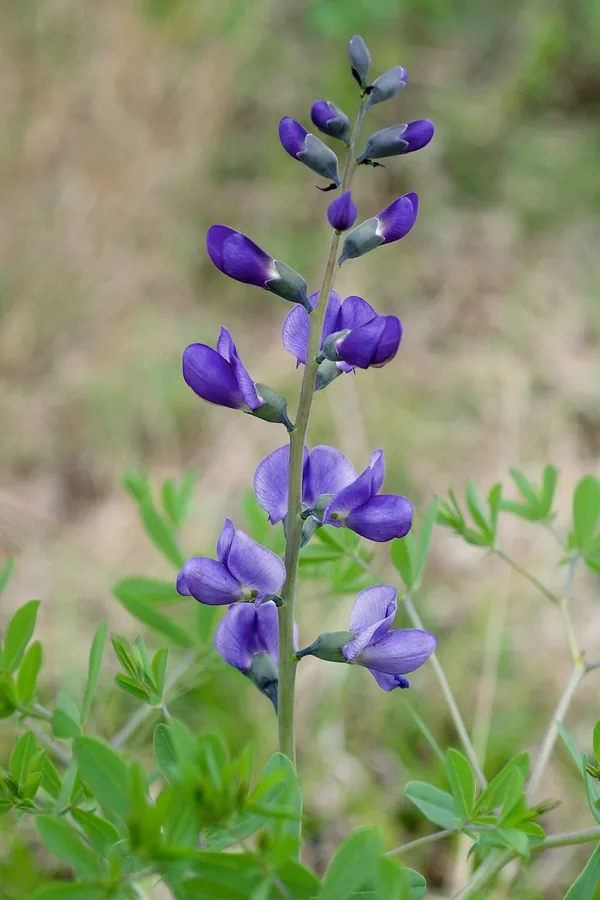
Baptisia australis is a long-lived native perennial that matures into a shrubby, rounded clump of blue-green foliage. As a member of the pea family it produces spikes of lupine-like flowers in late spring, predominantly in deep indigo blue. After anthesis the flowers develop into inflated black seed pods that rattle in the wind and persist well into winter.
Establishment is deliberately slow. The plant takes 2 to 3 years to reach flowering size because it invests early growth in a deep taproot rather than top growth, and that same taproot is what later anchors it through drought and poor ground and makes a mature specimen resent transplanting. Once established, however, it can hold a single position for a generation or more.
Its toughness follows from its biology. As a legume it fixes its own nitrogen through root symbiosis, so it tolerates lean soil and rarely needs feeding, and the deep root system lets it withstand heat, cold, and drought with little intervention. Supply sun and good drainage at planting and the plant largely manages itself thereafter.
Care
The short version: full sun, lean and well-drained soil, and consistent water only through the first year while the taproot develops. Once that root is down it carries the plant through drought, so leave it sited and undisturbed.
Light
False indigo flowers most freely in full sun, defined here as 6 or more hours daily, because strong light drives sturdy stem tissue and abundant bud set. It tolerates partial sun or light shade, but reduced light produces elongated stems that flop and a thinner display.
Water
Water regularly through the first year while the taproot extends and establishes. Thereafter the plant is highly drought tolerant, drawing on that deep root, and needs supplemental water only in a prolonged dry spell; it prefers dry to medium soil and resents waterlogging, so favor the drier side.
Soil
Grow it in average, well-drained soil, the single requirement it is least flexible about, since waterlogged roots are its main vulnerability. It tolerates poor, clay, and shallow rocky ground and leans slightly acidic, performing well across a pH of 5.0 and 7.0.
Temperature
The plant is markedly cold-hardy, rated from about -40°F to 95°F (-40°C to 35°C), which spans most of the temperate range. It requires no winter protection across most of the country and tolerates summer heat without stress.
Humidity
Ambient outdoor humidity is adequate, so no specific level applies. Good airflow is the more relevant factor, keeping foliage dry and discouraging trouble.
Feeding
As a nitrogen-fixing legume, false indigo supplies much of its own nitrogen and requires little to no fertilizer. A light spring application suffices at most; surplus nitrogen forces soft, floppy growth rather than improving the plant.
Pruning
Maintenance demands are minimal. Remove spent flower spikes after bloom if desired, or shear the foliage by about a third to maintain a rounded, self-supporting habit, accepting the loss of the ornamental pods. Cut the old stems to ground level in late winter or early spring before new growth emerges.
Repotting
False indigo is suited to permanent ground culture rather than containers. Because the deep taproot resents disturbance, an established plant should be left in place and not moved or divided once settled.
Size & spacing
A mature clump attains 3 to 4 feet (91 to 122 cm) in height and 2 to 4 feet (61 to 122 cm) in spread. Allow adequate room at planting, as the plant develops into a substantial, shrub-sized mound over several seasons.
When to plant
False indigo follows a slow developmental schedule. Sow seed in fall or start it indoors in late winter after an extended chill, transplant in spring once frost has passed, and expect the indigo-blue spikes in May and June. Flowering should not be expected in the first year or two while the plant builds its root system.
Northern hemisphere
Southern hemisphere
Typical months for a temperate climate: start earlier in warm zones, later where spring frosts linger.
- Sow: Late winter, after scarifying and cold-stratifying seed 6 to 12 weeks
- Plant: Spring after last frost, or sow fresh seed in fall
- Harvest: Late spring to early summer (May to June)
Hardiness
USDA hardiness zones: 3–9
Temperature: down to -40°C
Troubleshooting
False indigo presents few genuine problems, and those that occur generally reduce to inadequate light or excessively rich soil. Identify the cause against the entries below before intervening, since the plant is frequently in better condition than its appearance suggests.
Decline and chlorosis under black walnut influence
Baptisia is sensitive to juglone, the allelopathic compound that black walnut roots release into surrounding soil, so a plant within that root zone yellows and declines regardless of otherwise sound culture. Because the toxin acts at the root, no top-side care reverses it. Lift the crown with as much of the deep root as you can salvage and relocate it beyond the tree's influence, or establish replacements from seed well outside the canopy.
Fix:
- Transplant the crown to a site away from black walnut influence, taking as much of the deep root as possible
- Relocate or start new plants from seed well away from walnut trees
Stems splaying outward with a hollow center
Flopping traces to soft, weak stem tissue, and two conditions produce it: insufficient light, which drives leggy etiolated growth, and excess nitrogen or rich soil, which pushes lush growth faster than the stem can stiffen. Shearing the foliage by about a third immediately after flowering forces denser, lower branching that supports itself. Withhold nitrogen, and for plants in partial shade install a grow-through ring early so the new growth threads up through it.
Fix:
- Shear the foliage back by about one-third right after flowering to encourage a denser, self-supporting mound
- Provide a grow-through support ring early in the season for plants in partial shade
- Stop applying nitrogen fertilizer
Hollowed seed within sound, healthy pods
Weevils oviposit in the developing pods, and the larvae consume the seed internally while vegetative growth proceeds undisturbed. Dissecting a few mature black pods reveals the larvae or their exit holes, confirming the damage is confined to the reproductive structures. Because plant vigor is unaffected, no intervention is warranted on health grounds; remove and destroy infested pods only where seed set is the goal, which also suppresses the local weevil population.
Fix:
- Remove and discard affected pods to reduce the local weevil population
- No control is needed for plant health since damage is cosmetic to seeds only
Toxicity
All tissues of false indigo contain quinolizidine alkaloids, including cytisine and baptisin, which places it in the mildly toxic category for pets, livestock, and people. Small quantities tend to provoke gastric upset rather than serious harm, but the rattly black seed pods carry the highest concentration of concern and attract curious pets and children. Keep them inaccessible and wash your hands after pruning.
Toxic to
Cats · Dogs · Horses · Rabbits · Livestock · Birds · People
Cats Mild
In a cat, ingestion of foliage or a chewed pod typically provokes salivation, regurgitation, and some loose stool. The reaction is largely gastric and self-limiting, resolving without treatment in most cases.
Dogs Mild
Dogs are the species most inclined to seize a rattly pod, and a mouthful generally yields gastrointestinal upset with vomiting or diarrhea. The response is dose-dependent, so larger quantities provoke a stronger reaction; keep the pods inaccessible.
Horses Mild
Horses normally avoid the plant on their own. Where a hungry animal consumes a meaningful amount, the alkaloids in foliage and pods can disturb the gut and depress appetite.
Rabbits Mild
Rabbits are best denied access, since the same alkaloids occur in the leaves and seeds. Consumption beyond an incidental bite tends to produce digestive upset.
Livestock Mild
Cattle, goats, and sheep ordinarily bypass it on pasture. Poisoning arises chiefly when alternative forage is scarce and animals ingest the plant in quantity, which brings on gastric upset.
Birds Caution
The seeds and pods are not a suitable food and should never be offered. Wild birds generally disregard the plant, and the principal risk is a captive bird sampling a fallen pod.
People Caution
No part of false indigo is edible. Ingesting seeds or pods can cause nausea and gastric upset, so wash your hands after pruning and keep the pods away from small children, who find them tempting.
Generally safe to handle; wash hands after pruning and keep the rattly black seed pods away from curious pets and small children.
Helpline numbers

United States
ASPCA Animal Poison Control: (888) 426-4435 (fee applies)
Poison Control: (800) 222-1222



Canada
Poison Centres: 1-844-764-7669
Varieties
The wild species flowers in true indigo blue, while selection and hybridization have extended the color range into purples and yellows. The named selections below are the ones most commonly offered in the trade.
Purple Smoke
A vigorous hybrid bearing smoky violet-purple flowers on distinctive charcoal-gray stems, with somewhat greater shade tolerance than the species.
Twilite Prairieblues
A large, robust selection whose spikes combine violet-purple and yellow into a pronounced bicolor display.
Carolina Moonlight
A selection that replaces the species' indigo blue with soft butter-yellow spikes set against blue-green foliage.
Companions
False indigo pairs well with other sun-loving prairie plants that share its taste for dry, well-drained ground, and it struggles only near black walnut, whose roots poison the soil around it.
Plant near
Ornamental grasses: Pair well in sunny borders and prairie plantings, providing contrast and support for the upright clumps.
Coneflower (Echinacea): Shares the same full-sun, well-drained, low-water conditions in native and pollinator plantings.
Keep apart
Black walnut (Juglans nigra): Baptisia is sensitive to juglone and performs poorly within the root zone of black walnut.
How to propagate
False indigo multiplies slowly and reaches flowering size slower still, but seed is the dependable method. Softwood cuttings succeed with attention to humidity, while division is best avoided once the taproot has formed.
SeedModerate
Sow fresh seed in fall, or cold-stratify stored seed 6 to 12 weeks, then scarify and soak 24 hours before spring sowing · 2 to 3 years to first bloom
Seed is the most dependable means of propagation. The hard seed coat enforces dormancy, so scarify it with sandpaper or a nick and follow with a 24 hours soak to admit water; sow fresh seed in fall, or cold-stratify stored seed 6 to 12 weeks to satisfy the chilling requirement before a spring sowing. Fresh seed germinates best, in roughly two weeks, but plan for the slow juvenile phase, since it takes 2 to 3 years to reach first bloom.
Stem cuttingsModerate
Spring, from softwood growth in late April to early May · Roughly 8 weeks to root
Softwood cuttings succeed when taken in spring from the pliable late-April to early-May flush, before the tissue lignifies. Treat the base with rooting hormone and hold them under cover at high humidity to limit transpiration while adventitious roots form, a process of roughly 8 weeks.
DivisionDemanding
Spring, only if absolutely necessary · Slow and unreliable to recover
Division is a last resort, undertaken in spring and only when unavoidable. The deep woody taproot does not divide cleanly, making the operation difficult and risky, and recovery is slow and uncertain; replant immediately and keep the roots moist to limit desiccation. In most gardens, leaving the clump intact is the wiser course.
Myths
False indigo is the true source of indigo blue dye.
Settlers historically substituted Baptisia for true indigo, the latter derived from Indigofera, but it yields a markedly inferior pigment. The common name itself is precise: this is the false indigo, not the genuine commercial dye plant.
You can move or divide an established false indigo as easily as most perennials.
A mature specimen develops a deep, woody taproot and responds poorly to root disturbance, which renders division slow, hazardous, and frequently fatal. The sound practice is to site it once and leave it undisturbed, where it can persist for decades.