Ornamental · Fabaceae
Red Clover
Trifolium pratense
Sow it once and red clover fixes its own nitrogen through root nodules, feeding livestock now and the following crop later.
Full sun
Every 5–10 days
60–90 days
USDA 4–8
Overview
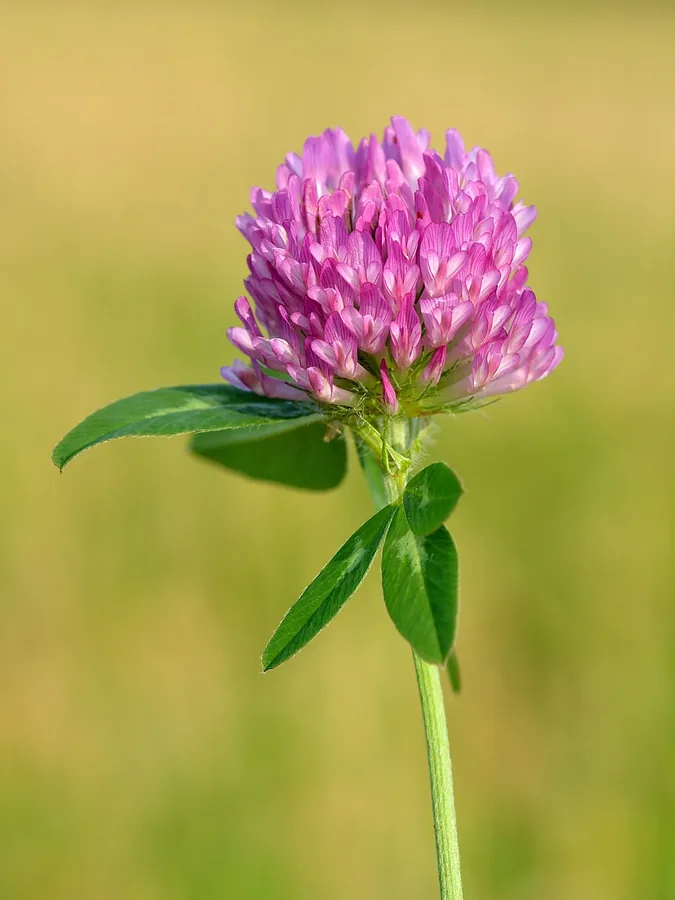
Red clover is a nitrogen-fixing legume, and that single trait explains most of its value: bacteria in its root nodules pull nitrogen from the air, so it feeds grazing stock as forage and leaves fixed nitrogen behind as a cover crop. The plant grows upright in a clump from a crown and a deep taproot, reaching about 1 to 2 feet (30 to 61 cm), and its rosy-pink heads draw the bumblebees that pollinate it.
Classify it as a short-lived perennial, because that lifespan drives how you manage it. Most stands persist only two or three years, and root rots and foliar disease push the common medium types toward biennial behavior. Since the crowns fail rather than the species, the practical response is to let it reseed, rotate the stand, or select improved cultivars bred to persist longer.
Among the legumes it establishes with relative ease. It roots in faster than alfalfa, which is why frost seeding into pasture during the late-winter freeze-thaw works so well, though the tradeoff is lower drought tolerance and a corresponding need for steadier moisture.
Care
The short version: full sun and fertile, well-drained loam at pH 6.0 and 7.0, seed inoculated with the correct Rhizobium and sown shallow for nodulation, steady moisture through establishment, and a cut or graze 2 to 3 times a season.
Light
Full sun suits red clover best, though it tolerates partial sun and partial shade. The more light it receives, the denser the stand and the heavier the bloom.
Water
Keep young stands evenly moist during establishment, and prevent the soil from drying into a hard crust that seedlings struggle to break through. Red clover roots in faster than alfalfa but tolerates drought less, so it depends on more reliable moisture through the season. Where rainfall is short, irrigate every 5 to 10 days.
Soil
Plant into fertile, well-drained loam or clay loam. Hold pH between 6.0 and 7.0, its optimal range, and note that red clover tolerates slightly acidic ground better than most legumes.
Temperature
Red clover is hardy across a wide range, from about -29°F to 95°F (-34°C to 35°C). That cold-hardiness is the mechanism behind frost seeding, since the plant survives the repeated freezing and thawing of late winter that carries the seed into the soil.
Humidity
Ambient outdoor humidity is adequate, so no target applies. Airflow and dry foliage matter more, because the warm, humid conditions that keep leaves wet are what let black patch and other leaf fungi establish.
Feeding
Because its root nodules fix atmospheric nitrogen, red clover needs little to no added N. Inoculate the seed with Rhizobium at planting so those nodules form, then supply phosphorus and potassium according to a soil test.
Pruning
Cut or mow for hay 2 to 3 times a year to keep the stand productive. As a cover crop, terminate it at mid-bloom by mowing or tilling, the growth stage at which the plant has accumulated the most fixed nitrogen for the following crop.
Repotting
none
Size & spacing
12–24 in (30–61 cm) tall
When to plant
Red clover is direct sown, never started indoors. Sow in spring or late summer, or frost-seed in late winter so the freeze-thaw cycles work the seed into firm contact with the soil, and expect bloom from late spring through summer.
Northern hemisphere
Southern hemisphere
Typical months for a temperate climate: start earlier in warm zones, later where spring frosts linger.
- Sow: Not typically started indoors; direct sown
- Plant: Spring or late summer; commonly frost-seeded or overseeded into small grains and pastures during freeze-thaw periods
- Harvest: Late spring through summer
Hardiness
USDA hardiness zones: 4–8
Temperature: down to -34°C
Troubleshooting
Red clover problems cluster into three categories: stand decline from its short lifespan, poor establishment from seeding or inoculation errors, and the fungal diseases and insect pests that intensify in warm, humid weather. Diagnosing which one you have points directly to the fix, whether that is reseeding, cutting, or rotating. Match the signs below before a patch goes bare.
Stand thins and dies back within a few seasons
This is expected behavior: red clover is a short-lived perennial that often functions as a biennial, so decline in the second or third season reflects the plant's natural lifespan. Root rots and foliar disease shorten the common medium types further. The remedy is to work with that biology by letting it reseed, frost-seeding fresh plants into thin patches, or sowing a persistent cultivar such as Kenland or Freedom that holds for 3 to 4 years.
Fix:
- Allow plants to reseed or interseed/frost-seed new clover into thinning stands
- Rotate or replant on a regular cycle
- Choose improved disease-resistant cultivars (e.g. Kenland, Freedom) that can persist 3-4 years
Weak, patchy establishment from failed nodulation or deep seeding
Most establishment failures trace to seed that was never inoculated, which prevents the Rhizobium nodules that fix nitrogen, or to seed set too deep in dry, crusted soil. Confirm it by lifting young plants: an absence of pink nodules on the roots signals failed inoculation. Coat the seed with fresh Rhizobium immediately before sowing, place it no deeper than 1/4 inch into firm, moist soil, and time frost-seeding to the freeze-thaw so the seed settles into close soil contact.
Fix:
- Inoculate seed with Rhizobium leguminosarum biovar trifolii (true clover inoculum) just before seeding
- Sow no deeper than 1/4 inch into firm, moist soil
- Frost-seed during freeze-thaw or seed into a prepared, firm seedbed for good seed-to-soil contact
Ringed dark lesions on foliage from black patch fungus
Ringed, dark lesions indicate black patch disease, caused by a fungus that flares in warm, humid weather, sometimes with anthracnose or powdery mildew present as well. That fungus produces slaframine, the alkaloid responsible for the harmless drooling seen in grazing animals, which makes early detection worthwhile. Cut or graze the affected forage early and remove clippings, withhold heavily infected hay, and plant anthracnose- and mildew-resistant cultivars.
Fix:
- Harvest or graze affected forage early and remove clippings
- Avoid feeding heavily infected, slaframine-tainted hay
- Plant anthracnose- and mildew-resistant cultivars
Chewed roots and notched foliage from clover pests
Two feeding groups are at work: clover root curculio larvae consume roots and nodules below ground, while potato leafhoppers and clover weevils feed on foliage, the leafhoppers causing the yellow scorch called hopperburn. Confirm it by scouting for notched leaves, leafhopper yellowing, and scarred crowns. A vigorous, well-fertilized stand tolerates much of this feeding, and cutting early combined with field rotation interrupts the pest cycles.
Fix:
- Scout regularly and harvest early to reduce leafhopper damage
- Maintain vigorous, well-fertilized stands to tolerate feeding
- Rotate fields to break pest cycles
Toxicity
Red clover is non-toxic to people and pets, and it is not listed by the ASPCA, which is why the dried blossoms are used in herbal teas. Cats, dogs, rabbits, and birds face no toxin in the plant. The two grazing cautions, both confined to livestock, stem from a fungus and from rumen physiology rather than from the clover itself.
Safe for
People · Cats · Dogs · Horses · Rabbits · Livestock · Birds
Cats None
Red clover carries no toxin listed by the ASPCA, so a cat that ingests a leaf or flower is unaffected.
Dogs None
Dogs can chew the foliage and blossoms without consequence, as the plant contains nothing toxic to them.
Horses Mild
The clover is sound forage for horses. The single caveat is fungal: forage carrying the black patch fungus can induce slaframine drooling, the slobbers, which resolves once the contaminated feed is removed.
Rabbits Safe
Rabbits can eat the leaves and flowers as a supplement, given in measured amounts alongside their regular hay.
Livestock Mild
Cattle, sheep, and goats graze it well. Two conditions warrant attention: slobbers from fungus-infected forage, and frothy bloat when ruminants consume lush, pre-bloom clover, both preventable through pasture management.
Birds Safe
Chickens and other birds can feed on the leaves and seed heads without restriction, as no part is toxic.
People Safe
People consume the dried blossoms as herbal tea. The flowers are edible, and the plant contains no harmful compound for human use.
Safe around pets and people. Two livestock-specific issues exist: when infected by the black patch fungus (Rhizoctonia/Slafractonia leguminicola), red clover produces the alkaloid slaframine that causes harmless but profuse drooling (slobbers) in grazing horses and cattle; and lush clover can cause frothy bloat in ruminants. Neither affects cats or dogs.
Varieties
Red clover cultivars sort mainly on two traits a grower can manage: regrowth speed, which sets how many cuttings a season yields, and disease resistance, which sets how long the stand persists.
Mammoth
A tall, vigorous late-maturing type that concentrates its yield into a single first cutting and regrows slowly afterward.
Medium (double-cut)
The standard type, whose faster regrowth supports two or more cuttings a year and a longer-lived stand than mammoth.
Kenland
An improved medium red carrying anthracnose and virus resistance, the trait that extends its persistence to 3 to 4 years.
Freedom
A disease-resistant selection chosen for greater persistence and a longer stand life than the common types.
Companions
Red clover pairs best with grasses and grains that balance the pasture or shelter the young stand, and it works as a green manure ahead of a hungry crop like corn.
Plant near
Forage grasses (e.g. orchardgrass, timothy, perennial ryegrass): Grass mixtures dilute the legume in pasture to reduce bloat risk and improve forage balance.
Small grains (wheat, oats, barley): Red clover is commonly frost-seeded or overseeded into small grains, establishing under the nurse crop and fixing nitrogen for the following crop.
Corn: Used as a green manure ahead of corn, supplying fixed nitrogen when terminated.
How to propagate
Red clover propagates by seed alone, since it forms no stolons or runners. The two factors that decide success are inoculation, which enables nitrogen-fixing nodulation, and seed-to-soil contact, which drives germination.
SeedEasy
Spring or late summer; often frost-seeded in late winter during freeze-thaw · Germinates in about 7 days; establishes within a few weeks to a season
Red clover reproduces by seed only, as it forms no stolons. Sow in spring or late summer, or frost-seed in late winter so the freeze-thaw draws the seed into the soil. Inoculate the seed with Rhizobium leguminosarum biovar trifolii to enable nodulation, then place it no deeper than 1/4 inch into firm, moist soil. It germinates in about 7 days and establishes over a few weeks to a season, and because it lacks stolons it reseeds without creeping from where it was sown.
Myths
Red clover and white clover are the same plant.
They are distinct clover species suited to different roles. Red clover grows upright at about 1 to 2 feet (30 to 61 cm) from a crown and taproot, persists only 2 to 3 years, and is pollinated mainly by bumblebees. White clover grows low, spreads by stolons, lives longer, and is worked chiefly by honeybees. The definitive distinction is growth habit: red clover never spreads by runners.