Ornamental · Fabaceae
Lupine
Lupinus polyphyllus
Give it full sun, cool roots, and lean soil, and lupine throws up tall spires of color from late spring into summer.
Full sun
Every 3–7 days
USDA 4–8
3–4 ft · 0.9–1.2 m
Overview
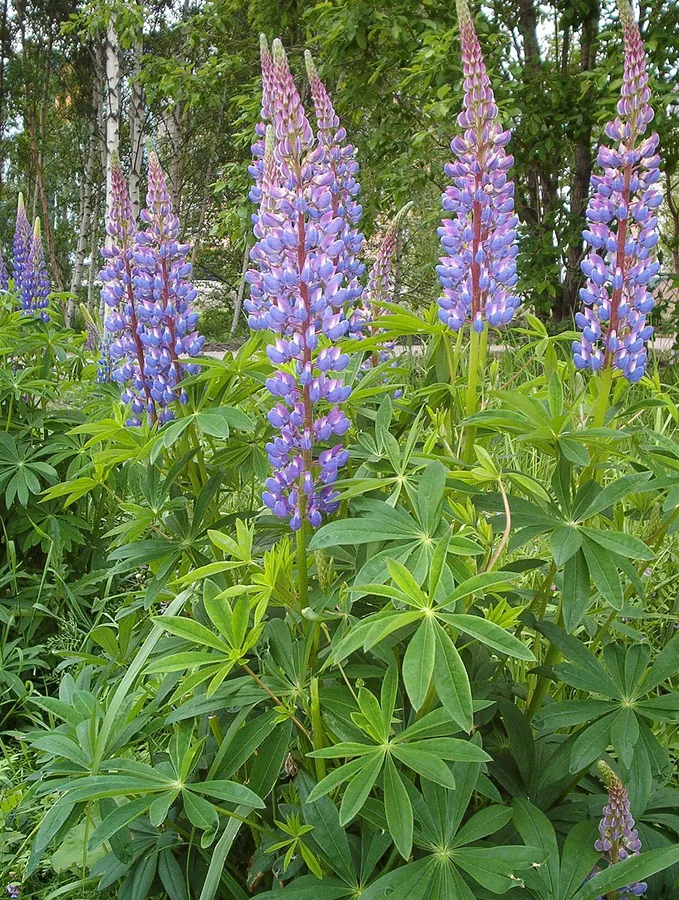
Lupine produces tall, densely flowered racemes of pea-type blooms above palmately divided foliage, giving it a commanding presence in the early-summer border. Membership in the legume family underpins much of its culture, since root-nodule bacteria fix atmospheric nitrogen and reduce its demand on soil fertility. The bigleaf species behind most garden strains originates in western North America and has naturalized broadly through cool, temperate regions.
The majority of named garden plants derive from the Russell hybrids, a strain selected for full, tightly packed spikes in clear colors and marked bicolors. They are perennial but short-lived, and they perform best where summers remain cool. A sunny position with sharp drainage brings them into their stride quickly.
One caveat governs how the plant is grown. All tissues contain quinolizidine alkaloids, most concentrated in the seeds and pods, which makes lupine a documented poison for grazing animals and unfit for casual human consumption. It is an ornamental for the eye, not the table.
Care
The short version: grow lupine in full sun with cool roots, in moderately rich, well-drained, slightly acidic soil held evenly moist. Feed sparingly, deadhead the spent spikes, and expect to replace the plants every few years.
Light
Lupine requires full sun to develop its tallest, most saturated spikes, since flowering scales with the light it captures. It tolerates partial shade, useful as afternoon relief in hot regions, but excessive shade reduces flower number and loosens the spike.
Water
Hold the soil evenly moist without waterlogging, matching lupine's medium water requirement rather than any bog affinity. In warm regions a mulch layer keeps the roots cool and buffers soil moisture. Sharp drainage is as decisive as irrigation, because saturated roots fail.
Soil
Establish lupine in moderately rich, well-drained loam amended with organic matter. It favors acidic conditions and performs best at a pH of 5.5 to 6.5, so alkaline or heavy soils suppress it.
Temperature
Cold hardiness is considerable, with the plant enduring winter lows to -29°F (-34°C), yet it objects to sustained heat much beyond 84°F (29°C). Cool summers sustain its vigor, whereas hot, humid ones stress the crown and shorten its life.
Humidity
Average outdoor humidity is adequate, so no target figure applies. The operative factor is airflow, because still, humid air within a crowded stand is what predisposes the foliage to powdery mildew.
Feeding
As a nitrogen-fixing legume, lupine supplies much of its own nitrogen and needs minimal feeding, a light low-nitrogen application at most. Treating the roots with legume inoculant at planting establishes the fixing symbiosis and yields sturdier, more productive plants.
Pruning
Deadhead the spent racemes as they fade to encourage a second flush, sustain vigor, and curb self-seeding. When flowering concludes, cut the declining foliage back to refresh the clump.
Size & spacing
Lupine attains 3 to 4 feet (91 to 122 cm) in flower and forms a clump roughly 12 to 18 inches (30 to 46 cm) wide. Allow that spacing so air circulates freely and mildew pressure stays low.
When to plant
Lupine follows a cool-season cycle. Sow seed in fall or start it indoors in late winter, transplant in spring after the last frost, and the racemes open from May into July.
Northern hemisphere
Southern hemisphere
Typical months for a temperate climate: start earlier in warm zones, later where spring frosts linger.
- Sow: 6 to 8 weeks before last spring frost; nick/scarify and soak seed to aid germination
- Plant: Spring after last frost, or sow seed in fall
- Harvest: May to July
Hardiness
USDA hardiness zones: 4–8
Temperature: down to -34°C
Troubleshooting
Lupine remains largely trouble-free, though a small set of familiar disorders and pests appear on the foliage and new growth. Early recognition keeps most of them minor. Identify the symptom below, then intervene before it advances.
White fungal bloom coating the foliage and stems
The coating is powdery mildew, a foliar fungus that establishes where stagnant, humid air lets spores settle on crowded or shaded plants. Because the disease needs moisture on the leaf surface and still air to spread, thin the clump for circulation, water only at the base, and remove heavily colonized foliage to reduce the spore load.
Fix:
- Improve air circulation by thinning and spacing plants
- Avoid overhead watering
- Remove and dispose of badly affected foliage
Colonies of sap-feeders distorting the shoot tips
The clusters are aphids, sap-feeding insects that congregate on the softest new growth and developing flower spikes, and their feeding distorts the tips. Dislodge them with a strong jet of water and follow with insecticidal soap for persistent colonies, conserve lady beetles as predators, and withhold nitrogen, since the soft flush it produces is precisely the tissue they exploit.
Fix:
- Spray plants with a strong jet of water to dislodge aphids
- Apply insecticidal soap if needed
- Encourage natural predators such as lady beetles
Progressive decline and loss of a clump after a few seasons
This reflects lupine's nature as a short-lived perennial, a lifespan that hot, humid summers compress further by stressing the crown. Because vigor and bloom characteristically fall off within 2 to 5 years, plan on periodic replacement, favor cool-summer sites or grow it as an annual where summers are hot, and permit some self-seeding to maintain the planting.
Fix:
- Replace plants every few years
- Grow in cool-summer sites or treat as annual in hot zones
- Allow some self-seeding or start new plants from seed
Nocturnal grazing leaving ragged holes in seedlings
The overnight damage points to slugs and snails, mollusks that feed after dark on soft seedling tissue and leave diagnostic slime trails. Since they rely on damp shelter through the day, hand-pick after dark or set traps, strip away the moist debris and heavy mulch near the crowns that harbor them, and protect vulnerable plants with a barrier or iron-phosphate bait.
Fix:
- Hand-pick at night or set out traps
- Reduce damp hiding spots and mulch buildup near crowns
- Use barriers or iron-phosphate baits
Toxicity
Regard lupine as a poisonous plant. All tissues hold quinolizidine alkaloids concentrated in the seeds and pods, and grazing animals bear the greatest risk. Pregnant cattle are most vulnerable, since the teratogen anagyrine induces crooked calf disease, and no part of the plant is safe for human consumption off the stem.
Toxic to
Cats · Dogs · Horses · Rabbits · Livestock · Birds · People
Cats Toxic
In cats the quinolizidine alkaloids act as gastrointestinal irritants, producing vomiting and diarrhea. A larger ingestion, particularly of the alkaloid-dense seeds, can progress to drooling, tremors, and further neurological signs, which argues for placing the plant out of reach.
Dogs Toxic
Ingestion in dogs typically opens with vomiting and diarrhea. Given that alkaloid concentration peaks in the seeds, a larger dose can produce agitation, tremor, and an unsteady, ataxic gait.
Horses Severe
Horses respond severely to the alkaloids, which induce muscular weakness, a staggering gait, and other neurological signs. The seeds and pods carry the greatest alkaloid load and should be excluded rigorously from feed and pasture.
Rabbits Severe
Lupine is unsuitable forage for rabbits. The same quinolizidine alkaloids that poison larger grazers act on a rabbit's smaller mass as well, so exclude the foliage, seeds, and pods from their access entirely.
Livestock Severe
In cattle, sheep, and goats the alkaloids cause muscular weakness, ataxia, and neurological signs. The critical hazard is to pregnant cattle grazing lupine across gestation days 40 to 100, when the teratogen anagyrine induces crooked calf disease, characterized by skeletal contracture deformities and occasional cleft palate.
Birds Severe
The alkaloid-rich seeds and pods are toxic to birds, and the remaining tissue is no safer. Poultry and pet birds should be kept away from lupine without exception.
People Caution
No part of garden lupine is casually edible for people. The bitter seeds are dense in alkaloids and become food only after prolonged soaking and debittering, so the whole plant should be regarded as inedible and children kept from sampling the pods.
Keep grazing animals, especially pregnant cattle, away from lupines; seeds and seed pods are the most alkaloid-rich parts.
Helpline numbers

United States
ASPCA Animal Poison Control: (888) 426-4435 (fee applies)
Poison Control: (800) 222-1222



Canada
Poison Centres: 1-844-764-7669
Varieties
Most garden lupines descend from a few established strains and named selections. These are the ones most frequently encountered.
Russell Hybrids
George Russell's foundational strain bears tall, densely packed spikes across bicolor and solid ranges, yet seed collected from garden plants does not reproduce the parent true to type.
The Governor
A bushy Russell-type selection identified by its distinctive blue-and-white bicolor spikes.
Manhattan Lights
A compact hybrid distinguished by purple-and-yellow bicolor spikes borne on sturdy, upright stems.
How to propagate
Lupine is propagated almost exclusively from seed, though the hard, impermeable coat must be breached before germination proceeds.
SeedModerate
Sow in fall, or start indoors 6 to 8 weeks before last spring frost · Blooms the first or second year from seed depending on sowing time
Lupine germinates readily from seed once the impermeable seed coat is breached. Nick or scarify each seed and soak it before sowing to admit water to the embryo, and inoculate the roots with legume inoculant to establish the nitrogen-fixing symbiosis early. Sow in fall or start indoors 6 to 8 weeks before the last frost, and anticipate bloom in the first or second year according to sowing time. Bear in mind that hybrids will not reproduce true from garden-collected seed.
Myths
Lupines are deadly to dogs and cats, so any contact is an emergency.
In dogs and cats, a small ingestion of lupine generally produces no more than vomiting or diarrhea. The serious hazard lies with grazing livestock, above all pregnant cattle, in which the alkaloids cause frank poisoning and the teratogen anagyrine induces crooked calf disease.
You can save seed from Russell hybrid lupines and get identical plants.
Seed harvested from a hybrid segregates into a variable population of seedlings rather than replicas of the parent. Only purchased seed or vegetative propagation reliably reproduces a named strain.