Ornamental · Fabaceae
White Clover
Trifolium repens
A nitrogen-fixing groundcover that greens turf, feeds pollinators, and runs on almost no inputs.
Full sun
Every 5–10 days
40–90 days
USDA 3–10
Overview
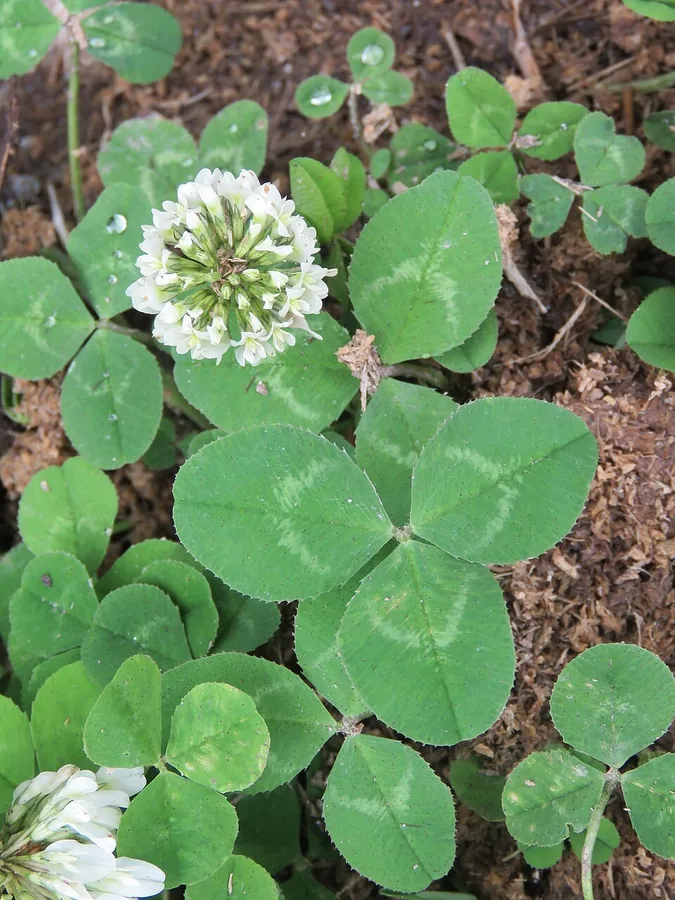
White clover is a creeping perennial legume in the pea family, ranging from mown turf to roadside verges. Its spread is stoloniferous: prostrate stems (stolons) run across the surface and root at each node, so a sparse seeding rapidly develops into a dense, low sward. The trifoliate leaves show a characteristic pale V-shaped watermark, and the round white to pinkish flower heads are held just above the canopy.
Its defining trait is biological nitrogen fixation. In root nodules the plant partners with Rhizobium bacteria that convert atmospheric nitrogen into a usable form, supplying both the clover and adjacent plants. That symbiosis explains its established roles in lawn mixes, as a cover crop, and as living mulch beneath vegetables and orchard or vineyard rows.
The species is also strikingly cold hardy, surviving to -29°F (-34°C), and it withstands both mowing and foot traffic because growth arises at rooted nodes rather than a single crown. Two trade-offs follow from its biology: the same stolons that build a sward let it spread into unwanted ground, and its ground-level flowers draw foraging bees during bloom.
Care
The short version: site white clover in full sun to partial shade on moist, well-drained soil, irrigate through severe drought, and withhold fertilizer, since nodule bacteria supply its nitrogen. Mow or trim to maintain a low canopy.
Light
White clover yields its densest sward and heaviest bloom in full sun, yet it also performs under partial sun and partial shade. The reduction under shade is one of density and flowering rather than survival, so a shaded planting still covers, if more thinly.
Water
Maintain soil that is moist but well drained, roughly every 5 to 10 days during dry weather, because the plant is shallow rooted. Established stands tolerate drought, though a prolonged hot spell browns and thins the canopy; recovery is typical once rainfall resumes, so intervention is rarely needed.
Soil
The species tolerates a wide range of soils but is most productive on a moist, fertile, well-drained loam. A pH of 6.0 to 7.0 is optimal, and because the plant supplies its own nitrogen, drainage and moisture matter more to performance than inherent fertility.
Temperature
Cold hardiness is exceptional, extending to -29°F (-34°C), with an upper working limit near 95°F (35°C). This tolerance is what underwrites its cultivation across hardiness zones 3 through 10.
Humidity
Ambient outdoor humidity is sufficient, so no target value applies. The plant accommodates both dry and humid air provided the root zone remains evenly moist.
Feeding
As a legume, white clover requires little to no fertilizer, since nodule Rhizobium fixes the nitrogen it needs. The one useful input is seed inoculation with Rhizobium where those bacteria are absent from the soil, a situation more common in warmer zones.
Pruning
Mowing or trimming keeps the canopy low and tidy, and the plant tolerates it because regrowth comes from rooted nodes. Cutting also removes open flowers, which is a practical way to reduce bee activity in play areas before barefoot use.
Repotting
none
Size & spacing
Mature height is modest at 4 to 8 inches (10 to 20 cm), while stoloniferous lateral growth lets each plant spread 1 to 3 feet (30 to 100 cm). That spreading habit is the mechanism by which a light seeding closes into a continuous mat within one season.
When to plant
Clover establishes readily and is forgiving on timing. Direct sow outdoors in spring or late summer, allowing about 40 days before the first killing frost so a late stand can root before dormancy. Emergence and cover follow within weeks, and bloom runs from late spring through fall with an early-summer peak.
Northern hemisphere
Southern hemisphere
Typical months for a temperate climate: start earlier in warm zones, later where spring frosts linger.
- Sow: Not typically started indoors; direct sow outdoors.
- Plant: Spring or late summer; allow about 40 days before first killing frost for late-summer seeding.
- Harvest: Late spring through fall (peak early summer); round white to pinkish flower heads.
Hardiness
USDA hardiness zones: 3–10
Temperature: down to -40°C
Troubleshooting
White clover is low-maintenance, and most reported problems are questions of siting and interactions rather than disease. Identify the situation below, then manage it according to whether the clover is wanted.
Browning and thinning under prolonged drought
Because the root system is shallow, a long, hot drought desiccates the canopy and thins the stand. The response is usually temporary, as established stands regenerate once soil moisture returns. Deep irrigation through the driest interval maintains soil moisture, after which an established planting recovers without further intervention.
Fix:
- Water deeply during prolonged drought to keep soil moist
- Allow established stands to recover naturally once rainfall resumes
Clover encroaching into turf as spreading patches
The patches arise from creeping stolons that root at each node in contact with soil, allowing a few plants to coalesce into a mat. The process is favored by low soil nitrogen, which handicaps grass while the nitrogen-fixing clover is unaffected. Where removal is the goal, raise turf nitrogen to strengthen the grass and apply a broadleaf herbicide containing fluroxypyr or clopyralid, most effective in fall.
Fix:
- Decide whether clover is desirable (eco-lawn) or a weed before acting
- Fertilize turf with nitrogen to favor grass over clover
- For removal, apply a broadleaf herbicide such as one containing fluroxypyr or clopyralid, most effective in fall
Foraging bees at flowers in the turf canopy
The ground-level blooms are highly attractive to honeybees and bumblebees, which forage across the flowering period at the height a bare foot occupies. The interaction benefits pollinators but poses a sting risk in play areas. Removing open flowers by mowing before use, wearing footwear on flowering patches, and leaving unmown clover elsewhere resolves the conflict without eliminating forage.
Fix:
- Mow before or during peak bloom to temporarily remove flowers in high-traffic or play areas
- Wear shoes when walking on flowering clover
- Keep some unmowed clover elsewhere to support pollinators
Toxicity
For companion animals and people the species is non-toxic and edible. Cats, dogs, rabbits, birds, and people are unaffected, and the young leaves and flower heads have a long record of culinary use in small amounts. The meaningful caution applies to ruminant livestock and horses, where heavy intake of lush stands can provoke bloat or a fungal-associated drooling known as slobbers.
Safe for
People · Cats · Dogs · Horses · Rabbits · Livestock · Birds
Cats None
Cats are unaffected. Ingestion of a leaf or flower has no consequence, as the plant contains nothing toxic to felines.
Dogs None
Dogs may sniff, chew, or roll through the stand without risk. The species is non-toxic, so an exploratory mouthful is harmless.
Horses Mild
For horses the plant is sound forage at normal intake. The caveat concerns heavy grazing of lush stands, where a clover-associated fungus can induce the benign but copious salivation termed slobbers.
Rabbits Safe
Rabbits take readily to clover, and it is a nutritious choice. Both leaves and flowers are safe to graze.
Livestock Mild
The species is excellent pasture, but heavy intake of lush, wet clover can precipitate bloat in cattle, sheep, and goats. A distended left flank and evident discomfort are the signs, and introducing ruminants gradually rather than onto empty stomachs reduces the risk.
Birds Safe
Birds face no hazard. Poultry may forage the leaves and flowers freely.
People Safe
The young leaves and flower heads are edible and have historically been consumed in small quantities. No part of the plant is toxic to people.
Safe for cats, dogs, and people. Note that lush white clover can cause bloat in grazing ruminant livestock (cattle, sheep) and clover can occasionally accumulate cyanogenic glycosides or fungal infection affecting grazing animals, but it is excellent forage and not poisonous to pets or people.
Varieties
White clover spans a size range from tall forage ecotypes to compact turf selections, each suited to a different use. The three most commonly encountered are described below.
Ladino clover
Ladino is a large, vigorous forage ecotype that reaches two to four times the height of the intermediate clovers and delivers the highest nitrogen fixation of the group.
Dutch white clover
Dutch white clover is the standard low-growing lawn type at roughly 6 to 12 inches (15 to 30 cm), valued for its tolerance of summer heat.
Microclover
Microclover denotes small-leaved turf selections such as Pirouette and Pipolina, bred to stay low, flower sparingly, and integrate almost imperceptibly into a lawn.
Companions
Clover pairs well with plants it can feed. Its nitrogen-fixing roots support neighboring grass and crops, which is why it turns up in lawn mixes and as a living mulch.
Plant near
turf grasses (fescue, ryegrass): Clover fixes nitrogen via Rhizobium that feeds neighboring grass, reducing fertilizer needs in lawn mixes.
vegetables and orchard/vineyard crops: Low-growing living mulch that suppresses weeds and enriches soil with nitrogen.
How to propagate
Few plants propagate more readily. It reproduces from seed and, vegetatively, by the same stolons that drive its spread.
SeedEasy
Spring or late summer (about 40 days before first killing frost) · Establishes within several weeks; full stand in one season
Seed is broadcast directly onto the soil surface in spring or late summer, allowing about 40 days before the first hard frost for autumn sowings to establish. Where compatible soil bacteria are lacking, particularly in warmer zones, the seed should be inoculated with Rhizobium beforehand. A new stand emerges within a few weeks and reaches full cover in a single season.
DivisionEasy
Spring through early fall · Quickly, as stolons root at the nodes
Vegetative spread is intrinsic: the plant issues creeping stolons that root at every node to form a self-repairing mat. Rooted segments can be lifted and transplanted at any point from spring through early fall and establish rapidly, since each already carries functional roots.
Myths
Clover is merely a lawn weed that ought to be eliminated.
The weed designation dates to the broadleaf-herbicide era rather than to any agronomic shortcoming. The species fixes its own nitrogen, provides pollinator forage, and requires minimal inputs, which is precisely why it is now deliberately sown into eco-lawns, bee lawns, cover crops, and living mulch.