Tree · Fabaceae
Eastern Redbud
Cercis canadensis
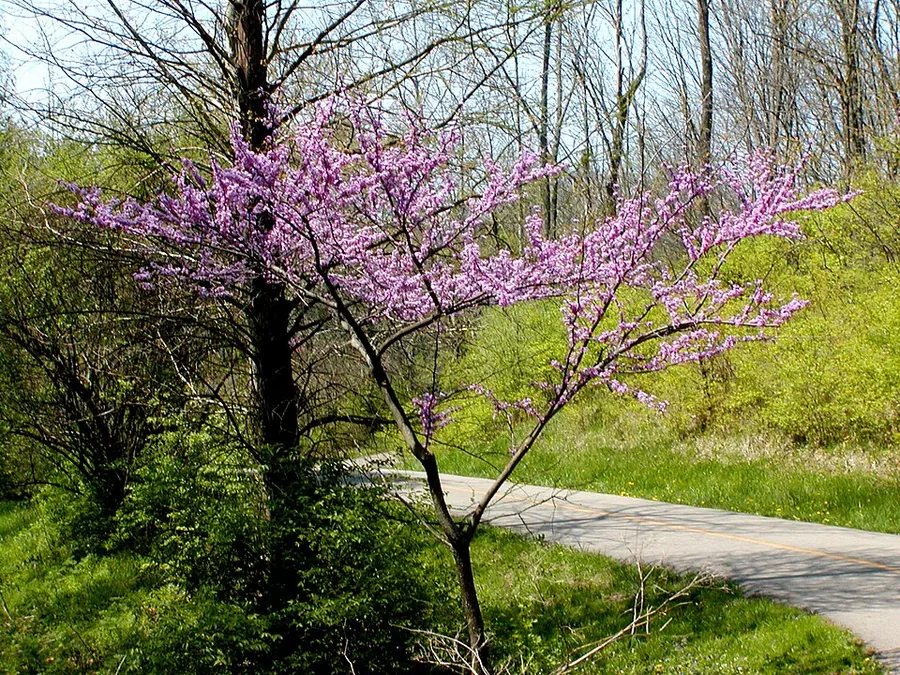
It sets the leafless spring woods alight with rose-pink flowers borne straight on the wood well before any leaf unfolds.
Full sun
Every 7–14 days
USDA 4–9
20–30 ft · 6.1–9.1 m
Overview
Eastern redbud earns its attention in early spring, the moment rose-pink to magenta flowers erupt directly from leafless branches and even the trunk while no foliage has yet appeared. Membership in the legume family, alongside peas and beans, accounts for both the pea-shaped form of each bloom and the flat seed pods that develop on the tree later in the growing season.
Once the bloom passes, broad heart-shaped leaves expand and the canopy assumes its easy rounded form. Mature height stays restrained at 20 to 30 feet (6 to 9 m), which lets it occupy a yard that a larger shade tree would overwhelm. Its tolerance for light spans full sun to fairly deep shade, a flexibility that makes it well suited to a woodland edge or a position beneath taller canopy.
Given time to root in, redbud proves hardy and low-maintenance across zones 4 through 9. Two things merit watchfulness: disturbance to the roots, which it strongly resents, and a handful of fungal diseases that exploit any tree under stress. Keep it in good health and the demands it places on you stay small.
Care
The short version: site it in full sun to part shade in average, well-drained soil, water it faithfully through its young years, and confine pruning to the period right after bloom. It accommodates most soils and laughs off cold, yet it will not endure waterlogged ground and objects to being moved once established.
Light
Redbud asks little where light is concerned, performing in conditions from full sun to full shade. Bloom is heaviest and the habit densest in full sun to part shade, which is precisely why a woodland edge that delivers sun for part of the day suits it so well.
Water
Hold the soil evenly moist through regular watering for the first year or two as the root system establishes. A mature tree weathers brief dry intervals, yet a sustained drought will defeat it and saturated, waterlogged ground makes it languish. Apply a deep soak any time a dry stretch carries past a few weeks.
Soil
The tree takes to loam, clay, or sand provided drainage is sound, and it tolerates a broad pH band from 5.5 to 8.0. Average, medium-moisture ground serves it well. The one condition it cannot accept is soil that remains wet.
Temperature
Redbud is genuinely cold-hardy, withstanding winter lows of -29°F (-34°C) and summer highs reaching 95°F (35°C). That tolerance for cold is the reason it succeeds over so broad a swath of the country.
Humidity
Ordinary outdoor humidity meets its needs entirely, so no figure warrants tracking. Air movement counts for more than atmospheric moisture, because still, congested conditions are what give leaf spot and other fungi their opening.
Feeding
Apply feed in early spring as growth restarts, choosing a balanced slow-release tree fertilizer. The benefit reaches past faster growth, since a properly nourished tree resists canker and wilt considerably better.
Pruning
Prune in late spring, just after bloom finishes, clearing dead, broken, or cankered wood and shaping where wanted. Cut out any cankered or wilting limb the instant it appears, which checks the spread of disease. Keep lawn weedkillers at a distance, as redbud reacts strongly to herbicide drift.
Repotting
Container culture is uncommon for redbud, and repotting is rarely called for. Should you keep a young one potted, look for roots circling or pushing out, water passing straight through, or sparse new shoots, each a signal that it needs more room or a place in the open ground.
Size & spacing
Plan for a mature specimen of 20 to 30 feet (6 to 9 m) in height carrying a broad spreading crown of 25 to 35 feet (7.5 to 10.5 m). Allow that full clearance from the start, since the canopy reaches wide and the tree resents disturbance once it is in place.
When to plant
Plant a young redbud in early spring, when it is small enough to ease into its permanent home, because it accepts relocation poorly as it ages. Payoff arrives the next spring, as those bare limbs flush into pink bloom from March through May, well in advance of most other plants in the garden.
Northern hemisphere
Southern hemisphere
Typical months for a temperate climate: start earlier in warm zones, later where spring frosts linger.
- Plant: early spring while young, in a permanent protected site (does not transplant well)
- Harvest: early spring (March to May), pea-like rose-pink to magenta flowers on bare branches and trunk before leaves emerge
Hardiness
USDA hardiness zones: 4–9
Temperature: down to -34°C
Troubleshooting
Nearly every redbud problem begins with a fungus that exploits a tree already stressed or wounded. Once you can separate a dangerous canker or wilt from cosmetic leaf spotting, the right response becomes clear: act decisively on the serious cases and leave the trivial ones be. Compare the descriptions that follow, then intervene early where it counts.
Dieback on limbs marked by sunken, dark lesions in the bark
What you are seeing is Botryosphaeria canker, a fungus that gains entry through bark wounds and stressed tissue, then expands until it girdles the limb and starves everything beyond it. The remedy is to cut back well past the lesion, destroy the prunings by burning or binning, and sanitize blades between each cut so spores do not ride along. Because this pathogen rarely overcomes a tree with strong vigor, consistent watering and sound culture form the real line of defense.
Fix:
- Prune out and destroy all dead, dying, and cankered branches well below the lesion
- Disinfect pruning tools between cuts
- Improve vigor with proper watering, mulching, and correct fertilization
One-sided wilt paired with undersized leaves
The cause here is Verticillium wilt, which invades from the soil through the root system and plugs the sapwood, so its toll usually appears lopsided, on one flank before the other. Lift the bark of a failing branch and the wood beneath shows the telltale dark streaking. Since no chemical cure exists, the strategy is to sustain vigor, take out the dead wood, and refuse to set another susceptible species into ground that has carried it. Among cultivars, 'Forest Pansy' suffers the worst.
Fix:
- Prune out dead wood and dispose of it
- Improve host vigor with light mulching and watering during dry periods of more than a few weeks
- Fertilize when appropriate and manage other stresses
Dark spotting and blotches scattered over the foliage
These markings point to fungal leaf spot and anthracnose, which gain ground whenever leaf surfaces stay damp and air stalls inside a crowded canopy. Unsightly as they are, they pose little real threat to a mature, established specimen. Clear away and destroy the fallen leaves, keep moisture off the canopy, and open up the air, and the tree carries on undisturbed.
Fix:
- Rake up and destroy fallen infected leaves
- Improve air circulation and avoid overhead wetting of foliage
- Maintain tree vigor with proper watering and fertilization
Toxicity
Reassuring news for households with pets and children: eastern redbud is harmless across the board. It carries no ASPCA toxic listing, presents no genuine threat to animals, and produces flowers and young pods edible enough to land in human salads. Not one part of this tree calls for fencing off.
Safe for
People · Cats · Dogs · Horses · Rabbits · Livestock · Birds
Cats None
Because the species sits off the ASPCA toxic list, an inquisitive cat may sample a leaf or a dropped bloom with no ill effect.
Dogs None
There is no toxin in play. A dog that gnaws on a pod or two comes to no harm, though swallowing a large wad of bulky pods can prompt a brief run of loose stool.
Horses Safe
Grazing horses face no hazard from this tree, and they will browse it on occasion without any consequence.
Rabbits Safe
Both foliage and bloom are harmless to rabbits, which routinely nibble tender redbud growth out in the wild.
Livestock Safe
Sheep, goats, and cattle may take the leaves and pods as browse with no risk attached.
Birds Safe
Seed-eating birds work the pods and others visit the early blooms, and every bit of it is harmless.
People Safe
Both the early pink blossoms and the tender immature pods are edible, finding their way into salads and fritters.
No special handling required for pet safety; as with any plant, discourage pets from gorging on fallen pods, which can cause mild non-specific stomach upset from the bulk.
Varieties
Apart from the wild form, growers have singled out redbuds for the color of their leaves, the strength of their bloom, and a more contained habit. The named selections below are the ones a nursery is most apt to stock.
'Forest Pansy'
Emerging foliage unfurls a rich scarlet purple that drifts gradually toward green as the season runs, a display it earns at the cost of being the cultivar most likely to fall to verticillium wilt.
'Appalachian Red'
No redbud blooms more intensely than this selection, whose magenta runs so saturated it verges on neon pink.
'The Rising Sun'
Young leaves break in apricot and gold, then mellow to lime and green, leaving the crown holding several shades at the same moment.
'Hearts of Gold'
Its defining trait is golden-yellow foliage, a happenstance discovery from a Greensboro, North Carolina garden in 2002.
'Ace of Hearts'
Built as a compact dwarf with small heart-shaped leaves, it slots into a snug corner that no full-size redbud could occupy.
How to propagate
Seed and grafting carry most redbud propagation, given how poorly the established tree relocates and how reluctantly it strikes from cuttings. Not one route is fast, so patience counts for more here than technical skill.
SeedModerate
Collect mature pods in fall; sow after pretreatment · 1-2 years to a transplantable seedling
Harvest the mature pods once they ripen in fall, then nick or abrade the hard seed coat and follow with a period of cold, moist conditioning, since that combination is what releases dormancy. Omit either step and the seed germinates only grudgingly. Once a seedling does appear, allow 1 to 2 years of growth before it has the size to be lifted and transplanted.
GraftingDemanding
Late winter to spring (budding in summer) · 1-2 seasons
Selections such as 'Forest Pansy' will not reproduce true from seed, which is why propagators bud or graft them onto seedling rootstock to preserve the trait. The schedule stretches from late winter through spring, with summer reserved for budding, and the graft union needs a season or two to knit firmly. This is precise work, suited to growers with experience behind them.
Stem cuttingsDemanding
Early summer from softwood · Several months to a season
Softwood cuttings can be attempted in early summer, but expectations should stay low. Redbud strikes roots slowly and inconsistently from cuttings, and even the few that catch demand several months to a full season before they settle. For that reason most growers turn first to seed or grafting.
Myths
Eastern redbud pods and seeds are dangerously poisonous to dogs and cats.
No ASPCA listing flags eastern redbud as toxic, and it is treated as safe around cats and dogs alike. Its blossoms and young pods are edible to the point that people put them on the table, so this is not the dangerous legume some growers imagine and does not belong among the genuinely harmful plants.