Tree · Fabaceae
Honey Locust
Gleditsia triacanthos
Fast, hardy, and adaptable, the honey locust casts a light dappled shade across difficult urban soils.
Full sun
Every 7–14 days
USDA 3–9
30–79 ft · 9–24 m
Overview
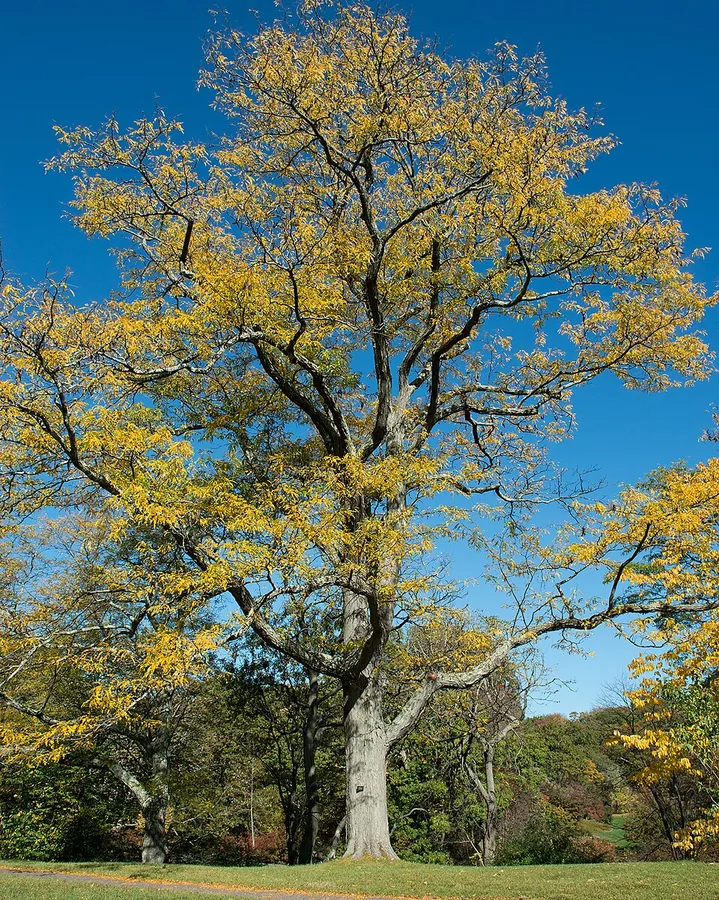
Honey locust is a fast-growing legume native to central North America, its common name taken from the sweet pulp held within the long, twisting pods. The pinnately compound leaves filter sunlight into a dappled shade open enough that turf and understory plants persist to the base of the trunk, a trait that established it as a favored street and yard species. Where unimproved, the tree attains 30 to 80 feet (9 to 24 m) over a broad, open crown.
Its site tolerance is exceptional. The species performs on clay, sand, compacted ground, and saline or alkaline urban soils, endures drought, and withstands winter minima of -40°F (-40°C) and summer maxima of 100°F (38°C). That amplitude, spanning USDA zones 3 to 9, accounts for its persistence on sites where more exacting trees fail.
The limitation lies in the wild form, which arms the trunk and branches with long, branched thorns and abscises heavy pods. Selection resolved both liabilities through thornless, seedless cultivars of var. inermis, and these dominate the nursery trade. A cultivar of that origin delivers the full site tolerance of the species without the thorns or the pod litter.
Care
The short version: provide full sun and almost any soil, irrigate consistently through the first two seasons, then withdraw supplemental water, because an established honey locust ranks among the most drought-tolerant shade trees available.
Light
Site the honey locust in full sun to develop the densest crown and the strongest growth. It accepts partial shade, but form and vigor are best with at least six hours of direct light, since the species is inherently a sun-demanding pioneer.
Water
Irrigate a young tree on a regular schedule through its first one to two years while the root system extends and anchors. Thereafter the tree is very drought tolerant and seldom requires supplemental water, so allow the top half of the soil profile to dry between applications.
Soil
Few trees are as indifferent to soil. It grows best in moist, rich loam but tolerates clay, sand, impoverished ground, compaction, salinity, and alkaline urban conditions across a broad pH range of 6.0 to 8.0.
Temperature
This is a cold-hardy species adapted to extremes, functioning from -40°F to 100°F (-40°C to 38°C). That tolerance defines its range across USDA zones 3 through 9 and permits growth where many shade trees cannot persist.
Humidity
Atmospheric humidity is immaterial to an established outdoor tree, so no target level applies. Good air movement through the crown is the more useful condition, as it accelerates leaf drying and lowers mite and pathogen pressure.
Feeding
As a nitrogen-fixing legume, the honey locust largely supplies its own nutrition and is not a heavy feeder. Withhold fertilizer unless the soil is genuinely deficient, and then apply a single balanced slow-release dose in spring.
Pruning
Prune in late winter to early spring during dormancy, when wounds are least exposed to pathogens. Train young trees to a single strong central leader, and remove crossing, dead, or damaged wood to maintain sound structure.
Repotting
The honey locust is a landscape tree rather than a container subject, so repotting rarely applies. If a young specimen is held in a container, pot it on once roots circle the interior or emerge from the drainage holes.
Size & spacing
Allow generous space, as the tree reaches 30 to 80 feet (9 to 24 m) in height and 25 to 50 feet (8 to 15 m) in spread. Position it well clear of structures, walls, and neighboring trees so the broad crown can develop unobstructed.
When to plant
The honey locust follows a predictable annual cycle. Plant in spring or fall, expect the small fragrant flowers in late spring, and look for the long brown pods to mature and abscise through early autumn.
Northern hemisphere
Southern hemisphere
Typical months for a temperate climate: start earlier in warm zones, later where spring frosts linger.
- Plant: Spring or fall
- Harvest: Inconspicuous fragrant greenish-yellow flowers in late spring (May to June); flat twisted brown seed pods ripen September to October.
Hardiness
USDA hardiness zones: 3–9
Temperature: down to -40°C
Troubleshooting
The honey locust is durable, yet a few recurrent pests and one consequential canker complex warrant recognition. Most foliar injury presents dramatically but carries little physiological cost. The cankers are the exception that merits real concern, so confirm the disorder against the descriptions below before making any cuts.
Sunken bark cankers accompanied by branch dieback
Sunken, discolored lesions girdling branches and the trunk are the diagnostic sign of Thyronectria or Nectria canker, opportunistic fungi that colonize trees already compromised by drought, wounding, or crowding. No fungicide cures an established infection, so prune well below each canker in dry weather and disinfect tools between cuts to avoid carrying spores into healthy wood. Remove a severely cankered tree before it becomes an inoculum source, and sustain the vigor of the rest through steady moisture and by preventing bark injury, since stress is what admits the pathogen.
Fix:
- Prune out infected branches well below the canker during dry weather and disinfect tools
- Remove and destroy severely cankered trees
- Improve vigor with proper watering and avoid bark wounds
Leaflets tied in silk and skeletonized during the middle of the season
Silk webbing enclosing colonies of small caterpillars identifies the mimosa webworm, and its preference for the tender foliage of golden cultivars explains why Sunburst suffers most. Prune out the nests while they are small to remove the feeding larvae directly, and apply Bt against the young caterpillars, since the bacterium acts only on actively feeding larvae. Rake and dispose of the litter beneath the canopy, because the pupae overwinter there and seed the next generation.
Fix:
- Prune out and destroy small webbed nests early
- Apply Bt (Bacillus thuringiensis) while caterpillars are small
- Clean up debris beneath the tree where pupae overwinter
Pod-shaped galls on leaflet tips with premature defoliation
The swollen, pod-like deformities are the feeding response to the honeylocust pod gall midge, whose maggots develop within the distorted leaflet tissue. Because a mature tree tolerates a light population and is rarely harmed, intervention is seldom warranted. Where galling is heavy, a horticultural oil applied to the expanding terminals in March or April targets the eggs before larvae establish, and excising the worst shoots reduces the source of the next brood.
Fix:
- Tolerate light infestations on established trees, which are rarely killed
- Apply horticultural oil to terminals in March-April to kill eggs
- Prune and destroy heavily galled shoots
Malformed, stunted spring foliage
Distorted or dwarfed spring leaves generally trace to the honeylocust plant bug, which feeds on the expanding foliage and injects the young tissue as it unfolds, so the deformity outlasts the insect and appears worse than the actual injury. The tree outgrows this early feeding, and light damage needs no treatment. When fine stippling and webbing follow in hot, dry summer weather, the cause shifts to spider mites, which a forceful water spray dislodges and insecticidal soap suppresses in heavier outbreaks.
Fix:
- Tolerate minor early-season plant bug damage; trees usually recover
- Hose down foliage to dislodge spider mites
- Use insecticidal soap or horticultural oil for heavy mite outbreaks
Toxicity
For a household with animals, the assessment is favorable: honey locust is safe. The ASPCA classifies it as non-toxic to dogs, cats, and horses, and livestock and wildlife consume the sweet pods each autumn without ill effect. The only genuine hazard is mechanical, the long, sharp thorns of wild trees, which is precisely why landscape cultivars are selected thornless.
Safe for
People · Cats · Dogs · Horses · Rabbits · Livestock · Birds
Cats None
No toxic principle is present for cats. Contact with a fallen leaflet or a chewed twig produces no poisoning.
Dogs None
Dogs face no toxin from this tree. Ingesting a dropped pod supplies only indigestible roughage, not a poisonous compound.
Horses None
Horses can graze in its vicinity without risk, and the sugar-rich pods function as forage rather than a hazard.
Rabbits Safe
Rabbits encounter no poisonous compound here. The bark and twigs represent coarse browse and nothing more.
Livestock None
The pods are palatable and nutritious forage consumed without adverse effect. Cattle, goats, and sheep have fed on them across generations.
Birds Safe
Birds are unaffected, and wildlife consumes the sugar-rich pods each autumn without consequence.
People Safe
The sweet pulp of the ripe pods has a long record of human consumption. The material hazard is mechanical, the elongated thorns of the wild form, so thorny trunks warrant careful handling.
The wild species bears large, sharp, branched thorns on the trunk and branches that can cause puncture injuries; landscape cultivars are typically thornless.
Varieties
Almost every honey locust offered for a yard or streetscape is a named thornless cultivar. The following are the selections most often encountered.
Shademaster
A vigorous, thornless and nearly seedless clone of vase-shaped habit with ascending branches, valued as a durable and reliable street tree.
Skyline
A thornless, podless cultivar of pyramidal form maintained on a strong central leader, developing clean golden-yellow autumn coloration.
Sunburst
A thornless, seedless selection grown for its bright golden new foliage, and also the cultivar most susceptible to mimosa webworm and pod gall midge.
Imperial
A thornless, seedless cultivar of compact, rounded habit carried on neat horizontal branching.
var. inermis
The naturally thornless botanical variety, its epithet meaning unarmed, which serves as the parent stock for most landscape cultivars.
How to propagate
Honey locust can be raised from its own seed, but the named cultivars require vegetative propagation to preserve their distinguishing characters.
SeedModerate
Spring after collecting ripe pods in fall · 1 to 2 growing seasons to a transplantable seedling
Collect ripe pods in autumn and sow the following spring, but first overcome the hard, impermeable seed coat by scarifying it with a file, hot water, or concentrated sulfuric acid, since without that treatment the seed will not imbibe and germinate. Allow the seedling one to two growing seasons to attain transplant size. Note that seed of a thornless parent does not breed true, as only about 60 percent of the progeny emerge thornless.
GraftingDemanding
Late winter to spring (grafting) or summer (budding) · 1 to 2 growing seasons
Because the named thornless, seedless cultivars do not reproduce true from seed, they are propagated vegetatively, grafted from late winter to spring or budded in summer onto seedling rootstock. Vegetative propagation preserves the clone intact, after which the young tree establishes over one to two growing seasons.
Myths
Honey locust is poisonous to pets and livestock, as the other locust trees are.
The toxicity attributed to honey locust actually belongs to the black locust (Robinia pseudoacacia), a distinct species with which it is frequently confused. Honey locust is non-toxic, and its sweet pods serve as forage for livestock and wildlife. The toxalbumins that poison dogs and horses reside in black locust, not in this tree.
A honey locust planted in a yard will develop vicious thorns and shed messy pods.
The wild taxon does bear formidable branched thorns and long pods, but that phenotype is not what the trade supplies. Nearly all landscape trees are thornless cultivars of var. inermis, and a substantial share are additionally seedless and podless.