Tree · Fabaceae
Black Locust
Robinia pseudoacacia
A tough, nitrogen-fixing tree with brittle wood and a serious toxic streak.
Full sun
Every 14–30 days
2190–2920 days
USDA 3–8
Overview
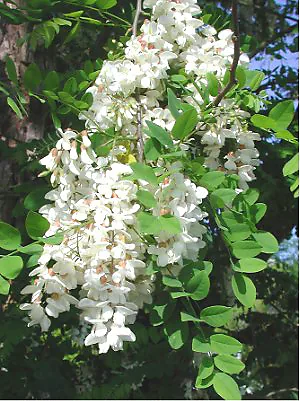
Black locust (Robinia pseudoacacia) is a fast-growing member of the legume family, Fabaceae, and it earns the easy rating by asking for almost nothing. It carries fragrant white pea-like flowers in drooping clusters and reaches a large landscape size, all while tolerating sites that defeat most trees.
The reason it shrugs off poor ground is biology: as a legume it fixes its own nitrogen, so it colonizes dry, sandy, rocky, and eroded soils that lack fertility. That same trait makes feeding pointless and high-nitrogen fertilizer counterproductive. Once roots take hold, the tree is extremely drought-tolerant and rarely needs watering.
The trade-offs are real. The wood is naturally brittle and locust borer tunneling weakens it further, so limbs fail in storms. The tree spreads hard by root suckers and seed, and every part except the flowers is poisonous, horses most of all. Plant it with those liabilities in mind.
Care
The short version: Give black locust full sun and well-drained ground, then mostly leave it alone. It fixes its own nitrogen, so skip fertilizer; it is drought-tolerant once established, so water only young transplants every 14 to 30 days. Prune while dormant to clear weak, dead, and borer-damaged wood, wear gloves for the paired spines, and pull root suckers to keep it from spreading.
Light
Plant in full sun for the densest crown and strongest growth. The tree tolerates partial shade, but reduced light thins the canopy and stretches the limbs, which is the last thing a brittle-wooded tree needs.
Water
Once established this tree is extremely drought-tolerant, drawing on deep roots and thriving on dry, sandy, eroded ground. Water only young transplants, letting the soil dry completely between soakings on roughly a 14 to 30 days cycle until they root in.
Soil
It accepts well-drained poor to average soil and shrugs off dry, sandy, rocky, eroded, and infertile sites because it fixes its own nitrogen. The one firm requirement is drainage. It performs across a wide pH band of 4.6 to 8.2, from acid to alkaline.
Temperature
Hardy across a broad temperate range, black locust handles roughly -40°F to 104°F (-40°C to 40°C), which lines up with USDA zones 3 through 8. No cold or heat protection is needed within that band.
Humidity
Average ambient humidity suits it fine, and no adjustment is necessary. The tree's drought tolerance means dry air is a non-issue.
Feeding
Skip the fertilizer. As a nitrogen-fixing legume it supplies its own nitrogen, so it needs little to none, and high-nitrogen feeds in particular do more harm than good by pushing soft, weak growth.
Pruning
Work in late winter or early spring while the tree is dormant. Cut out dead, crossing, weak, and storm-damaged limbs, raise the crown as needed, and stay ahead of root suckers to limit spread. Always wear gloves, because the paired spines are sharp.
Repotting
Not relevant for an established landscape tree. Only young container or balled-and-burlapped stock gets moved, and transplanting goes best while dormant. In a pot, circling roots, roots out the drainage holes, or water running straight through signal it is overdue.
Size & spacing
Give it room. Black locust reaches 30 to 50 feet (9 to 15 m) tall and spreads 20 to 35 feet (6 to 11 m), and the brittle wood makes proximity to buildings, walkways, and parking a real hazard. Site it well clear of targets.
When to plant
These windows assume a temperate Northern Hemisphere season. Scarify and start seed in late winter, set out plants in spring after the last frost or in fall during dormancy, and expect the fragrant white bloom from April to June.
Northern hemisphere
Southern hemisphere
Typical months for a temperate climate: start earlier in warm zones, later where spring frosts linger.
- Sow: Late winter; scarify seed (hot water or acid) before sowing to break hard seed coat.
- Plant: Spring after the last frost, or fall, while dormant.
- Harvest: Fragrant white pea-like flowers in drooping clusters in late spring (April to June).
Hardiness
USDA hardiness zones: 3–8
Temperature: down to -40°C
Troubleshooting
Most problems on black locust trace back to two facts about the tree: insects love its wood and leaves, and that wood is brittle to begin with. Match the symptom below to the cause, confirm before acting, and prioritize anything that threatens a target.
Locust borer larvae are tunneling the wood
The grubs feed inside the trunk and limbs, hollowing the wood from within. That galleried wood loses strength, so the swollen, knotted sections snap under wind load. This pest hits black locust harder than almost any other tree.
Fix:
- Maintain vigorous tree health to resist attack
- Prune out and destroy heavily infested, dead, or hazardous limbs
- Remove severely declining hazard trees near targets
Brittle wood is failing under load
Black locust grows weak, brittle wood by nature, and borer galleries make it weaker still. Add the weight of ice or a gust to an overextended limb and the union cracks. Failures cluster near targets like walkways and roofs.
Fix:
- Prune out weak, dead, and hazardous limbs while dormant
- Reduce long, heavy limbs over walkways or structures
- Remove hazardous trees near high-use areas
Locust leafminer is grazing the leaf tissue
Larvae mine between the leaf surfaces while adults graze the underside, stripping the green tissue down to a brown lace. The damage looks alarming but stays cosmetic; the canopy refoliates the following spring on its own.
Fix:
- Tolerate damage as it rarely kills established trees
- Rake and remove heavy leaf litter
- Maintain tree vigor with adequate moisture for young trees
Toxicity
Treat this tree as poisonous everywhere but the flowers. The inner bark and seeds concentrate toxalbumins that shut down protein synthesis and clump red blood cells, and horses are the species most likely to die from it.
Toxic to
Cats · Dogs · Horses · Rabbits · Livestock · Birds · People
Cats Moderate
Chewing bark or seeds can bring on vomiting, low appetite, weakness, and lethargy as the toxalbumins block protein synthesis in the gut lining.
Dogs Moderate
Expect vomiting, depression, anorexia, weakness, and possibly bloody diarrhea if a dog gnaws bark or swallows seeds.
Horses Severe
The most vulnerable species; bark-chewing triggers weakness, colic, encephalopathy, and rising blood ammonia, and poisoning can be fatal.
Rabbits Toxic
The same lectins that agglutinate red blood cells make any bark, seed, or sprout intake dangerous; treat as a serious exposure.
Livestock Severe
Cattle and other grazers that eat sprouts, seeds, or bark show weakness, digestive upset, and difficulty breathing, with deaths recorded.
Birds Toxic
Seeds carry the toxalbumins, so ingestion is hazardous; keep pods away from caged birds and poultry.
People Caution
Eating bark, seeds, or young sprouts can cause nausea, vomiting, weakness, and bloody diarrhea; the flowers are the only part considered non-toxic.
Wear gloves when pruning to avoid the sharp paired thorns, and keep bark, seed pods, prunings, and sprouts away from horses, livestock, pets, and children.
Helpline numbers

United States
ASPCA Animal Poison Control: (888) 426-4435 (fee applies)
Poison Control: (800) 222-1222



Canada
Poison Centres: 1-844-764-7669
Varieties
The named selections are chosen for color or form, not for sound structure. With one thornless exception, they keep the species' brittle wood, so plan placement the same way you would for the wild tree.
Purple Robe
Selected for rose-pink to purple flowers and bronze-tinted new shoots, though it inherits the species' weak, break-prone wood.
Frisia
Holds golden-yellow leaves from spring through fall, with the same brittle wood that fails like the wild form.
Twisty Baby (Lace Lady)
A dwarf prized for contorted, corkscrewing branches; it seldom flowers and keeps the brittle wood.
Umbraculifera
A thornless form with a tight, rounded mop-head crown that rarely sets flowers.
How to propagate
You can raise black locust from seed, root suckers, or grafts, and the route you pick depends on what you want. Seed and suckers give you the species; grafting is the only way to keep a named cultivar true.
SeedModerate
Spring · 1-2 seasons
The hard seed coat blocks water, so scarify in spring with near-boiling water for about a minute or an acid soak before sowing. Treated seed sprouts and needs a season or two to settle; even stored seed stays viable for 10 or more years.
DivisionEasy
Dormant season · 1 growing season
Because the tree naturally throws root suckers, this is the simplest route during dormancy. Suckers and dormant root cuttings from a quarter inch to an inch thick strike roots fast and fill in within one growing season, which is exactly why the species is so hard to contain.
GraftingDemanding
Dormant season or summer budding · 1-2 seasons
Cultivars such as Purple Robe and Frisia will not reproduce true from seed, so propagators bud or graft them onto seedling rootstock. Graft during dormancy or bud through summer; the union takes a season or two to knit.
Myths
Black locust is safe because it is a native legume like edible beans, and people eat its flowers.
Only the flowers turn up in food, and the tree does fix its own nitrogen, but everything else is toxic. Bark, leaves, seeds, and sprouts hold toxalbumins that can kill, with horses the most at risk.
Black locust is a neat, low-trouble shade tree.
It pushes up root suckers and self-seeds into dense thickets, spreading invasively beyond its home range. The brittle wood drops limbs, and locust borers undermine its structure further.