Tree · Arecaceae
Windmill Palm
Trachycarpus fortunei
Hardy down to single digits, the windmill palm brings a true tropical form to gardens far colder than most palms will endure.
Partial shade
USDA 7–10
8–40 ft · 2.4–12.2 m
Overview
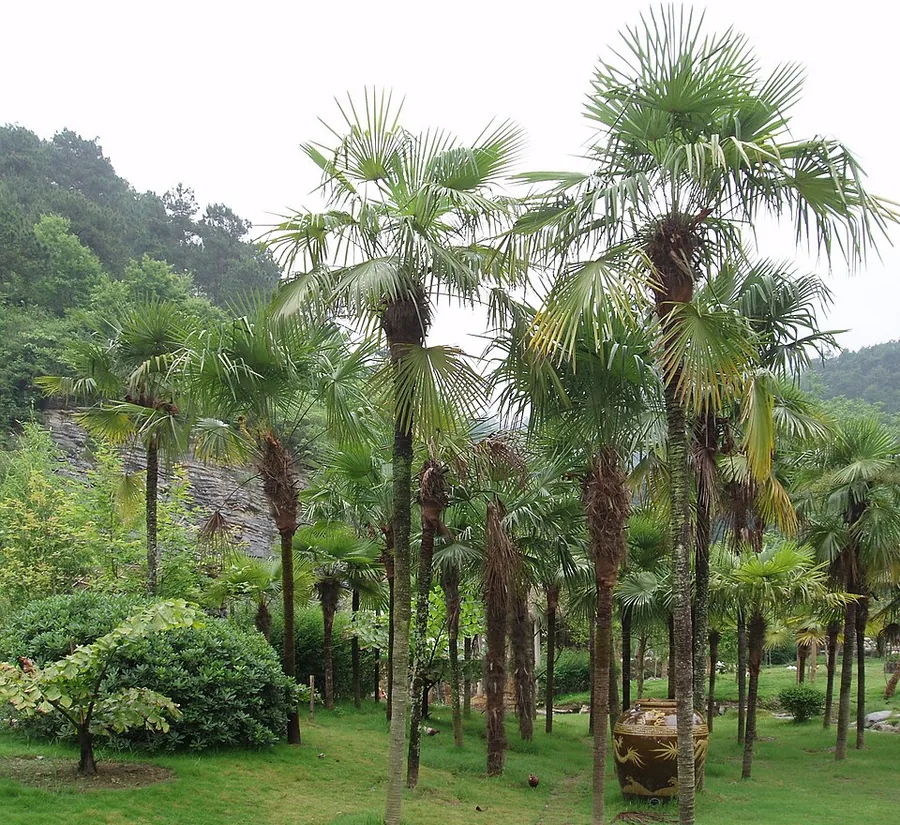
The windmill palm is the trunked fan palm that extends palm culture well outside the subtropics. Its native range lies in the mountains of central and eastern China, and that montane origin accounts for a cold tolerance most palms lack, holding to roughly 5°F (-15°C). The stiff, near-circular fans are borne in a radial arrangement that reads like the vanes of a windmill, which gives the common name.
The plant develops a single, slender stem clothed in coarse brown fiber, and it extends slowly, frequently only a few inches of height a year. Across decades it may attain 8 to 40 feet (2.4 to 12 m), though cultivated specimens seldom approach the upper figure. It performs as a hardy landscape tree through USDA zones 7 to 10, in a large container, or under glass in a cool conservatory.
This is the palm to specify when the tropical form is wanted without demanding upkeep, since it needs little once established. Provide fertile soil, consistent moisture, and shelter from harsh wind, and it persists for years with minimal intervention.
Care
The short version: part shade to full sun, fertile and well-drained soil held evenly moist but never waterlogged, a slow-release palm feed across the growing season, and protection from cold, drying winds.
Light
Optimal growth occurs in partial shade, with full sun tolerated once the plant is established. Light to medium shade suits it, and juvenile specimens in particular benefit from protection against the harshest midday irradiance.
Water
Supply regular, ample water into soil held evenly moist yet freely draining. An established palm withstands a moderate dry interval, but it will not endure standing water or a high water table, conditions that induce root rot.
Soil
Grow it in rich, fertile, well-drained loam. A pH of 6.0 to 7.5 is appropriate, the species accepts sand and a broad range of soils, and its moderate salt tolerance supports use in coastal plantings.
Temperature
This is the most cold-hardy trunked palm, enduring cold to 5°F (-15°C) and heat to 104°F (40°C). That thermal breadth is precisely what permits outdoor culture well beyond conventional palm range, though young plants still warrant winter protection.
Humidity
Ambient outdoor humidity is sufficient, so no target value is needed. Shelter from cold, drying wind contributes far more to the plant's condition than any humidity reading.
Feeding
Fertilize across the growing season, spring into early fall, using a slow-release palm fertilizer carrying micronutrients such as manganese, magnesium, and iron. Palms are prone to nitrogen, potassium, magnesium, and manganese deficiencies on sandy soils, so an appropriate feed forestalls the chlorosis that yellows the fronds.
Pruning
Minimal pruning is warranted. Remove only the fully dead, browned lower fronds and spent flower or fruit stalks, and never cut a healthy green frond. Loose trunk fiber may be tidied for appearance, but the apical growing point at the crown must remain intact.
Repotting
Advance a container plant to a larger pot every 2 to 3 years, or when it becomes rootbound. Mature landscape specimens are not lifted, so the practice applies only during the container phase.
Size & spacing
A windmill palm attains 8 to 40 feet (2.4 to 12 m) in height over many years, with a crown spread of 4 to 6 feet (122 to 183 cm). Given the slow growth rate, site it with its ultimate dimensions in mind.
When to plant
The windmill palm is a slow, year-round grower rather than a plant tied to a sowing window, so no planting schedule applies. What it does maintain is a phenological rhythm: yellow flowers open in early summer, and on female plants the dark drupes ripen from late summer into fall.
Northern hemisphere
Southern hemisphere
Typical months for a temperate climate: start earlier in warm zones, later where spring frosts linger.
- Harvest: Yellow flowers on drooping panicles in early summer (June to July); dark blue to nearly black drupe fruits ripen on female plants in late summer to fall.
Hardiness
USDA hardiness zones: 7–10
Temperature: down to -18°C
Troubleshooting
The windmill palm presents few genuine problems, and most of what does appear is cosmetic or readily prevented. Monitor the fronds and the soil drainage, since both express the earliest diagnostic signs. Match the presentation below and intervene before a minor disorder becomes established.
Crown decline and wilt persisting in saturated soil
Wilt in the presence of wet soil signals root rot, the classic response to waterlogging. Saturated soil and a high water table displace the oxygen roots need, so the tissue suffocates, goes soft and dark, and can no longer move water to the canopy, which is why the crown declines even as the ground stays wet. Correct the drainage, reduce supplemental irrigation, and avoid any low-lying position that collects runoff.
Fix:
- Improve drainage and reduce supplemental watering
- Avoid planting in low spots that collect water
Sticky fronds carrying sooty mold over small raised bumps
The sticky film is honeydew excreted by scale insects or palm aphids as they draw sap from the fronds, and the black coating is a sooty mold colonizing that sugar. The insects read as fixed armored bumps or soft colonies on both leaf surfaces, favoring the undersides. Because these are contact-vulnerable, smother them with horticultural oil or insecticidal soap, and excise any frond too heavily colonized to recover.
Fix:
- Treat with horticultural oil or insecticidal soap
- Remove heavily infested fronds
Chlorotic, frizzled new fronds signaling a mineral shortfall
Discoloration and distortion on the newest fronds point to a nutrient deficiency, most often manganese, potassium, or magnesium. These mobile and semi-mobile elements are leached readily from light soils, which is why sandy sites express the symptom first and most sharply. Supply a slow-release palm fertilizer formulated with micronutrients, and correct on a sustained schedule, since a single heavy dose cannot rebuild a chronic shortfall.
Fix:
- Apply a slow-release palm fertilizer containing micronutrients
- Correct deficiency on a regular schedule rather than a single dose
Fronds splitting and shredding along the leaf segments
This is mechanical wind damage, not pathology. The palmate blades are held on long petioles and catch cold, drying gusts like sails, so the wide fans tear along the natural folds between segments rather than at random. The plant is not weakened by it, so relocate a container specimen to a sheltered aspect or install a windbreak, and remove only the most shredded or fully dead fronds.
Fix:
- Provide a windbreak or relocate to a more sheltered position
- Trim only the most badly damaged or fully dead fronds
Toxicity
For households with animals, the assessment is favorable: the windmill palm is non-toxic without exception. It is a true palm, not the poisonous sago palm it is routinely confused with, so it contains no cycasin or comparable toxin to endanger pets, livestock, or children.
Safe for
People · Cats · Dogs · Horses · Rabbits · Livestock · Birds
Cats None
The species is documented as non-toxic to cats by the ASPCA, so a cat investigating or batting the fronds is at no toxicological risk.
Dogs None
The ASPCA carries the same non-toxic listing for dogs, so ingestion of a chewed frond produces no poisoning in canines.
Horses None
NC State Extension classifies the windmill palm as non-toxic to horses, which makes it a sound choice for planting near a paddock.
Rabbits Safe
No compound in this true palm is known to harm rabbits, so an incidental nibble carries no established risk.
Livestock Safe
Cattle, goats, and sheep can graze in its vicinity without concern, as the plant contains no toxins that act on ruminants.
Birds Safe
Both the fronds and the ripe drupes present no poisoning hazard to birds, whether wild visitors or aviary stock.
People Safe
The plant is safe for people, children included. It is the true palm, distinct from the toxic sago it is confused with, so handling a frond poses no hazard.
Often confused with the highly toxic sago palm (Cycas revoluta); the true windmill palm is a different, non-toxic plant.
Varieties
Only two named windmill palms circulate widely in cultivation, and each is grown for a functional trait rather than ornament.
Trachycarpus fortunei var. wagnerianus ('Waggie')
Its stiffer, smaller, more compact leaves resist tearing in wind far better than the type, marking it as the selection for exposed plantings.
Trachycarpus fortunei 'Nanus'
A dwarf selection that matures appreciably shorter than the standard species, useful where vertical space is constrained.
How to propagate
A single method applies to increasing the windmill palm, and it demands patience more than technique.
SeedModerate
Sow fresh, cleaned ripe seed in spring at its own depth in a moist, free-draining medium. · Seed germinates in roughly 1 to 3 months; several years are needed to develop a visible trunk.
Propagation is by seed alone, and because the species is dioecious you need both a male and a female plant to obtain viable seed. Sow fresh, cleaned seed in spring at its own depth in a moist, free-draining medium, where germination follows in 1 to 3 months. The limiting factor is time, since several years pass before a visible trunk forms. As a solitary, single-trunked palm it produces no basal offsets or pups and cannot be struck from cuttings, so seed is the only route.
Myths
The windmill palm is the same as the sago palm and just as poisonous.
The two are not congeners and are not even in the same lineage. The sago palm (Cycas revoluta) is a cycad and genuinely toxic, whereas the windmill palm is a true palm in the family Arecaceae. The ASPCA lists the windmill palm as non-toxic, so conflating the two is a taxonomic error with no safety basis.