Houseplant · Arecaceae
Lady Palm
Rhapis excelsa
Slow, shade-adapted, and non-toxic to pets, Rhapis excelsa is among the most tractable palms for interior culture.
Bright indirect
55–81°F · 13–27°C
USDA 9–11
4–15 ft · 1.2–4.6 m
Overview
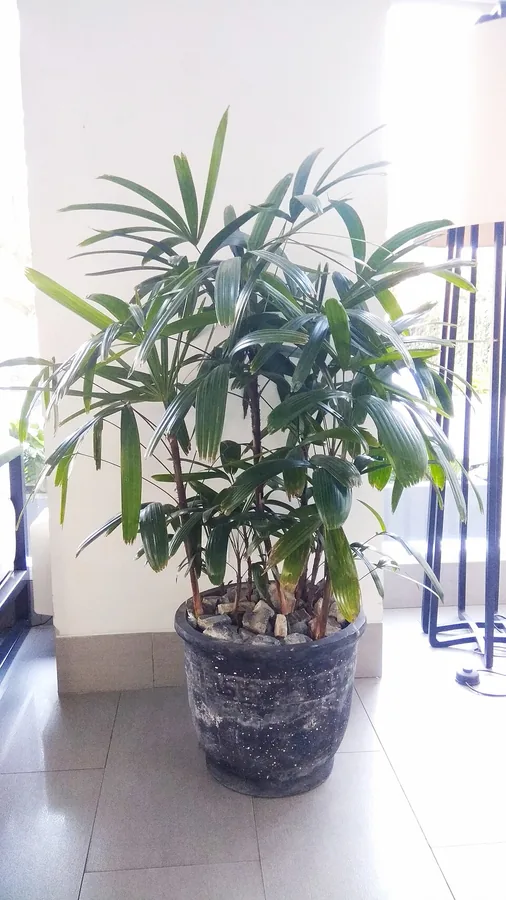
Rhapis excelsa is a clumping fan palm native to the forest understory of southern China and Vietnam, where it grows beneath a canopy of taller trees. That understory origin explains its low light requirement indoors, since the plant is adapted to filtered rather than direct sun. It produces slim, bamboo-like canes sheathed in dark fiber, each terminating in glossy fans of broad leaf segments.
Its habit is slow-growing, which keeps it well scaled to interior spaces for years at a time. Rather than gaining height quickly, the plant expands laterally through rhizome offshoots from the base, developing into a dense, multi-cane clump. Under interior conditions it typically holds near 6 feet, with additional height possible over time as canes mature.
As a houseplant it is valued for being tough and forgiving, tolerating low light, average interior humidity, and irregular attention without decline. It is also non-toxic to people and pets. Bright indirect light and consistent moisture bring out the best growth, but the plant withstands lapses in either without lasting harm.
Care
The short version: provide bright indirect light, though the plant tolerates shade and low light, and maintain even soil moisture through the growing season with reduced watering in winter. Feed at low rates, supply average room humidity, and keep it root-confined; growth is slow and demands are minimal.
Light
The optimum is bright indirect light, though the species is unusual among palms in tolerating medium light, partial shade, and even genuine low light. Exclude harsh direct sun, which scorches the fronds. Reduced light slows the growth rate without compromising plant health.
Water
During spring and summer growth, water freely and keep the mix evenly moist, permitting the surface to dry slightly between thorough applications. Reduce watering over winter, and never allow the pot to stand in water. Twice a year, apply a heavy drench to leach accumulated fertilizer salts.
Soil
Use a rich, porous, well-drained medium high in organic matter; an African violet type mix is suitable. The species prefers acidic conditions, a pH of 5.0 to 6.0, so avoid alkaline or heavy substrates.
Temperature
Ordinary interior temperatures suit it, with an ideal range of 55°F to 81°F (13°C to 27°C). Return it indoors ahead of cold weather, as it does not tolerate near-freezing conditions.
Humidity
Average interior humidity is adequate, and no target figure applies. The plant tolerates dry air, and its sole indicator of insufficient humidity is marginal leaf browning, which modest supplementary humidity prevents.
Feeding
As a slow grower it has minimal nutritional demand. A balanced liquid or slow-release fertilizer applied at low rates during spring and summer growth suffices. Excess fertilizer is counterproductive and is the usual cause of tip browning.
Pruning
Cut dead or damaged canes and fronds off at the base. Do not cut the growing point of a living cane, since a topped cane will not regenerate; the clump renews from new basal shoots instead.
Repotting
Repot only every 2 to 3 years, and only once roots have filled the container. The plant performs best when slightly root-confined, so avoid over-potting into a much larger vessel.
Size & spacing
Indoors it commonly holds near 6 feet, though the species spans 4 to 15 feet (1.2 to 4.5 m) in height and spreads 6 to 15 feet (1.8 to 4.5 m) as the clump matures. Allow lateral room so the arching fronds are not crowded.
Troubleshooting
Rhapis excelsa presents few disorders, and those it does are legible on the foliage. Two account for nearly all complaints: marginal browning and pest infestation. Identify the pattern below and intervene early, while correction remains straightforward.
Sticky residue, stippling, or bumps on the leaf bases and fronds
The likeliest agent is scale insects, a major pest of this species that shelters within the fibrous leaf bases where inspection is difficult. Fine webbing with stippled, faded foliage instead indicates spider mites, which build up under the low humidity and warmth of a heated room. Isolate the plant from the collection, remove the scale and apply horticultural oil or insecticidal soap, and rinse the fronds to suppress the mite population.
Fix:
- Isolate the plant from other houseplants
- Wipe or wash off scale and treat with horticultural oil or insecticidal soap, repeating as needed
- Raise humidity and rinse foliage to discourage spider mites
- Inspect new growth and leaf bases regularly
Necrotic tips on the older, lower leaves
The primary driver is soluble fertilizer salt accumulation in the mix from feeding at too high a rate, and because the oldest leaves have transpired the longest they show the damage first. A parallel cause is dry air or under-watering, which browns tips more broadly. Leach the container with several heavy drenches to carry the salts out, lower the feeding rate, and hold the mix at even moisture.
Fix:
- Drench the pot heavily and repeatedly to leach excess salts (do this about twice a year)
- Reduce fertilizer to low rates and only during active growth
- Keep the mix evenly moist and avoid letting it fully dry
- Trim only the dead tip tissue if desired
Toxicity
For households with animals the assessment is favorable: Rhapis excelsa is non-toxic across every species assessed. The ASPCA records it as safe for cats and dogs, and it poses no toxic risk to horses, rabbits, livestock, birds, or people. Ingestion of frond material may produce brief, mild gastrointestinal upset from the fiber, and nothing more serious.
Safe for
People · Cats · Dogs · Horses · Rabbits · Livestock · Birds
Cats None
The ASPCA classifies this palm as non-toxic to cats. Any reaction is limited to transient gastrointestinal upset from the indigestible frond fiber, which resolves without intervention.
Dogs None
The ASPCA rates it non-toxic to dogs as well. A dog that ingests a substantial amount of foliage may show brief salivation or soft stool, consistent with mechanical irritation rather than poisoning.
Horses Safe
The species carries no compound known to harm equines. Its rigid, fibrous fronds are unpalatable and pose no toxic risk to a horse that samples them.
Rabbits Safe
No toxic principle in the plant affects rabbits. A large intake of the coarse foliage may loosen the gut briefly, an effect of bulk fiber rather than toxicity.
Livestock Safe
Cattle, goats, and sheep face no toxic hazard from it. The fronds contain no poison, only fiber that is difficult to digest in quantity.
Birds Safe
The foliage holds no compounds hazardous to birds, so it can stand near pet species without concern.
People Safe
The plant is non-toxic to people, a trait behind its long standing as an indoor palm. It is not cultivated as food, so there is no rationale for consuming any part.
Varieties
Rhapis excelsa is most often supplied as the green type, but two forms are worth distinguishing by name.
'Variegata'
Its foliage bears creamy white striping, and it develops more slowly than the type while demanding less light and less fertilizer.
Rhapis humilis (reed rhapis / slender lady palm)
A closely allied species distinguished by taller, more slender canes and a higher number of narrow leaf segments than R. excelsa.
How to propagate
The reliable route to increase Rhapis excelsa is division of an established clump, since the plant generates its own basal offshoots. Seed propagation is possible but slow and comparatively demanding.
DivisionEasy
Spring · Several months to root and resume active growth
Division is the standard method, and it works because the plant spreads by rhizome offshoots that already carry their own roots. Lift a rooted sucker in spring with as much of the root system intact as possible, avoid injuring the parent crown, and pot it just large enough to hold the roots. Allow several months for the division to root out and resume active growth.
SeedModerate
When ripe seed is available · Slow; germination and growth take a long time
Seed propagation is feasible but slow. Because the species is dioecious, viable seed requires both a male and a female plant, and once sown the germination and juvenile development proceed slowly over many months.
Myths
Lady palm needs constant high humidity to survive indoors.
The species acclimates to ordinary interior air and has a low humidity requirement. A humid room is welcome, yet suboptimal humidity manifests as marginal leaf browning rather than decline, so supplemental humidification is unnecessary.
A cut or topped lady palm cane will branch and regrow from its cut.
Growth in each cane proceeds from a single apical meristem, so severing that tip terminates the cane permanently. Renewal comes instead from rhizome offshoots at the base, which is why spent canes are removed low and replacements are allowed to emerge from the crown.