Houseplant · Arecaceae
Majesty Palm
Ravenea rivularis
Match its riverbank origins with steady moisture, bright light, and humid air, and this palm fills a room with feathery green.
Bright indirect
Every 4–7 days
64–84°F · 18–29°C
USDA 10–11
Overview
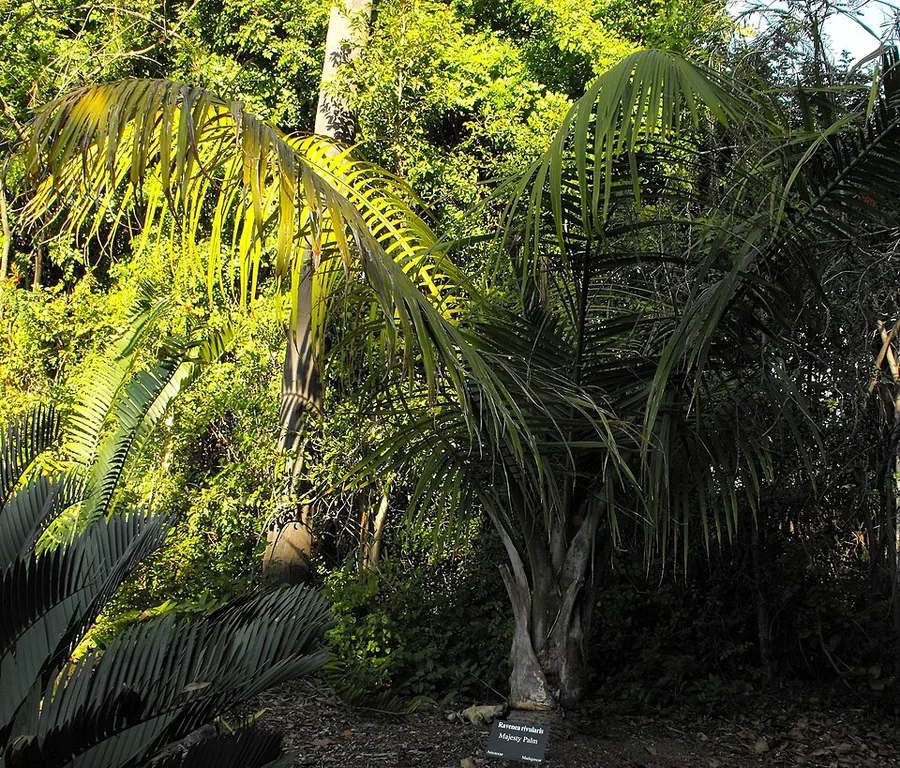
The majesty palm reads as a tall, feathery floor plant, its arching fronds radiating from a single trunk. Its native ground lies along the riverbanks of southwest Madagascar, where it establishes in damp, seasonally wet soil, and that habitat explains most of its indoor requirements. Where conditions allow it reaches considerable height in the wild, but confined to a pot it holds to a manageable size.
Most failures come from treating it as a drought-hardy palm, which it is not. This is a moisture-loving species that expects evenly damp soil and elevated humidity, both consequences of its riverbank ecology. Supply bright indirect light and water before the medium dries, and it responds with steady, graceful growth. Allow the root zone to dry within dry indoor air, and the leaflet tips desiccate and brown.
It is a sound choice for a household with animals. The ASPCA lists it as non-toxic to cats, dogs, and horses, a status that distinguishes it clearly from the toxic sago palm with which it is routinely confused. Manage moisture and humidity correctly, and the remaining care is undemanding.
Care
The short version: provide bright indirect light, hold the soil evenly moist but never saturated, and maintain humid air. Feed lightly through the active season, keep it warm, and remove only fully browned fronds.
Light
Site the majesty palm in bright, indirect light, near a window but shielded from direct midday sun. It tolerates partial shade and gentle sun, yet direct exposure scorches the fronds because the tissue is not adapted to full radiation, while deep shade limits photosynthesis and yields thin, weak growth.
Water
As a thirsty riverbank palm, it wants the medium held consistently moist, more so than most palms tolerate. Water roughly every 4 to 7 days, before the soil dries, but never leave it waterlogged, since saturated soil in an undrained pot excludes oxygen and drives root rot.
Soil
Use a rich, organic loam or clay-based mix that retains moisture while still draining, matching the damp riverbank substrate it evolved in. It accepts high organic content and a broad pH range of 6.0 to 8.0, so a standard potting mix amended for drainage performs well.
Temperature
Hold it within the warm band it is adapted to, 64°F to 84°F (18°C to 29°C). It has little cold tolerance, so cold drafts and chilled windowsills stress it; keep it clear of doors and AC vents through winter.
Humidity
Humidity is the decisive factor for this palm. It requires high humidity, and dry indoor air is the standard cause of brown, crispy leaflet tips through elevated transpiration. Grouping plants, a pebble tray, or a nearby humidifier all raise the local moisture in the air.
Feeding
Feed lightly during the spring and summer growing season, about monthly, when the palm is actively assimilating nutrients. Use a balanced or palm-specific fertilizer that supplies micronutrients, and suspend feeding through the low-light winter months when growth slows.
Pruning
Remove only fully browned, dead, or damaged fronds, cutting at the base. Each stem grows from a single crown, the sole meristem, so cutting or wounding that growing point ends the stem permanently, as it cannot regenerate a new one.
Repotting
Repot every 2 to 3 years, or sooner when it is clearly rootbound, and do so in spring at the start of active growth. Diagnostic signs include roots circling out of the drainage holes and water passing straight through soil that has become largely root mass.
Size & spacing
Indoors the species matures to roughly 5 to 10 feet (1.5 to 3 m) tall with a frond spread of 3 to 6 feet (90 to 180 cm). Allocate floor space accordingly so the arching fronds extend without contacting a wall and abrading.
Troubleshooting
Nearly every complaint on a majesty palm registers in the foliage, and the root cause is usually dry soil, dry air, or the pests those conditions favor. Interpreting the early symptoms lets you intervene before a few brown tips progress across the canopy. Match the sign below, then correct the underlying condition while it still helps.
Fine webbing and speckled fronds
Faint webbing and a dry, stippled cast across the foliage indicate spider mites, a pest whose populations climb in the hot, dry conditions this palm is poorly suited to. The stippling is feeding damage, where mites drain cells and leave pale flecks behind. Confirm by tapping a frond over white paper to see the specks move, then rinse the foliage to reduce numbers, raise humidity to slow their reproduction, and apply insecticidal soap or horticultural oil if they persist.
Fix:
- Rinse or wipe the foliage to physically remove mites
- Raise humidity to discourage them
- Treat with insecticidal soap or horticultural oil as needed
Brown, crispy frond tips and yellowing leaves
Crispy leaflet tips on a majesty palm signal moisture stress, either soil that dried below what this thirsty riverbank species tolerates or indoor air too dry for it. Because the plant evolved in consistently damp ground, a shortfall shows first in the oldest fronds, which the palm sacrifices to protect newer growth. Restore even soil moisture, lift ambient humidity with a pebble tray or humidifier, and hold it in bright indirect light so recovering foliage can photosynthesize.
Fix:
- Keep the soil consistently moist and water before it dries out
- Raise humidity with grouping, a pebble tray, or a humidifier
- Move to bright indirect light
- Feed lightly during the growing season if growth is pale
Toxicity
This is a low-risk plant for households with pets and children. The majesty palm is non-toxic to cats, dogs, and horses, and no part of it contains a poisonous principle. Its fronds are coarse and fibrous, so heavy ingestion may cause transient mechanical upset, but no chemical poisoning is possible.
Safe for
People · Cats · Dogs · Horses · Rabbits · Livestock · Birds
Cats None
As a true palm in the Arecaceae, the majesty palm carries no toxin, and the ASPCA classifies it non-toxic to cats. Any reaction is mechanical rather than chemical, so a cat that ingests a quantity of the fibrous fronds may show brief digestive upset that resolves without intervention.
Dogs None
The species contains no poisonous compound, so dogs are unaffected chemically. A dog that chews the coarse leaves faces only the possibility of mild, self-limiting gastrointestinal upset from the fiber itself.
Horses None
The ASPCA lists this palm as safe for horses, consistent with the absence of any toxic principle. A grazed frond presents no toxicological risk.
Rabbits None
No constituent of the plant is toxic to rabbits, placing it firmly in the safe category. The coarse, fibrous laminae are unpalatable, so ingestion tends to be limited in any case.
Livestock None
Ruminants such as goats, sheep, and cattle encounter no toxin in this palm, and as a tropical ornamental it rarely enters their grazing environment.
Birds None
The fronds hold no toxic compounds, so perching or nibbling birds face no chemical hazard from the plant.
People None
For people, including children, the majesty palm presents no poisoning risk. It is not cultivated as a food crop, yet an incidental taste carries no toxicological consequence.
How to propagate
The majesty palm is among the more difficult houseplants to propagate, a direct consequence of its single-trunked growth habit, which rules out the cloning methods used for trailing species.
SeedDemanding
Sow fresh seed in warm, humid conditions; germination is slow and erratic · Several months to a year or more for seedlings to establish
Propagation is limited to seed, and it demands patience because palm germination is inherently slow. Sow fresh seed in warm, humid conditions and anticipate erratic emergence, followed by several months to a year or more before a seedling is established. As a solitary, single-trunked palm arising from one growing point, the species cannot be divided the way clumping plants are. The full look of a nursery specimen typically comes from several seedlings grown together in one pot, which can be separated but does not constitute true division of an individual palm.
Myths
The majesty palm is the same as the sago palm and just as dangerous to pets.
The confusion rests on a shared common name and nothing more. The majesty palm (Ravenea rivularis) is a genuine palm in the Arecaceae, and the ASPCA lists it as safe for cats, dogs, and horses. The sago palm (Cycas revoluta), by contrast, is a cycad, an entirely different lineage, and it is severely poisonous to pets. Botanically these are unrelated plants, so identify by species rather than by the word palm.