Houseplant · Arecaceae
Parlor Palm
Chamaedorea elegans
Give it low light and steady moisture, and the parlor palm thrives where fussier plants sulk.
Bright indirect
59–86°F · 15–30°C
USDA 10–12
2–7 ft · 0.6–2 m
Overview
The parlor palm acquired its common name in Victorian parlors, where its tolerance of dim corners and dry air let it persist long after showier plants failed. It sits in the palm family and occurs in the wild as an understory species in the forests of Mexico and Guatemala, evolved for deep shade and the low, filtered light beneath a canopy. That native niche is the direct reason it performs so well in the muted light of an interior.
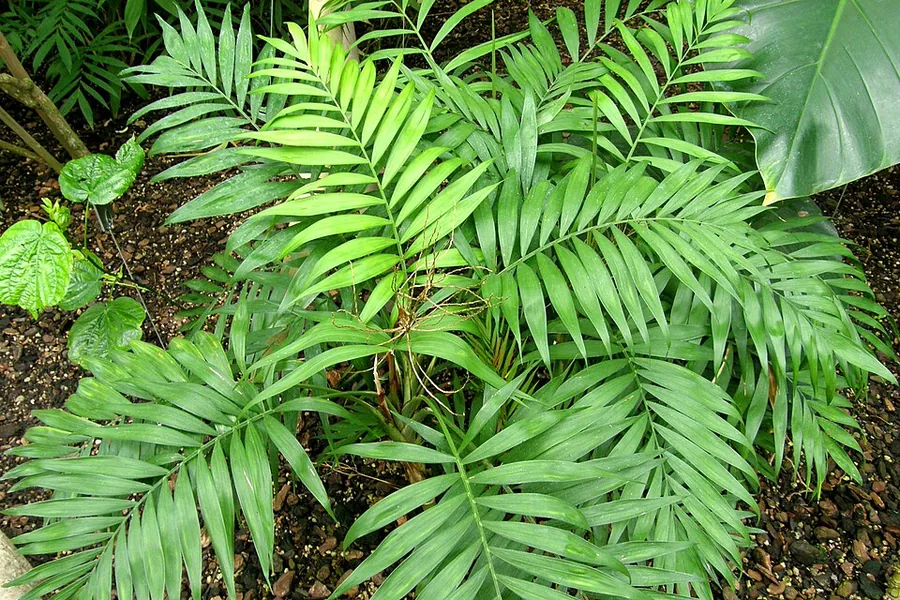
Growth is slow and compact, the plant reaching roughly 2 to 6 feet (60 to 200 cm) only across many seasons. Each stem terminates in a tuft of soft, arching fronds, and because a single stem stays sparse, nurseries pot several seedlings together to read as full from the outset. Given adequate light, a mature specimen produces sprays of small yellow flowers in spring.
Its cultural demands are among the lowest of any houseplant. It withstands low light, average humidity, and irregular watering, and its non-toxic status makes it suitable for households with cats, dogs, or small children. The two conditions that genuinely compromise it are a waterlogged medium and persistently dry air, both of which act on tissues the plant cannot readily repair.
Care
The short version: bright indirect light is ideal though it performs in low light, water when the surface dries and never leave it in standing water because that drives root rot, hold ordinary room warmth, and feed lightly in spring and summer alone.
Light
The optimum is bright, indirect light, but the defining trait of this understory palm is its capacity to hold in low light and shade that stall most foliage plants. Direct sun should be avoided, because the unhardened frond tissue scorches under it. A north or east exposure supplies the moderate light the species evolved to use.
Water
Water thoroughly once the soil surface has dried, then empty the saucer so the roots are never left in standing water. A saturated or poorly draining medium starves the roots of oxygen and drives the root rot that is the plant's chief killer, so err toward slightly dry. No calendar applies; the drying of the surface is the reliable cue.
Soil
The medium should be porous and humus-rich so that it drains freely. A high organic content buffers moisture without holding the profile waterlogged, which is what protects the roots. The species tolerates a pH from 6.0 to 7.5.
Temperature
Standard interior temperatures suit it, spanning 59°F to 86°F (15°C to 30°C). Cold drafts and the desiccating flow from heating vents both stress the foliage and are best avoided. The plant has no frost tolerance whatsoever.
Humidity
Average household humidity meets its needs, so no target figure is required. That said, dry air is what precipitates tip browning and spider mite outbreaks, so supplemental moisture through winter is a sensible hedge. A gravel-and-water tray or periodic misting raises the local humidity enough.
Feeding
Fertilize only during the active growth of spring and summer, applying a slow-release palm fertilizer two or three times across the season. Withhold feed entirely in winter, when growth halts and unused salts would only accumulate. Keep the rate modest, since excess fertilizer concentrates the soluble salts that scorch the leaf tips.
Pruning
Pruning is confined to removing a whole dead or damaged frond at its base. A stem must never be topped, because it grows from one apical point with no reserve buds below, so cutting the crown kills the stem rather than forcing it to branch.
Repotting
Repot only every few years, or once the plant is visibly crowded, since it flowers and grows contentedly while somewhat pot-bound. Roots circling the pot or escaping the drainage holes, a medium that dries very fast after watering, and stalled growth together signal that the container has been outgrown.
Size & spacing
Mature dimensions run to a height of 2 to 6 feet (60 to 200 cm) and a spread of 2 to 3 feet (60 to 90 cm), attained slowly over years. As a container subject it requires no field spacing, only sufficient clearance for the arching fronds to extend.
Troubleshooting
The parlor palm is a low-maintenance subject, and the few disorders it develops register on the foliage before anywhere else. Two account for nearly all of them: browning tips and a stippled, dull surface. Reading them correctly at the first sign makes correction straightforward.
Stippled, bronzed foliage carrying fine webbing
Spider mites colonize the plant when warmth and dry air favor rapid reproduction, feeding on the undersides of the fronds where they pierce cells and drain their contents. That feeding leaves the characteristic stippling and bronzed cast, and heavy populations spin the fine webbing that confirms the diagnosis. Because the mites cannot tolerate moist conditions, wiping the foliage with a damp cloth, misting, and raising the humidity all suppress them.
Fix:
- Rinse or wipe foliage with a damp cloth and mist regularly
- Raise humidity to discourage mites
- Move plants outdoors in summer for natural predator control or treat as needed
Necrotic browning confined to the leaflet tips
Low humidity is the leading driver of tip necrosis, since dry air pulls moisture from the leaflet margins faster than the plant can replace it, and the thin tip tissue dies back first. A parallel cause is a buildup of soluble fertilizer salts, which the roots cannot exclude and which accumulate at the leaf edges, along with soil that swings between bone-dry and saturated. The tip browns while the rest of the blade stays green, and the oldest fronds, having transpired longest, show it first. Raise humidity, reduce the feeding rate, flush the medium to leach the salts, and hold the soil evenly moist.
Fix:
- Raise humidity with a gravel-and-water saucer or room humidifier
- Reduce fertilizer rate and flush the pot with water to leach accumulated salts
- Maintain even soil moisture, watering thoroughly when the surface dries
Toxicity
For pet-keeping households the record is unambiguous: the parlor palm is non-toxic in every category. The ASPCA lists it as safe for cats and dogs, and no toxic principle is documented for other animals or for people. The lone qualification concerns the fruit pulp, which carries skin irritants, so gloves are warranted during seed processing.
Safe for
People · Cats · Dogs · Horses · Rabbits · Livestock · Birds
Cats None
The ASPCA classifies Chamaedorea elegans as non-toxic to cats, so ingestion of the foliage produces no poisoning response.
Dogs None
No toxic principle is documented for dogs. Ingesting a large volume of any plant matter may provoke transient gastric upset, but the palm itself is not the cause.
Horses Safe
The foliage contains no toxic compounds known to affect horses, so browsing carries no risk of poisoning.
Rabbits Safe
Rabbits may consume the fronds without consequence, as the tissue holds no compound toxic to them.
Livestock Safe
Ruminants such as cattle, goats, and sheep face no poisoning hazard, since the parlor palm is classed as a non-toxic plant.
Birds Safe
Neither the fronds nor the small black fruit carry any documented toxin, so exposure poses no danger to pet birds.
People Safe
The plant is non-toxic to people. The single qualification is that the fruit pulp contains skin irritants during seed processing, which gloves address.
Gloves are advised when handling Chamaedorea fruits during seed processing because the fruit pulp can contain skin irritants.
Varieties
The parlor palm is grown almost exclusively as the true species, with little of the cultivar selection that shapes other houseplants. In practical terms there is a single entry to consider.
Chamaedorea elegans (species)
This is the true species, a compact single-stemmed palm that nurseries raise as multi-seedling clumps in one pot to produce the full, bushy habit buyers expect.
How to propagate
Propagating the parlor palm turns on patience rather than technique. Two routes exist, seed and division of an established clump, and neither yields a finished plant quickly.
SeedDemanding
Sow fresh seed in warmth; germination is slow and erratic · Seed may not begin germinating for several months and can continue sporadically for over a year
Seed is the primary means of propagation, and it demands patience because germination is inherently slow and uneven. Sow fresh seed under warmth and expect no emergence for several months, with sporadic germination continuing for over a year as individual seeds break dormancy. The fruit pulp holds skin irritants, so clean the seed with gloves on.
DivisionModerate
When repotting a multi-stemmed clump · Several weeks to re-establish after separating clumps of seedlings
Where a pot holds several seedlings grown together, separate the clump at repotting to make new plants, allowing several weeks for the divisions to re-establish their roots. A genuinely single-stemmed plant offers no such option, because the one apical meristem cannot be split into independent growing points.
Myths
Parlor palms are poisonous to cats and dogs.
The ASPCA classifies Chamaedorea elegans as non-toxic to both cats and dogs, meaning no toxic principle has been documented in the plant. An animal that nibbles it is not poisoned, which is why the species is a fixture on pet-safe plant lists.
You can keep a leggy parlor palm short by cutting off the top of the stem.
Each stem carries a single apical growing point and no dormant lateral buds along its length, so removing the crown leaves nothing to resume growth. Topping the stem therefore kills it outright. Fullness comes from planting a multi-seedling clump, not from cutting the plant back.