Houseplant · Arecaceae
Pygmy Date Palm
Phoenix roebelenii
Steady bright indirect light and even soil moisture hold this slow palm in good form for years.
Bright indirect
61–81°F · 16–27°C
USDA 10–11
5–7 ft · 1.5–2 m
Overview
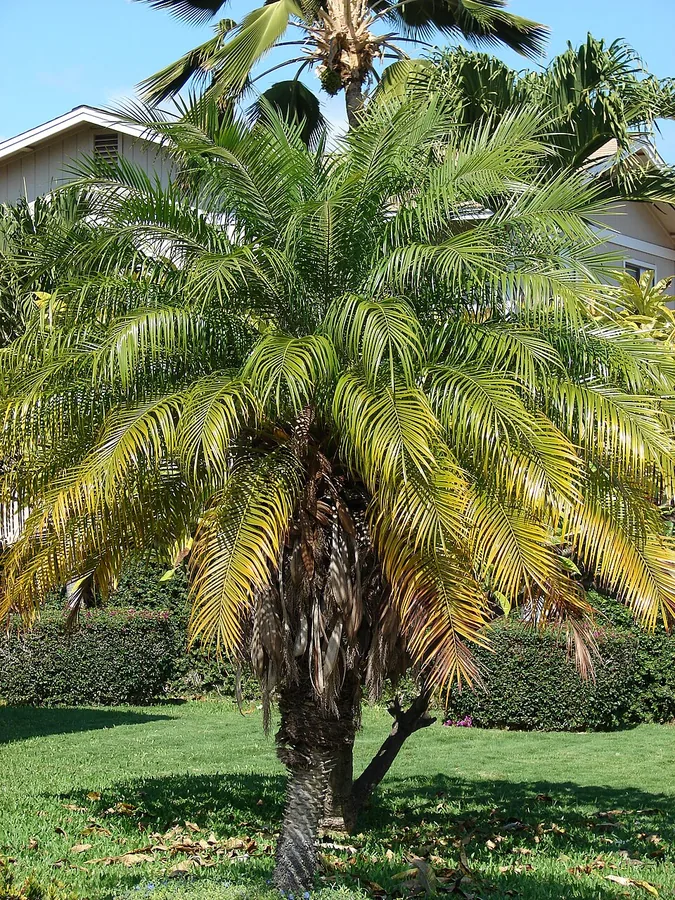
Phoenix roebelenii is a small palm well suited to indoor culture. In its native Southeast Asia it occupies riverbank habitats, an origin that explains its preference for steady moisture, and under room conditions it reaches only 5 to 6.5 feet (150 to 200 cm), a fraction of its wild stature. The finely divided, arching fronds account for the light, feathery canopy that reads well in a bright position.
Its growth is slow, a trait that limits how often the root system outgrows its container and lets a single specimen hold its architecture for years. Female plants produce flowers followed by small purple drupes, and the seed within those fruits is the propagation unit for the species.
One structural feature separates it from typical foliage houseplants. At the base of each frond the lowest leaflets are modified into stiff, needle-sharp spines, a defensive adaptation capable of inflicting a deep puncture. The tissue is not toxic if ingested, so the spines, not the sap, are the reason to handle it with care during pruning or relocation.
Care
The short version: bright indirect light, a growing medium held slightly moist yet freely draining, ordinary indoor warmth and humidity, and a restrained seasonal feed. Because the basal spines can puncture, glove the hands before working near the frond bases.
Light
Position it in bright, indirect light, the exposure an east-facing window supplies. It tolerates partial sun and medium indirect light, but insufficient light limits photosynthesis, so the fronds elongate, thin, and lose pigment.
Water
Hold the medium slightly moist across the growing season, and never leave the pot in standing water, because saturated soil excludes oxygen and invites root rot. Palms also absorb fluoride and soluble salts readily, and their accumulation scorches the leaf margins, so low-mineral water spares the tips.
Soil
Use a porous, well-drained medium enriched with organic matter, since free drainage keeps the roots aerated. Root texture is not limiting, as it accepts clay, loam, or sand, and it performs across a broad pH span of 6.0 to 8.0.
Temperature
It grows within 61°F and 81°F (16°C to 27°C), the range of ordinary heated interiors. Cold drafts and glass chilled in winter can damage tissue, so keep it clear of both.
Humidity
Average household humidity meets its needs, so no specific target applies. In very dry air the leaf tips desiccate and brown, and modest supplemental moisture offsets that.
Feeding
Confine feeding to spring and summer, when active growth can use the nutrients. A slow-release palm fertilizer carrying micronutrients, such as 12-4-12 or 8-2-12, applied two or three times through the season, supplies them without excess, since surplus salts are what burn the leaf tips.
Pruning
Remove only fronds that have fully died or browned, and never cut the single growing crown, because this palm carries one apical meristem and severing it kills the stem. Glove up first, as the lowest leaflets are hardened into very sharp spines.
Repotting
The species prefers a slightly root-bound state and rarely warrants repotting. Move it up only when roots encircle the pot or exit the drainage holes, when water passes through with little uptake, or when growth slows against crowded stems.
Size & spacing
59–79 in (150–200 cm) tall
Troubleshooting
Nearly every disorder on this palm registers on the fronds, and the underlying causes cluster around water quality, salt accumulation, and a few pests. Because the earliest signs appear well before a frond is lost, an accurate reading buys time to intervene. Identify the symptom below, then correct the cause rather than the symptom.
Yellowing fronds above softened, rotting roots
Yellowing fronds over a soured base point to root rot, the result of a medium so wet the roots are deprived of oxygen. Exposing the root ball reveals brown, mushy tissue and an off odor. Let the medium dry slightly between waterings, transfer it to a porous palm mix that drains freely, and stop the pot from sitting in collected water.
Fix:
- Allow the soil to dry slightly between waterings
- Repot into a porous, well-drained palm mix with drainage holes
- Never let the pot stand in water
Sticky, stippled, or lesioned leaflets
Sticky exudate, fine stippling, or spotting indicates scale insects and thrips, at times with a fungal leaf spot present. Inspection shows small brown bumps from scale, a dusty stippling from thrips, and circular discolored lesions where leaf spot has taken hold. Treat scale with horticultural oil or insecticidal soap, raise air circulation to suppress the fungus, and excise fronds beyond recovery.
Fix:
- Wipe off or treat scale with horticultural oil or insecticidal soap
- Improve air circulation and avoid wetting foliage to limit leaf spot
- Remove and discard severely affected fronds
Necrotic brown tips along the older leaflets
Brown, dead tips signal leaf-tip burn, which on a palm reflects accumulated fluoride and soluble salts from tap water or an excess of fertilizer. The damage surfaces on the oldest leaflets first, and soil that is dry or salt-crusted intensifies it. Irrigate with low-fluoride water, leach the pot periodically to displace stored salts, and lower the feeding rate.
Fix:
- Water with low-fluoride water and leach the pot periodically to flush salts
- Maintain slightly moist soil during the growing season
- Reduce fertilizer rate and follow a slow-release palm fertilizer schedule
Toxicity
The safety profile here is reassuring. The ASPCA records the pygmy date palm as non-toxic to cats, dogs, and horses, with no toxic principle identified, so ingestion of a leaflet carries no poisoning risk. The hazard is mechanical: the sharp basal spines on each frond can penetrate skin, which is why placement away from traffic and gloved handling matter more than any concern about the foliage.
Safe for
People · Cats · Dogs · Horses · Rabbits · Livestock · Birds
Cats None
No toxic effect on cats is on record. The realistic risk is a cat contacting the frond bases and sustaining a wound from the sharp spines, so position the pot where it will not be brushed.
Dogs None
Dogs face no toxicity from any part of this palm. A nose investigating the lower leaflets can still be pierced by the stiff spines, and that mechanical injury is the sole concern.
Horses None
Horses encounter no toxic compounds in the plant. As an indoor palm it seldom occupies the same space as a horse, which further limits exposure.
Rabbits None
No toxic principle acts on rabbits. A free-ranging rabbit should be kept from the spiny frond bases, because the spines penetrate as readily at ground level.
Livestock None
Grazing livestock face no poisoning from the species. The spines constitute the only hazard, and only where the plant lies within reach.
Birds None
Pet birds sustain no toxic effect from the foliage. The sharp basal spines still merit caution around a bird inclined to perch or climb on it.
People None
People are not poisoned by the plant, and female specimens even yield small edible drupes. The spines, however, can draw blood and occasionally seed an infection, so glove the hands during handling and keep children at a distance.
Although non-toxic, the lower leaflets near the frond base are modified into very sharp, stiff spines that can cause painful puncture wounds and occasional infections; wear gloves and supervise children and pets around the plant.
Varieties
Trade material is almost always the species rather than a named cultivar, offered in two structural forms. The distinction affects the plant's habit and is worth confirming at purchase.
Phoenix roebelenii (single-trunk form)
This is the solitary, slender-trunked expression grown as one specimen, in contrast to the clumping multi-stemmed form more commonly stocked by garden centers.
How to propagate
Propagation rewards patience and follows one reliable path. This palm reproduces from seed rather than vegetative cuttings, and the seed itself germinates on a slow schedule.
SeedModerate
Sow fresh, cleaned seed when warm; germination is slow and uneven · Several months to germinate and one or more years to develop into an established plant
Seed is the standard propagation method for the species. Extract and clean seed from the purple drupes borne on female plants during warm conditions, then sow it fresh, since viability favors freshness. Germination is slow and irregular, occupying several months, and a further year or more passes before the seedling develops into an established plant. The palm does not root from cuttings, leaving seed as the only route.
Offsets & pupsModerate
Growing season, when basal suckers are large enough to separate · Several months to root and establish after division
Specimens that produce basal suckers can occasionally be divided during the growing season, provided each offset has enlarged enough to detach with intact roots. After separation, several months are needed for the division to root and reestablish. Seed nonetheless remains the principal means of increasing the species.
Myths
The pygmy date palm is poisonous to cats and dogs.
The ASPCA classifies Phoenix roebelenii as non-toxic to cats, dogs, and horses, so ingestion of a leaflet presents no toxicological risk. The hazard is mechanical rather than chemical: the sharp basal spines can drive a puncture wound that occasionally becomes infected, which is the injury actually worth preventing.