Houseplant · Arecaceae
Kentia Palm
Howea forsteriana
Set it in bright, indirect light and water it steadily, and the kentia palm holds a slow, easy elegance in any room.
Bright indirect
Every 7–14 days
61–81°F · 16–27°C
USDA 9–11
Overview
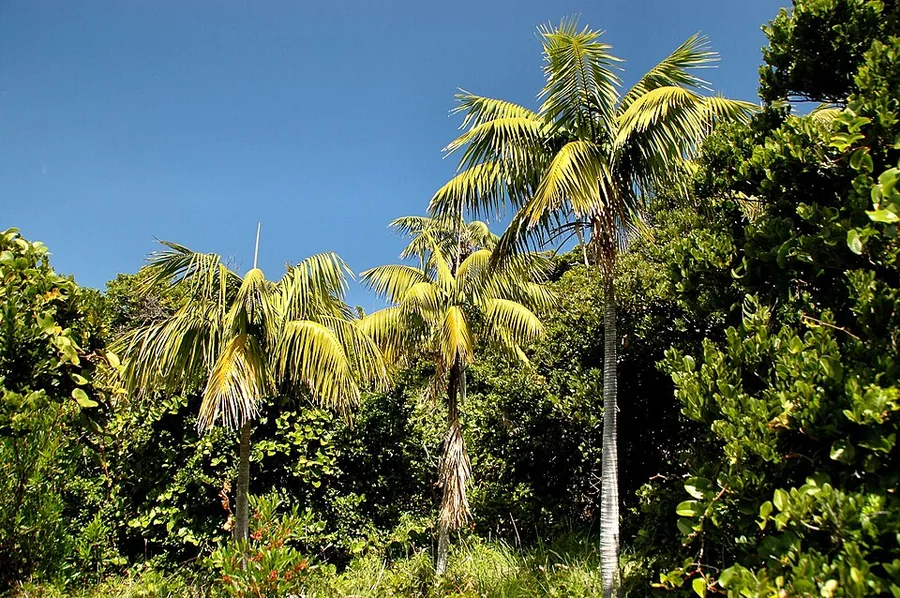
Howea forsteriana is endemic to Lord Howe Island off the Australian coast, where it matures into a tall, single-trunked tree. Its indoor cultivation reaches back well over a century, driven by the way its arching, dark green fronds settle a corner. Among cultivated palms it ranks as one of the most forgiving species for interior use.
Its indoor success rests on two traits: a slow growth rate and a wide tolerance for conditions. Because it lays down growth so gradually, it retains its form over years, and its capacity for low light and dry air lets it hold where more demanding palms decline. That physiological tolerance explains its long standing in lobbies and living rooms alike.
One structural fact governs its care. The plant has a single growing point and produces no branches, so a damaged crown cannot be replaced from a lateral bud the way many houseplants recover. Protect the apex and the specimen persists for many years.
Care
The short version: bright, indirect light, watering triggered once the top of the mix dries, and a temperature range of 61°F to 81°F (16°C to 27°C). Feed sparingly through the growing season, withhold nutrients in winter, and never cut the growing tip.
Light
The kentia palm performs best under bright, indirect light, though its defining asset is a broad tolerance. It sustains itself in medium light, low light, and even full shade, which accounts for its persistence in the dim positions that eliminate most palms. Screen it from harsh direct sun, which scorches the fronds.
Water
Allow the top inch or so of mix to dry before watering, then water thoroughly to wet the full root zone. Through the warm growing season the plant transpires freely and takes up water quickly, whereas in winter its uptake falls and watering should wait until the mix has dried. Persistently waterlogged mix excludes oxygen from the roots and drives root rot.
Soil
Grow it in a porous, well-drained potting mix amended with ample organic matter to hold moisture without becoming saturated. It is undemanding as to substrate, accepting sand, loam, or clay and a pH spanning 6.1 to 7.5 across the slightly acidic to slightly alkaline range.
Temperature
Ordinary interior warmth meets its needs, with the working range at 61°F to 81°F (16°C to 27°C). Keep it clear of cold drafts and chilled winter glazing, since the plant carries no frost tolerance under indoor conditions.
Humidity
Average household humidity satisfies the plant, so no target figure applies. Even so, dry winter air favors spider mites, so occasional misting or a position away from a hot radiator reduces the drying that lets those populations build.
Feeding
Fertilize only during the spring and summer growing season, applying a slow-release palm fertilizer with an analysis such as 12-4-12 or 8-2-12 two or three times a year. Suspend feeding through autumn and winter, when metabolic activity and growth slow markedly.
Pruning
Pruning demands little intervention. Remove only the fully dead, brown fronds at the base and leave healthy tissue in place. Never cut the single crown or growing tip, because a solitary palm has no capacity to regenerate from a damaged apex.
Repotting
The species prefers its roots confined and reacts poorly to disturbance, so repot only every two or three years and only once roots have filled the container. The indicators are roots circling within the pot, roots emerging from the drainage holes, and water passing straight through with little absorption.
Size & spacing
Under interior culture the palm attains 4 to 10 feet (1.2 to 3 m) in height over many years and carries its fronds across a spread of 3 to 6 feet (90 to 180 cm). Allow floor clearance for the fronds to arch without abrading against a wall or window.
Troubleshooting
The kentia palm is a low-maintenance species, and the few disorders it develops register in the fronds. The two you will diagnose most often are brown tips and a light spider mite presence. Identify the signs early and the corrective step is generally straightforward.
Chlorotic stippling and fine webbing on the frond undersides
Yellow stippling with fine webbing on the undersides is the diagnostic signature of spider mites, sap-feeding pests whose populations expand fastest in the hot, dry air common to heated interiors. Wash the foliage to dislodge the colony mechanically, then raise humidity around the plant to slow further breeding. Where the infestation persists, apply insecticidal soap or horticultural oil and repeat on schedule, since a single pass rarely reaches every generation.
Fix:
- Rinse or wash the foliage to physically remove mites
- Raise local humidity and avoid hot, dry placement
- Treat with insecticidal soap or horticultural oil per label directions, repeating as needed
Necrotic brown tips forming along the frond margins
Brown margins trace back most often to low ambient humidity or a plant left thirsty between waterings, and a rising concentration of fertilizer salts in the mix scorches the tissue by the same drying action. Hold watering even through active growth and periodically leach the pot with clear water, which carries the accumulated salts out through the drainage holes. Cut back only the dead brown tissue and leave a narrow brown margin, because cutting into living green removes tissue the frond still needs.
Fix:
- Maintain even moisture during active growth and water before the mix fully dries out
- Leach the pot periodically by flushing with clear water to remove accumulated salts
- Reduce or correct fertilizer rate
- Trim only the dead brown tissue, leaving a thin margin of brown rather than cutting into green tissue
Toxicity
For a household with pets or young children, the assessment is reassuring: the kentia palm is non-toxic in every category. The ASPCA records it as safe for cats and dogs, and no plant part holds a compound capable of poisoning other animals or people. A chewed frond may provoke minor stomach upset, but nothing of clinical concern.
Safe for
People · Cats · Dogs · Horses · Rabbits · Livestock · Birds
Cats None
The ASPCA classifies the kentia palm as non-toxic to cats, meaning a nibbled frond delivers no poison. Ingesting a large volume of any plant fiber can trigger a cat to vomit, but that response comes from the roughage rather than any toxic compound in this palm.
Dogs None
The same ASPCA listing extends the non-toxic classification to dogs. Beyond the mild gastric upset that chewing any greenery can cause, the plant presents no chemical hazard.
Horses Safe
The record documents no toxic compounds in this palm, so it presents no poisoning risk to horses.
Rabbits Safe
The fronds contain nothing harmful to rabbits, although a potted specimen is better treated as an ornamental than as browse.
Livestock Safe
Cattle, goats, and sheep can graze in its vicinity with no toxic effect arising from the foliage.
Birds Safe
The plant carries no toxin and sits safely around pet birds, so an exploring beak encounters no chemical hazard.
People Safe
The kentia palm is non-hazardous to people. It functions as a cultivated ornamental rather than a food crop, yet handling it or an incidental taste produces no adverse effect.
Varieties
The kentia palm reaching the market is almost invariably the straight species, so there is effectively one taxon to recognize.
Howea forsteriana (species)
The species is recognized by a slender trunk topped with an arching crown of dark green, feather-shaped fronds that carry a flatter profile than the more strongly recurved leaves of the related Howea belmoreana.
How to propagate
Propagation is the single demanding aspect of growing this palm. Seed is the only method available, and it requires warmth together with a long and patient timeline.
SeedDemanding
Sow fresh seed in warm conditions · Germination is slow and erratic, ranging from about three months to several years
Seed is the sole method of propagation for this palm, and the demanding part is the germination behavior rather than the sowing itself. Fresh seed sown into warm conditions germinates slowly and erratically, spread across a window of three months to several years rather than emerging on a predictable schedule. Because the species is solitary and cannot be divided, the clustered trunks offered for sale represent several seedlings raised together, not a single divisible clump.
Myths
A multi-stemmed kentia palm in a pot can be split into separate single-trunk plants by division.
Howea forsteriana is a solitary palm propagated exclusively from seed, so it offers no basal offsets or clumping crowns to separate. The multiple trunks in a single container are simply several individual seedlings potted together to produce a fuller specimen, which means dividing the pot only damages each seedling and yields no additional plants.