Tree · Arecaceae
Date Palm
Phoenix dactylifera
Provide full sun, sharp drainage, and desert heat, and the date palm returns sweet fruit for decades.
Full sun
USDA 8–11
49–79 ft · 15–24 m
Overview
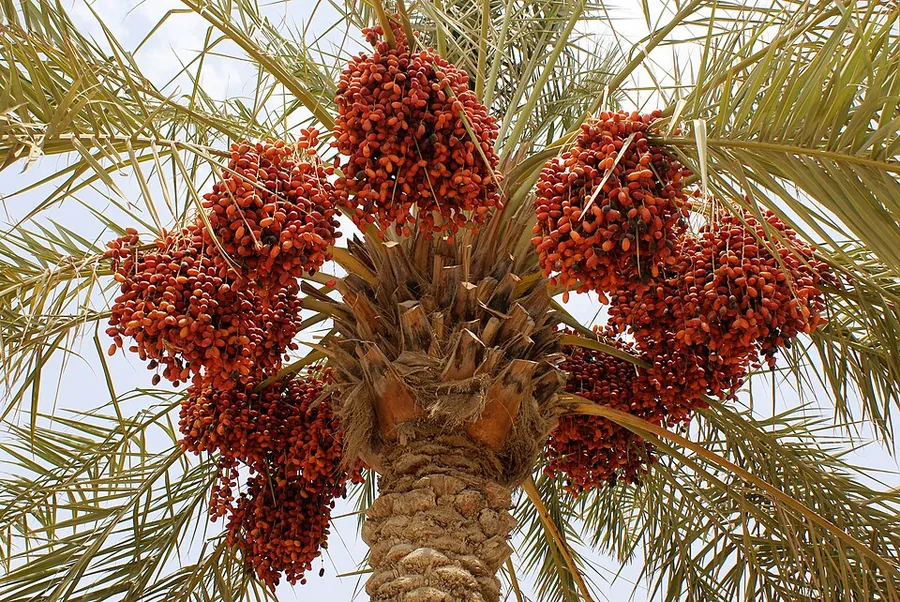
Few trees have served people as long as the date palm, a desert staple cultivated for millennia that still pulls double duty as a fruit crop and a commanding landscape specimen. Botanically it is a true palm in the family Arecaceae, with a native range running from the Arabian Peninsula across to South Pakistan. Given the right climate it builds into a tall, single-trunked tree topped by long arching fronds, reaching up to about 80 feet.
Everything about its constitution points to the desert. Deep roots give it real drought tolerance once established, full sun is exactly what it wants, and lean sandy ground that would stall most trees suits it well. Its cold hardiness is the surprise, holding to about 16°F (-9°C), which is what lets it grow outdoors across USDA zones 8 to 11.
There is one piece of biology to settle before planting: the date palm is dioecious, so every tree is either male or female. Fruit forms only when a female has a male close enough to pollinate it, which means a lone tree stays ornamental but fruitless. Add the stiff spines on the lower leaf bases, and the tree clearly wants generous spacing away from paths and play areas.
Care
The short version: full sun, fast-draining soil, and steady warmth do most of the work. Irrigate young trees until the deep root system takes hold, then cut back, and run a true palm fertilizer to keep the canopy fed and green.
Light
Site a date palm in full sun. Partial sun is tolerated, but the strongest growth and best fruiting come from an open, all-day exposure that matches the baking light of its native desert.
Water
Count on a highly drought-tolerant tree. Irrigate young specimens regularly while they establish, then taper off, because a mature palm in a suitable climate asks for little extra water once its deep roots are in place. It grows naturally both in deserts fed by deep groundwater and along rivers, so it copes with dry ground far better than with saturated soil.
Soil
Plant into well-drained soil; even pure sand is fine. It favors the acidic-to-neutral range, roughly pH 5.5 to 7.0. The one thing it cannot tolerate is water standing around the roots.
Temperature
This palm works across a wide band, about 16°F to 100°F (-9°C to 38°C). That lower limit is unusual for a palm and is what extends its range well past the tropics, though it still needs long, hot summers to ripen a crop.
Humidity
Low humidity suits it perfectly. As a desert tree it actually prefers dry air, which separates it from the rainforest palms commonly kept indoors.
Feeding
Use a true slow-release palm fertilizer through the warm growing season, one formulated at an 8-2-12 plus 4 magnesium analysis with micronutrients. That ratio is built to head off the potassium, magnesium, and manganese deficiencies palms run into. Standard lawn fertilizer works against the tree rather than for it.
Pruning
Take off only fronds that have turned fully brown and dead, and leave green ones in place, since stripping live fronds saps the tree. A few growers thin the lowest leaves to limit fungal issues. Whatever comes off, gear up first, because the leaf bases are armed with sharp 3- to 4-inch spines.
Repotting
A date palm belongs in the ground as a large landscape tree, not in a container. Repot only while it is young and still potted, and even then infrequently. Roots circling the pot or water draining straight through with no uptake signal that a young one has outgrown its container.
Size & spacing
Plan for a substantial tree, 50 to 80 feet (15 to 24 m) tall with a crown spanning 20 to 25 feet (6 to 7.5 m). Set it well back from walkways, foundations, and play areas, and account for fronds and fruit dropping from height.
When to plant
Treat the date palm as the long-lived perennial it is rather than a seasonal sowing; there is no narrow planting window to chase. Set it out in the warm growing months so the roots establish before any stress, and at maturity the edible dates ripen from late summer into autumn, but only where a male and a female tree grow together.
Northern hemisphere
Southern hemisphere
Typical months for a temperate climate: start earlier in warm zones, later where spring frosts linger.
- Harvest: Edible dates ripen in late summer to autumn; both male and female trees must be present for fruit set
Hardiness
USDA hardiness zones: 8–11
Temperature: down to -12°C
Troubleshooting
Date palm problems sort into two buckets: an incurable disease and correctable nutrient gaps. The fastest way to tell them apart is to read where the symptom sits. Damage at the emerging crown points one direction, trouble on the oldest lower fronds points another.
Crown thinning as fronds collapse across the canopy
A palm sliding into broad decline, with fronds dying back and sometimes the whole tree dropping fast, is showing lethal yellowing, a disease this species is documented to contract. The infection is incurable, which is why an affected tree gets felled and destroyed rather than treated. Your only real control is siting: never establish a date palm where lethal yellowing is already active in the area.
Fix:
- Avoid planting where lethal yellowing is present
- Remove and destroy confirmed infected palms to limit spread
Distorted, frizzled spear and emerging fronds
Newest fronds emerging frizzly and necrotic while the older canopy looks healthy is the signature of frizzle top, a manganese deficiency. High soil pH is the common driver because it locks up manganese and blocks uptake at the roots. Supply the nutrient through a complete palm micronutrient program and pull an elevated pH back down so the tree can actually absorb what you apply. Ignore it and the crown keeps deforming until the palm fails.
Fix:
- Apply manganese as part of a complete palm micronutrient fertilization program
- Address high soil pH that reduces manganese availability
Pale margins working in along the oldest fronds
When yellowing settles on the outer edges of the lowest fronds while the upper, newer growth holds its color, the tree is short on magnesium, a mobile nutrient it pulls from old tissue to feed new. The correction is a magnesium deficiency fix through proper feeding: switch to a complete palm fertilizer at an 8-2-12 plus 4 magnesium analysis with micronutrients and keep it on a steady schedule. Turf fertilizer applied near the root zone is the usual trigger, so keep it well away.
Fix:
- Apply a complete palm fertilizer such as 8-2-12 plus 4 magnesium with micronutrients
- Continue regular scheduled feeding to correct and prevent recurrence
Toxicity
For a home with pets or children, the chemistry is reassuring: the date palm carries no toxin. The fruit is an everyday food, and ASPCA lists Phoenix palms as non-toxic to cats, dogs, and horses. The real hazard here is mechanical, not chemical, since the sharp 3- to 4-inch spines at the leaf bases can inflict deep puncture wounds, so keep everyone clear of the lower fronds.
Safe for
People · Cats · Dogs · Horses · Rabbits · Livestock · Birds
Cats None
No toxic concern for a cat. As a true palm bearing edible fruit, it falls under the Phoenix species ASPCA records as non-toxic to cats.
Dogs None
The plant itself poses no poisoning risk to dogs, because Phoenix palms hold no toxin. The only thing to manage is a curious dog nosing into the spiny lower fronds.
Horses None
Neither foliage nor fruit is toxic to horses, and ASPCA records Phoenix species as non-toxic.
Rabbits Safe
A rabbit nibbling a frond faces no poisoning, since the plant contains no harmful compound.
Livestock Safe
Cattle, goats and sheep can graze around a date palm with no toxic effect from leaves or fruit.
Birds Safe
Neither fruit nor foliage is toxic to birds, which feed on ripe dates freely in the wild.
People Safe
The dates are a staple food eaten fresh or dried with no concern. The genuine risk is mechanical rather than toxic: the stiff 3- to 4-inch spines at the leaf bases can inflict deep puncture wounds, so work the lower fronds carefully.
Wear thick gloves, long sleeves and eye protection when handling or pruning: the lower leaf bases carry very sharp, stiff 3- to 4-inch spines (modified leaflets) that can cause deep puncture wounds and infections. Male trees release abundant airborne pollen that is highly allergenic.
Varieties
Named date palms are selected chiefly for fruit, and a small number of cultivars account for most of what reaches the market. These two are the ones worth recognizing.
Medjool
One of the leading commercial dates worldwide, valued for its large, soft, intensely sweet fruit.
Deglet Noor
A semi-dry type produced in volume for export, and the date most often packaged for retail shelves.
How to propagate
A date palm can be raised from seed or from the basal offshoots a mature tree throws, and the decision carries real weight. Seed leaves sex and fruit quality to chance, while an offshoot is a clone that reproduces the parent exactly.
SeedEasy
Sow ripe seed in warm conditions; viable for long periods · Several months to germinate and establish a seedling, with many years before fruiting maturity
Ripe seed germinates readily under warm conditions and holds viability for a long stretch. Expect a slow start, though: a seedling needs several months to establish and many years to reach fruiting age. Since seed-grown plants vary in both sex and fruit quality, they fit landscape planting far better than they fit a dependable harvest.
Offsets & pupsModerate
Remove rooted basal offshoots from an established mother palm during warm growing weather · Several months to a year to root and establish after separation
Detach rooted basal offshoots from an established mother palm during warm growing weather, then allow several months to a year for them to root and settle after separation. This is the method that keeps cultivars true to type, and because the offshoot is a clone, you know its sex from day one, something seed can never guarantee.
Myths
Any palm sold as a date palm will reliably produce edible dates on its own.
Because the species is dioecious, a female tree sets fruit only with a male close enough to pollinate it. Named fruiting cultivars are propagated from offshoots, not seed, for a reason: only offshoots stay true to the parent and carry a known sex. A solitary seed-grown palm leaves both of those outcomes to chance.