Tree · Arecaceae
Pindo Palm
Butia capitata
A feather palm of unusual cold hardiness, producing recurved gray-green fronds and sweet, jelly-suited fruit.
Full sun
USDA 8–11
15–35 ft · 4.6–10.7 m
Overview
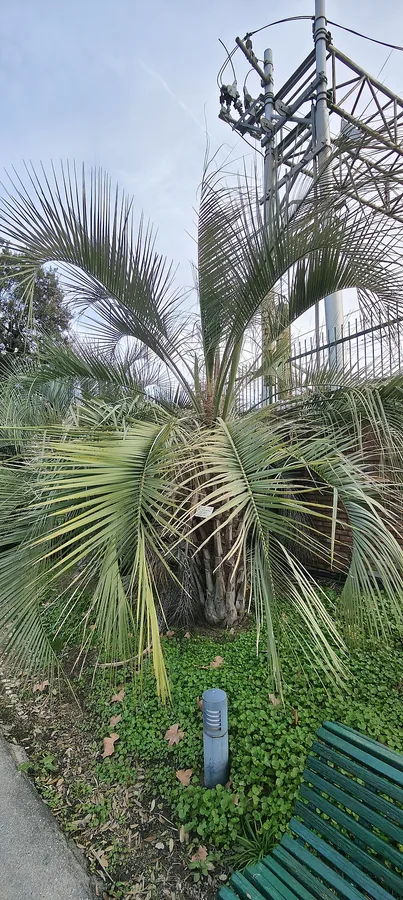
The pindo palm supplies a tropical form to gardens that experience genuine winter cold. A member of the true palm family native to South America, it develops on a single stout trunk crowned by arching, blue-gray to gray-green fronds that recurve toward the ground. Growth is slow, so it advances gradually before maturing into a durable, long-lived landscape palm.
Cold tolerance is the defining trait. It withstands temperatures near 10°F (-12°C), a threshold few palms reach, which is why it succeeds where most cannot. Sited in full sun on freely draining ground, and once its deep root system is established, it endures drought, marginal soils, and moderate salt exposure.
The fruit completes the profile. Clusters of edible orange fruit mature through summer with a sweet, acidic flavor and are processed into jelly or fermented into a rustic wine. Those fruit are precisely the source of the jelly palm and wine palm names.
Care
The short version: provide full sun and well-drained soil, irrigate regularly during establishment and far less thereafter, and apply a controlled-release palm fertilizer several times a year to forestall the nutrient deficiencies to which palms are predisposed.
Light
Site the pindo palm in full sun to develop the fullest, densest crown. It tolerates partial sun and partial shade, but reduced light yields a thinner canopy and slower growth, since photosynthetic supply governs frond production.
Water
Irrigate regularly during establishment so the deep root system can develop; that root architecture is what later confers good drought tolerance and reduces demand. The consistent failure point is wet, poorly drained soil, which deprives the roots of oxygen.
Soil
The palm accepts nearly any well-drained medium, including sandy, dry, and alkaline soils, which accounts for its broad adaptability. Moist, fertile soil amended with organic matter yields the strongest growth, but drainage takes precedence over fertility.
Temperature
Its functional range spans roughly 10°F to 100°F (-12°C to 38°C), and that breadth explains its success outside typical palm climates. The lower bound is the true constraint: sustained cold beneath it injures the apical bud.
Humidity
Ambient outdoor humidity is adequate, so no target value applies. Under muggy, stagnant conditions, air movement matters more than the humidity reading, because a wet, still canopy favors leaf spot infection.
Feeding
Nutrition is the non-negotiable element of pindo culture. Apply a controlled-release palm fertilizer with micronutrients, such as an 8-2-12 with 4% magnesium, over the growing season. Roughly three applications per year forestall the potassium and manganese deficiencies characteristic of palms.
Pruning
Prune minimally. Remove only the completely dead, uniformly brown fronds and retain any green or partly green tissue, because cutting live fronds stresses the palm and can intensify an existing nutrient deficiency. Spent fruit and flower stalks may be removed.
Repotting
As a landscape palm, it rarely requires repotting. A container-grown juvenile can be potted up every 2 to 3 years until planted out, after which it remains in place permanently.
Size & spacing
A mature specimen reaches roughly 15 to 35 feet (4.5 to 10.5 m) in height with a crown spread of 10 to 15 feet (3 to 4.5 m). Allocate that much clearance so the arching fronds have room and air can pass through the canopy.
When to plant
The pindo palm grows slowly across the whole year rather than following a discrete crop season. Establish it during the warm months so the root system settles ahead of cold, and expect fragrant flowers in spring and summer followed by orange fruit ripening through the summer.
Northern hemisphere
Southern hemisphere
Typical months for a temperate climate: start earlier in warm zones, later where spring frosts linger.
- Harvest: Blooms spring to summer (creamy yellow, fragrant); edible orange fruit ripens in summer
Hardiness
USDA hardiness zones: 8–11
Temperature: down to -12°C
Troubleshooting
Nearly every pindo palm problem reduces to nutrition, freeze injury, or fungal disease. The fronds register the first evidence, so reading them enables early intervention. Match the symptom below and respond while treatment still alters the outcome.
Woody, fan-shaped brackets emerging at the trunk base
Fan-shaped conks low on the trunk are the fruiting bodies of Ganoderma butt rot (Ganoderma zonatum), which decays the structural trunk tissue internally. Because the pathogen works from within, no fungicide reaches or arrests it. The only sound response is to remove and destroy the palm with as much stump and root as can be excavated, then keep palms out of that ground entirely.
Fix:
- Remove and destroy the affected palm including as much of the stump and root as possible
- Do not replant another palm in the same location
Yellow-orange discoloration on the lowest fronds, with frizzled brown leaflet tips
The classic yellow-orange banding on the lowest fronds signals potassium deficiency, often with concurrent magnesium shortage, and it appears on the oldest tissue because the palm is a mobile-nutrient scavenger. Correct it with a controlled-release palm fertilizer supplying potassium, magnesium, and micronutrients. Leave the affected fronds intact, since the palm withdraws those elements from old tissue to provision the new spear.
Fix:
- Apply a controlled-release palm fertilizer containing potassium, magnesium and micronutrients
- Do not remove the discolored fronds, as the palm translocates nutrients from them
Frond browning and collapse following a severe freeze
Sustained temperatures below roughly 10°F (-12°C) exceed the palm's cold tolerance and desiccate the foliage, but the operative risk is bud rot invading the injured apical meristem. Probe the central spear: a spear that lifts out soft warrants a fungicidal bud drench to suppress secondary rot. Retain all surviving green tissue and allow the palm to regenerate from the meristem.
Fix:
- Leave any remaining green tissue in place and wait for new growth
- If the spear is soft, treat the bud with a fungicide to limit secondary rot
Minute dark pustules stippling the frond surfaces under humid conditions
Raised gray-to-black pustules on the frond surface indicate fungal leaf spot, the false smut complex, which colonizes tissue kept wet by stagnant humid air. The damage is cosmetic and seldom compromises the palm's health. Manage it culturally by spacing plants to move air across the canopy and by irrigating at the base so the fronds are not repeatedly wetted.
Fix:
- Improve air circulation by proper spacing
- Avoid wetting the fronds during irrigation
Toxicity
The safety verdict is straightforward: the pindo palm presents no toxic risk. The orange fruit is edible out of hand or as jelly, and no part of the plant is documented to harm pets, livestock, or people. It may be sited anywhere without concern.
Safe for
People · Cats · Dogs · Horses · Rabbits · Livestock · Birds
Cats None
No toxicity is documented for cats, and the palm appears on no ASPCA toxic list. Incidental chewing of a frond carries no expected consequence.
Dogs None
The record identifies no compound in this palm that would harm a dog. Ingestion of foliage or ripe fruit is regarded as safe.
Horses None
No hazard to horses is on record, and the foliage contains no recognized equine toxin.
Rabbits None
The tissue holds no toxic principle, so rabbits face no risk, though the fibrous fronds offer them little nutritionally.
Livestock None
Cattle, goats, and sheep may browse in proximity without hazard, as no part of the palm is poisonous.
Birds None
Birds incur no toxic risk, and wild species readily consume the sugary fruit at ripening.
People None
The orange fruit is edible fresh and serves as the substrate for jelly and palm wine; the remaining tissue is non-toxic.
Varieties
Pindo palms circulate under overlapping names, and a well-known hybrid adds further ambiguity. Two entries are worth knowing.
Butia odorata
This is the hardier species that underlies most landscape pindo palms in cultivation, historically subsumed under the B. capitata name.
x Butiagrus nabonnandii (mule palm)
A sterile intergeneric cross of pindo and queen palm, it outpaces both parents in growth rate while retaining a substantial share of the pindo's cold hardiness.
How to propagate
One method of propagation is effective, and it demands patience more than technique.
SeedModerate
Sow fresh seed in the warm season · Germination takes about 3 months in warm conditions (around 95-105°F), with several years to reach landscape size.
Seed is the sole practical means of propagation, a consequence of the palm's solitary, non-suckering habit that yields no offsets or pups for division. Sow fresh seed in the warm season and scarify the hard endocarp beforehand to improve emergence. Germination is protracted, requiring roughly 3 months to sprout under warmth near 95°F to 105°F (35°C to 41°C), after which several additional years pass before the seedling attains landscape stature.
Myths
Butia capitata is the accepted botanical name for pindo palms in cultivation.
Taxonomic revision now assigns most palms long sold as B. capitata to Butia odorata, the hardier garden species, while restricting true B. capitata to a rarer, more tropical taxon of lower cold tolerance. The two epithets remain interchangeable in the nursery trade, which perpetuates the confusion.
Pindo palm fruit is poisonous.
The sweet orange fruit is entirely edible and is the source of the jelly palm and wine palm epithets. It is eaten fresh, processed into jelly, and fermented into wine. No tissue of the plant is documented as toxic.