Vegetable · Brassicaceae
Watercress
Nasturtium officinale
Supplied with cool, clean, moving water, watercress yields a peppery harvest from spring through fall.
Full sun
Every 1–3 days
32–77°F · 0–25°C
50–60 days
Overview
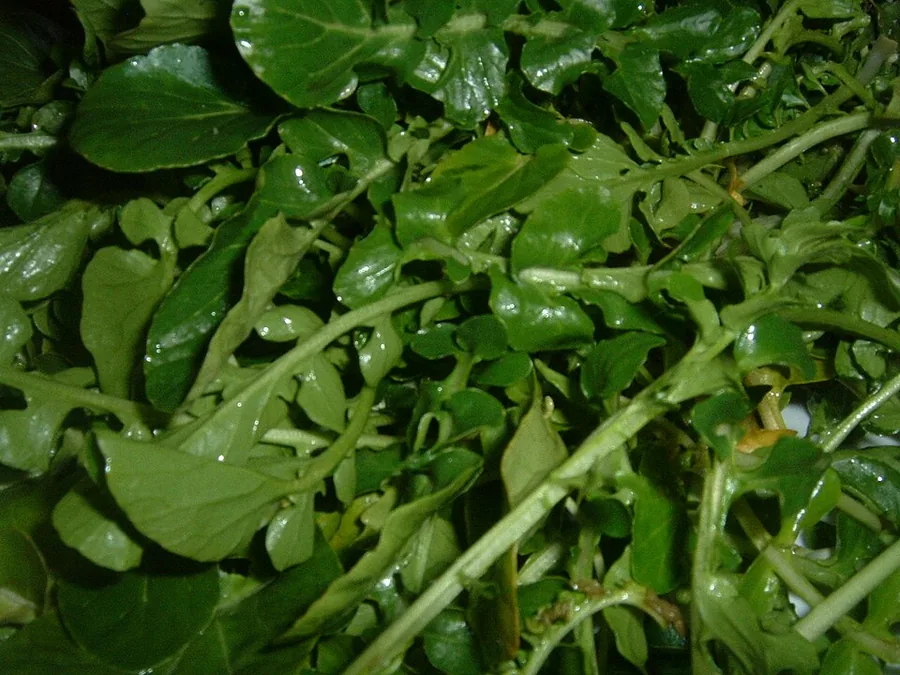
Watercress is a fast-growing aquatic member of the Brassicaceae, the mustard family that also holds cabbage and radish, and its peppery flavor comes from the same mustard-oil chemistry. Growers often confuse it with the climbing garden nasturtium, but the two are unrelated. In the wild it colonizes the margins of cool, clean streams throughout the temperate world.
Its defining requirement is a permanently saturated root zone. The roots perform best submerged in flowing spring water, where a constant current delivers oxygen and dissolved nutrients, though the plant will root equally into a muddy bank or a pot standing in a tray of water. Kept cool and moving, that water drives its fast growth.
Among edible crops it ranks as one of the least demanding, provided the water stays right. Frequent pinching of the shoots keeps the stand bushy and tender. Allow the water to warm or stagnate, however, and the plant bolts, the leaves turn bitter, and the mat thins.
Care
The short version: maintain cool, clean water at the roots at all times, provide full sun to part shade, and harvest often to hold the leaves tender and suppress flowering.
Light
Watercress accepts full sun to partial shade. Full sun maximizes photosynthesis and yield, yet a degree of afternoon shade in summer is worthwhile because it moderates both water and leaf temperature and delays bolting.
Water
This is the crop's controlling factor. The roots must remain submerged or in constantly saturated soil, since even brief drying kills them. Cool, clean, flowing or spring water is ideal because movement keeps it oxygenated; in a container, stand the pot in a tray of water and refresh it every 1 to 3 days to hold it cool, clean, and aerated.
Soil
Use rich, mucky loam at a water margin, or a soil-filled pot standing in water. It tolerates a broad pH range from 6.5 to 8.0 and favors the neutral-to-alkaline end, a preference that reflects its origin in limestone spring streams.
Temperature
As a cool-water species watercress performs between about 32°F to 77°F (0°C to 25°C). It withstands frost, but water temperatures much above that band trigger bolting and bitterness, so summer shade and cool water sustain leaf production.
Humidity
Being aquatic, it grows in very humid air, from 70% up to nearly 100%. The standing water at its roots evaporates and keeps the surrounding air moist on its own, so ambient humidity seldom needs managing.
Feeding
In clean flowing water the current supplies enough dissolved nutrients, so fertilizer is unnecessary. In a container, where still water cannot, apply a dilute balanced liquid feed monthly through spring and summer.
Pruning
Pinch and harvest the shoot tips often to maintain bushy, tender growth. Remove flower stalks as soon as they emerge, because flowering diverts the plant's energy, turns the leaves bitter, and signals the end of tender production.
Repotting
Lift and divide the mat about once a year, or sooner once the stems crowd and new growth slows. Stems creeping over the tray rim indicate the stand has outgrown its space.
Size & spacing
The plant stays low at 4 to 20 inches (10 to 50 cm) tall but spreads laterally into a mat 12 to 35 inches (30 to 90 cm) wide. Allow room for that spread, or thin the stand so water continues to circulate through it.
When to plant
Watercress is a cool-season crop that grows vigorously in spring and fall and declines under summer heat. Surface-sow seed in late winter to early spring, transplant after the risk of hard frost has passed, and harvest leaves from spring through fall, or year-round wherever the water stays cool and moving.
Northern hemisphere
Southern hemisphere
Typical months for a temperate climate: start earlier in warm zones, later where spring frosts linger.
- Sow: Late winter to early spring, surface-sown on constantly moist medium
- Plant: Spring after danger of hard frost, or fall in mild-winter regions
- Harvest: Harvest leaves spring through fall (year-round in mild flowing water); small white cross-shaped flowers appear late spring to summer
Hardiness
USDA hardiness zones: 4–10
Temperature: down to -34°C
Troubleshooting
Nearly every watercress disorder originates in the water or the ambient temperature. Warm, stagnant water and summer heat account for the majority, and the foliage registers the stress early. Identify the symptom below and correct the growing conditions before the entire mat declines.
Pale, chlorotic leaves on a declining mat
The cause is almost always warm, stagnant water. When the current stops, the water loses dissolved oxygen and warms, and the oldest leaves lose color first. Refresh or circulate the water to cool and aerate it, shift the plant into partial shade through summer, and, in container culture, correct the nitrogen shortfall with a dilute balanced fertilizer.
Fix:
- Refresh or circulate the water to keep it cool and oxygenated
- Move to partial shade during summer heat
- Apply a dilute balanced fertilizer when grown in containers
Flower stalks emerge and the foliage turns harsh and bitter
This is bolting, a heat-driven response. Once the water exceeds about 75°F (24°C), the plant initiates flower stalks, the leaves shrink, and the peppery flavor sharpens into bitterness. Pinch out the flowering stems, relocate the plant to shade and cooler water, and, where summer heat prevails, restart from stem cuttings once conditions cool.
Fix:
- Harvest and pinch out flowering stems
- Provide shade and cooler water
- Restart from stem cuttings in the cooler season
Distorted leaves with clustered insects or fine shot-holes
Two pests account for most of this damage. Aphids colonize the leaf undersides and distort new growth, while flea beetles chew the small round perforations that speckle a leaf like shot. Dislodge both with a strong jet of water, and prune out any shoots too heavily fed upon to recover.
Fix:
- Dislodge pests with a strong jet of water
- Remove and discard heavily infested shoots
Toxicity
On toxicity the record is clear: watercress is a food crop and poses no poisoning risk. It is safe for cats, dogs, horses, rabbits, livestock, birds, and people, with no toxin in any tissue. The single meaningful caution applies to people and concerns the water the cress grew in, not the plant.
Safe for
People · Cats · Dogs · Horses · Rabbits · Livestock · Birds
Cats None
Watercress is non-toxic to cats. An exploratory nibble causes no harm, though the peppery foliage rarely interests them for long.
Dogs None
It is safe for dogs, foliage and stems alike. A dog that consumes a large mouthful may develop mild, self-limiting gas, but nothing more serious.
Horses None
Horses can graze it without adverse effect. The pungent mustard tang generally deters them from eating much regardless.
Rabbits Safe
Rabbits can take watercress as part of a mixed green diet. Introduce it gradually, as with any new leafy vegetable, to let the digestive tract adjust.
Livestock Safe
Cattle, goats, and sheep browse watercress safely, as it contains no toxin capable of harming grazing stock.
Birds Safe
Poultry and other birds feed on the tender foliage without ill effect, and the greens supply a modest dietary variety.
People Safe
Watercress is a nutritious salad green eaten raw or cooked. The single genuine hazard concerns wild plants, since cress foraged from livestock-grazed water can carry liver fluke parasites; cook wild-harvested cress or grow your own in clean water before eating it raw.
Food-safety note for people (not pet toxicity): wild watercress from water that may be contaminated by grazing livestock can carry liver fluke (Fasciola) larvae and waterborne pathogens. Cook wild-harvested cress or grow it in clean, uncontaminated water before eating it raw.
Varieties
The watercress in cultivation is usually the wild species itself, but two named types merit attention.
Improved Broad Leaved
A cultivated selection developed for larger, broader leaves and higher yield than the wild type produces.
Nasturtium microphyllum (one-row, small-leaved watercress)
A closely related species with smaller leaves and seeds borne in a single row, which hybridizes readily with true watercress where their ranges overlap.
How to propagate
Watercress propagates with unusual ease, rooting readily from cut stems in water or germinating from seed scattered on damp ground.
Stem cuttingsEasy
Any time during active growth, best in spring or fall · 1 to 2 weeks
Stem cuttings are the fastest route and can be taken at any point in active growth, with spring and fall most reliable. Cut stems roughly 4 to 6 inches (10 to 15 cm) long and either stand them in water or insert them into wet soil, where they root from the nodes within 1 to 2 weeks.
SeedEasy
Spring, in cool moist conditions · 2 to 3 weeks to germinate and establish
Seed germinates well in the cool, moist conditions of spring. Sow the fine seed on the surface of a constantly moist medium rather than burying it, since it requires light and cannot be allowed to dry. Under cool temperatures it takes 2 to 3 weeks to germinate and establish.
Myths
Wild watercress is always safe to eat raw straight from the stream.
Cress drawn from water grazed by livestock can harbor liver fluke larvae and other waterborne pathogens invisible to the eye. The reliable safeguard is to cook wild-harvested cress, or cultivate your own in clean water, before consuming any of it raw.
Edible watercress is the same plant as the ornamental garden nasturtium.
The two share a peppery taste and a common name but nothing botanical. Edible watercress is Nasturtium officinale in the mustard family, whereas the climbing garden nasturtium is Tropaeolum majus, a genus in an entirely different family.
Watercress needs deep running water and cannot be grown at home.
Flowing spring water is optimal but not obligatory. A pot of rich soil standing in a tray of water, kept saturated and regularly refreshed, sustains a productive stand on a windowsill or patio.