Ornamental · Pontederiaceae
Water Hyacinth
Pontederia crassipes
A free-floating bloom whose buoyant petioles conceal one of the water garden's most aggressive spreaders.
Full sun
50–86°F · 10–30°C
USDA 9–11
6–9 in · 15–23 cm
Overview
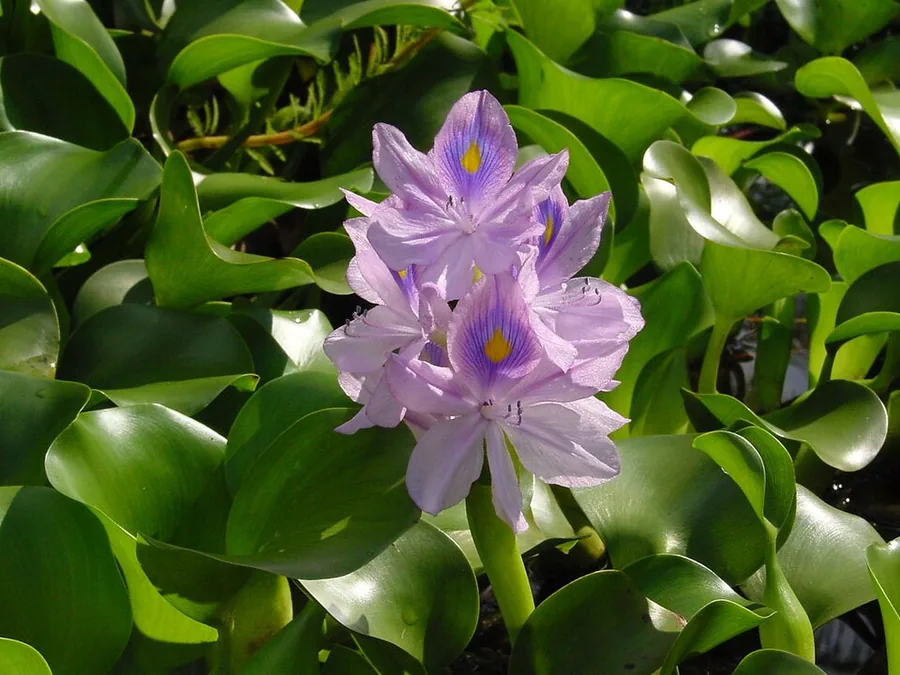
Water hyacinth is a free-floating aquatic native to South America, recognized by glossy leaves borne on inflated, spongy petioles whose air-filled tissue provides the buoyancy that keeps each rosette at the surface. Through summer it produces erect spikes of lavender blue flowers, each with a yellow eye. That ornamental appeal is what drove its worldwide distribution.
Cultivation is trivial because the plant is adapted to draw nutrients directly from the water column, so it needs neither soil nor a pot, only standing fresh water and full sun. The consequence of that efficiency is speed: under warm, sunlit, nutrient-rich conditions a stand can double in 6 to 18 days, closing over a water surface with little warning.
The same vegetative vigor makes it one of the world's most damaging aquatic weeds. In open water the mats it forms intercept light, suppress dissolved oxygen, and kill fish, which is the basis for the bans and regulations many states enforce. Confine it to a fully contained feature, thin it routinely, and ensure no fragment escapes to natural water.
Care
The short version: maintain it on standing fresh water in full sun above 50°F (10°C), thin the surface regularly, and prevent any escape into natural waterways.
Light
Provide full sun for maximum growth and flowering; partial sun is tolerated but suboptimal. Because photosynthetic rate governs its expansion, more light translates directly into faster proliferation and therefore more frequent thinning.
Water
Treat it as the free-floating aquatic it is, resident at the water surface and never potted in soil. On standing fresh water in full sun, the submerged roots absorb nutrients directly from the water. It should never be released into or near a natural waterway.
Soil
No substrate is used or needed. The roots dangle in the water column while the plant floats, taking up nutrients from water buffered between a pH of 6.0 and 8.0.
Temperature
Its functional range is 50°F to 86°F (10°C to 30°C), and genuine warmth is required for vigorous growth. Cold water suppresses metabolism and frost is lethal, so the plant cannot overwinter outdoors in cool climates.
Humidity
Sitting on open water, it exists in constant high humidity with unlimited access to moisture, so no target figure applies. Its immediate environment is the water body itself.
Feeding
Supplemental fertilizer is almost never warranted. The plant assimilates dissolved nutrients so efficiently that added fertilizer nearby simply accelerates its explosive growth, so maintaining low nutrient levels is the sounder strategy.
Pruning
Thin and physically remove surplus plants often to keep it from overrunning a contained water garden. Bag and compost the removed material on dry land, and never return a fragment to water, where even a small piece can re-establish.
Repotting
not applicable (free-floating, not potted)
Size & spacing
Individual rosettes reach only 6 to 9 inches (15 to 23 cm) in height, yet lateral spread runs 6 to 18 inches (15 to 46 cm) and continues to expand clonally. Planning should focus less on spacing and more on the recurrent removal that prevents a colony from consolidating into a mat.
When to plant
As a frost-intolerant warm-season species, it should be introduced only after the last spring frost, will flower through summer, and will be killed by the first autumn frost, since it does not persist outside zones 9 to 11.
Northern hemisphere
Southern hemisphere
Typical months for a temperate climate: start earlier in warm zones, later where spring frosts linger.
- Plant: After all danger of frost has passed in late spring, only into a fully contained water garden away from natural water
- Harvest: Summer (roughly June to September)
Hardiness
USDA hardiness zones: 9–11
Temperature: down to -7°C
Troubleshooting
Nearly every disorder in water hyacinth traces back to its own vigor rather than to disease. The entries below concern managing an unusually productive plant and keeping it out of habitats it can damage. Review them before establishing a stand.
A stand doubles within days and closes the surface
This reflects the explosive vegetative spread that defines the species. Under warm water, full sun, and surplus nutrients a population can double in 6 to 18 days as stolons generate daughter rosettes, and those rosettes interlock into a mat that seals the surface within days. Manage it by skimming and raking on a fixed schedule, lowering the nutrient load, and composting all removed material on dry land.
Fix:
- Physically skim and rake out plants repeatedly to keep the surface mostly open
- Reduce nutrient inputs to the water
- Bag and compost all removed plant material on dry land, never return any fragment to water
Closed mats degrade the entire water body
Once a mat consolidates, the ecological damage proceeds rapidly. Light interception kills submerged plants and phytoplankton, dissolved oxygen falls, and fish are stressed or die, while the same mat obstructs irrigation, flood control, and navigation. This is the reason it is kept away from natural or shared water, and why infestations of open waterways are referred to a state aquatic invasive species agency.
Fix:
- Never plant or release it where it can reach natural or shared water bodies
- Report infestations of natural waterways to your state aquatic invasive species or extension agency
- Remove and dispose of plants on dry land before mats establish
Ownership may be prohibited in your state
Because of its destructiveness, many states classify it as a prohibited or noxious aquatic weed, with statutes covering possession, sale, and transport. Florida lists it as a Noxious Weed and Class 1 Prohibited Aquatic Plant, and Texas prohibits possessing or transporting it entirely. Verify the status with your state department of agriculture or natural resources before acquisition, and substitute a legal aquatic ornamental where it is banned.
Fix:
- Confirm legality in your state before obtaining the plant
- Do not buy, sell, move, or transport it where it is regulated
- Dispose of any existing plants by composting on dry land
Foliage blackens and collapses after frost
Water hyacinth is frost-tender and does not persist through winter outside zones 9 to 11. With the onset of cold the leaves blacken, the plant collapses, and it decomposes into the water. In cold climates it is best treated as an annual, with the dead material lifted and composted on dry land before it fouls the water.
Fix:
- Treat it as an annual in cold climates
- Remove and compost dead material on dry land before it fouls the water
Toxicity
The ASPCA classifies water hyacinth as non-toxic, so its rank on the poison scale is low, but the tissue is not innocuous to chew. The foliage contains insoluble calcium oxalate crystals that mechanically irritate the mouth and digestive tract, producing mild drooling or gastric upset in most pets, livestock, and people who bite it. The plant's principal hazard is ecological rather than toxicological, given its standing as a notorious invasive that must never reach open water.
Toxic to
Cats · Dogs · Horses · Rabbits · Livestock · Birds · People
Cats Mild
A cat that bites the foliage may drool, paw at the mouth, and vomit as the oxalate crystals embed in and irritate the soft oral tissue. The response is generally mild and resolves once chewing stops.
Dogs Mild
Chewing the foliage typically produces drooling, oral irritation, and occasional vomiting or loose stool in dogs. Most reject it quickly, since the raphides render it unpalatable.
Horses Mild
The crystals can irritate a horse's mouth and gastrointestinal tract, so ingestion tends to cause mild drooling and stomach upset rather than serious injury.
Rabbits Mild
A rabbit that nibbles it may show oral irritation and a brief reduction in appetite. It should be kept off the diet in favor of greens known to be safe.
Livestock Mild
Cattle, goats, and sheep that browse the foliage can develop mild oral and gastrointestinal irritation from the oxalate. A more significant concern is that plants taken from polluted water may carry heavy metals and other contaminants.
Birds Mild
Birds seldom consume it, but a bird that chews the leaves can experience the same mild oral irritation. No part of the plant is a safe food to offer.
People Caution
The plant is not a food source, and biting the raw leaves or stems produces a burning, prickling sensation from the calcium oxalate. Children should be kept from chewing it, and no part should be treated as edible.
Chewing the oxalate-containing leaves can irritate the mouth and stomach; the plant can also accumulate heavy metals and other contaminants from polluted water. Keep pets and children from chewing it.
Helpline numbers

United States
ASPCA Animal Poison Control: (888) 426-4435 (fee applies)
Poison Control: (800) 222-1222


Canada
Poison Centres: 1-844-764-7669
Varieties
Only the wild species is in cultivation, as it has not been developed into ornamental cultivars. The single point worth clarifying is how to separate it from a frequently confused look-alike.
Pontederia crassipes (species)
What is cultivated is the wild species itself, since no meaningful ornamental cultivars have been selected, and it remains a banned or regulated noxious invasive across many states.
Water lettuce (Pistia stratiotes) - look-alike, not a variety
This is a distinct floating species frequently confused with water hyacinth, distinguished by its velvety, ribbed pale green rosettes and by lacking the inflated bulbous petioles and lavender blue flowers of the true plant.
How to propagate
Increasing this plant is never the difficulty; restraining it is. It reproduces vegetatively faster than nearly any other subject in the water garden, which is precisely why its movement is restricted.
DivisionEasy
Warm season (late spring through summer) · 1 to 2 weeks
Deliberate propagation is essentially unnecessary, because the plant reproduces on its own. Throughout the warm season it generates stolons and daughter plants and can double its population in 6 to 18 days, with each division establishing within a week or two. That reproductive rate is exactly why moving or spreading it is discouraged and illegal in many states, so no division should ever reach natural water.
SeedModerate
Warm season · Variable
It also produces seed during the warm season, with germination timing that varies. Seed functions as a secondary route alongside its dominant vegetative spread, yet it still contributes to the plant's dispersal.
Myths
Water hyacinth is merely a harmless, attractive floating pond plant.
The lavender flowers are genuinely attractive, yet the species ranks among the world's most damaging aquatic invasives and is regulated or banned in many states. Introduced to natural water, its mat-forming growth chokes entire waterways and eliminates the native plants and fish beneath. Never release it into or near open water, and dispose of all plants on dry land.