Houseplant · Cactaceae
Thanksgiving Cactus
Schlumbergera truncata
As a forest epiphyte, it responds to bright indirect light and cool fall nights by flowering on the holiday schedule.
Bright indirect
50–86°F · 10–30°C
USDA 10–12
4–20 in · 10–50 cm
Overview
Schlumbergera truncata is an epiphytic forest cactus from the coastal mountains of Brazil, where it anchors itself on tree branches rather than in open desert ground. That ecology explains its care: growing under a canopy, it evolved to take more water and softer light than a terrestrial desert cactus. Its reward for suitable conditions is a display of bright flowers in late fall, near Thanksgiving.
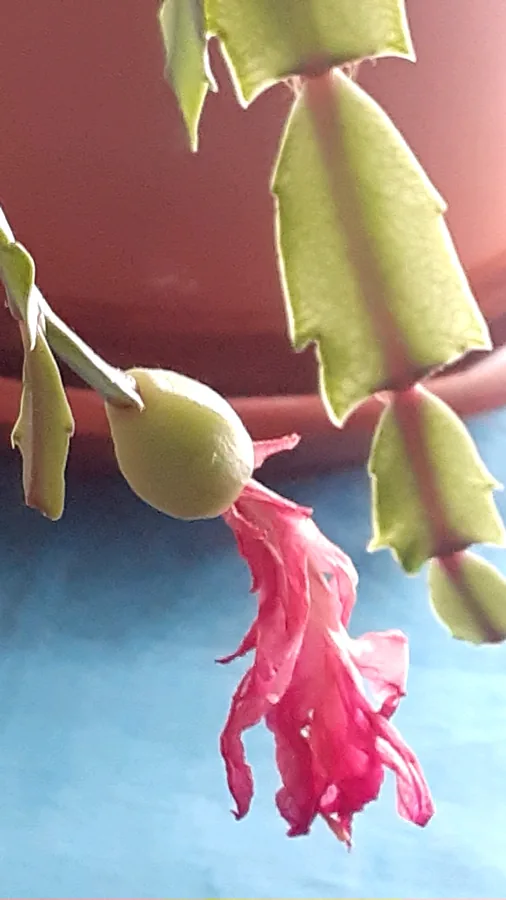
Identification rests on segment morphology. Each flat stem segment carries pointed, claw-like teeth along its margins, the trait behind the names crab cactus and claw cactus. The true Christmas cactus, Schlumbergera × buckleyi, instead bears rounded, scalloped segments and flowers roughly a month later. In commerce the two are routinely confused, and most stock sold as Christmas cactus is in fact this species.
This is an easy, long-lived cactus that persists for decades and flowers more freely with maturity. Two requirements govern its performance: environmental stability once buds have formed, and the cool nights and shortening autumn photoperiod that induce those buds. Meet both and the plant tolerates lapses elsewhere.
Care
The short version: bright indirect light, irrigation once the upper mix has dried, and a period of cool fall nights to induce flowering. A slightly potbound root system favors bloom, so resist repotting, and hold the plant still once buds set.
Light
Provide bright, indirect light, which matches the filtered exposure of its canopy habitat; direct sun is unnecessary and damaging. It tolerates partial shade or mild sun, but intense midday radiation bleaches the segments to pale or red. An east or north aspect delivers the right intensity.
Water
Allow the upper half of the mix to dry, then irrigate thoroughly. Its epiphytic origin means it needs more moisture than a desert cactus yet cannot tolerate saturation, which rots the roots. After buds set, maintain even moisture, since a dry spell at that stage triggers bud drop.
Soil
Use a well-drained, organic-rich potting mix of the epiphytic type, formulated to shed excess water quickly while retaining some moisture at the root. Aim for a slightly acidic reaction, pH 5.5 to 6.5.
Temperature
The species is comfortable across 50°F to 86°F (10°C to 30°C). The horticulturally important detail is seasonal: a run of cool nights combined with short days is the photoperiodic and thermal cue that initiates bud formation.
Humidity
Average indoor humidity meets its needs, so no target value applies. Slightly raised humidity assists newly struck cuttings during rooting, but an established specimen requires no supplementation.
Feeding
Apply a dilute balanced houseplant fertilizer monthly through spring and summer, then withhold feed in late summer; the check to growth helps direct the plant into fall flowering. It has an above-average magnesium demand, which an occasional Epsom-salt solution satisfies.
Pruning
Once flowering ends, pinch or twist off a few stem segments. Removing terminal segments stimulates lateral branching, which over time produces a denser, bushier habit.
Repotting
Repot only every 3 to 4 years, because a mildly constrained root system promotes flowering. Move up a pot size when roots emerge from the drainage holes, water passes straight through, or growth stalls.
Size & spacing
Growth is compact, reaching about 4 to 20 inches (10 to 50 cm) in both height and spread. One specimen occupies a hanging basket, or a pot on a windowsill, without encroaching on neighboring plants.
Troubleshooting
Nearly all disorders in this species present as bud abscission or as soft, discolored stems, and both derive from irrigation and siting. Identify the symptom below, then correct the underlying condition before damage advances.
Basal stems soft, mushy, and darkening
Soft, blackening basal tissue indicates root rot driven by a persistently wet medium. Excise the rotted segments and any brown, softened roots, repot into a fast-draining epiphytic mix, and reduce irrigation. Management is preventive: let the surface of the mix dry between waterings so the roots are never left saturated.
Fix:
- Reduce watering frequency
- Repot into a fast-draining epiphytic mix
- Remove rotted segments and affected roots
Buds abort and drop before opening
Bud drop is an abscission response to environmental change. After buds form, the plant demands a fixed location, consistent moisture, and freedom from drafts and thermal fluctuation. Relocating it, even to display the flowers, commonly causes the buds to fall within days, so it should remain in place until anthesis.
Fix:
- Keep the plant in one stable spot once buds form
- Keep the mix evenly moist (not soggy) while in bud
- Avoid drafts and temperature swings
Segments fading to pale yellow or red
Pale yellow or reddish segments signal excess direct sun, most pronounced in a hot, bright window over the summer months. Relocate the plant to bright indirect light and shade it from direct midday radiation. Pigmentation normalizes once the exposure is corrected.
Fix:
- Move to bright indirect light
- Shade from hot midday summer sun
Toxicity
For households with animals, the assessment is straightforward: Schlumbergera is non-toxic to cats, dogs, horses, and people, a status the ASPCA confirms. The single qualification is mechanical rather than chemical, since a large volume of fibrous stem tissue can provoke a brief, mild gastrointestinal upset.
Safe for
People · Cats · Dogs · Horses · Rabbits · Livestock · Birds
Cats None
Non-toxic to cats; neither stems nor flowers contain a harmful compound. Ingestion of a large amount of the fibrous segments may cause transient drooling or vomiting, which resolves without treatment.
Dogs None
No toxic principle affects dogs. The likely outcome of eating a large quantity of the chewy stems is a brief episode of mild gastrointestinal upset.
Horses Safe
The ASPCA also lists it as safe for horses. An incidental taste presents no meaningful hazard.
Rabbits Safe
Rabbits are unaffected by the plant. As with any high-fiber green, a large intake may loosen the stool for a day.
Livestock Safe
Grazing stock encounter no toxin in the stems or flowers. Consuming a large volume of the fibrous segments may produce a short, mild digestive disturbance and nothing further.
Birds Safe
Pet birds are safe in its presence, as the plant contains no poisonous tissue.
People Safe
Safe for people, including young children. It is not a culinary plant, and the fibrous stems are simply unpalatable rather than harmful.
Varieties
Cultivated Schlumbergera spans a range of flower colors alongside a few closely allied forms. The selections below are those most often encountered.
'White Christmas'
A truncata cultivar selected for pure white flowers in place of the more common pinks and reds.
'Cambridge'
A truncata cultivar valued for warm blooms grading from pink through to orange.
Schlumbergera × buckleyi
The authentic Christmas cactus, a hybrid distinguished by rounded, scalloped segments and a bloom that trails the Thanksgiving type by roughly a month.
How to propagate
Vegetative propagation from stem segments is among the most reliable methods in cultivation, and a single segment cutting develops into a complete plant with minimal intervention.
Stem cuttingsEasy
Late spring to early summer (May-June) · Roots in about 3-8 weeks
Take stem cuttings in late spring to early summer, around May or June, during active growth. Detach a section of 3 to 5 jointed segments, allow the cut surface to callus for a day or two, then insert it into a moist, well-drained medium held under humid conditions. Roots develop over 3 to 8 weeks, yielding an independent plant.
Myths
A plant sold as Christmas cactus is necessarily the true species.
The great majority of holiday cactus in trade is Schlumbergera truncata, the Thanksgiving or crab cactus. Two diagnostic traits confirm it: the pointed, claw-like teeth along each segment and a late-fall bloom that precedes the true Christmas cactus by about a month.
Holiday cactus is toxic to pets.
The ASPCA classifies Schlumbergera as non-toxic to cats, dogs, and horses. Any effect is limited to a brief, mild digestive upset, and only after a pet consumes a substantial quantity of stem tissue.