Vegetable · Convolvulaceae
Sweet Potato
Ipomoea batatas
Given full sun, sustained warmth, and a long season, Ipomoea batatas channels its energy into swelling storage roots.
Full sun
Every 5–7 days
64–95°F · 18–35°C
90–120 days
Overview
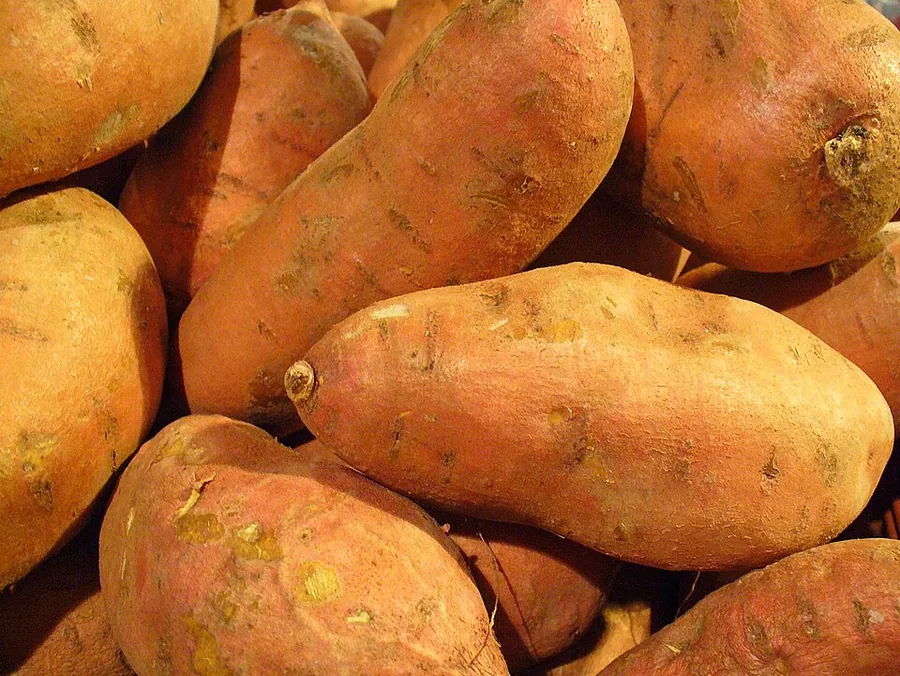
Ipomoea batatas is a heat-loving perennial vine grown for the storage roots it swells below the soil surface. Its membership in the morning glory family, not the nightshade family that holds the Irish potato, sets it apart botanically despite a shared common name. Over a long, warm season the sprawling canopy expands to cover a bed while the roots enlarge underground.
Once established the crop demands little intervention. The trailing stems extend 3 to 15 feet (90 cm to 4.5 m), shading the soil and suppressing weeds as they run, while the harvestable roots bulk out of sight beneath. The young leaves and shoot tips are also edible, prepared as a cooked green much like spinach across much of the tropics.
Warmth governs everything about its performance. Growth stalls in cold soil and the plant is killed outright by frost, so a warm bed and an extended warm season are prerequisites for the roots to reach size. Patience through that period is the grower's main task.
Care
The short version: site the crop in full sun on loose, well-drained soil ridged for drainage, supply roughly 1 inch of water a week and taper it toward harvest, and apply only a light low-nitrogen feed so the plant directs growth into root fill rather than foliage.
Light
Full sun, on the order of six to eight hours daily, drives the vegetative growth that in turn supplies the roots, so full sun is the baseline. The plant tolerates light afternoon shade, but reduced light means less canopy and a smaller yield below ground.
Water
Deliver about 1 inch of water a week in deep soakings and allow the surface to dry between them, which encourages roots to draw from lower in the profile. Reduce watering as harvest nears, since a heavy drink after drought drives rapid expansion that splits the roots.
Soil
Use loose, well-drained loamy or sandy soil, and ridge it so the enlarging roots have room to form and are never waterlogged. The crop performs best at a mildly acidic pH of 5.5 to 6.5.
Temperature
As a tropical species it requires sustained heat, roughly 64°F to 95°F (18°C to 35°C), to grow actively. Cold soil suspends development and frost is lethal, which is why transplanting is held until spring soil has warmed.
Humidity
Ambient summer humidity in the 40% to 70% band is sufficient, and outdoors it is not a factor a grower manages. Heat and light govern this crop far more than atmospheric moisture.
Feeding
Fertility should be modest. Incorporate a low-nitrogen fertilizer such as 5-10-10 before planting and sidedress once before the canopy closes over the row. Excess nitrogen promotes foliage at the expense of the roots, which is the opposite of the goal.
Pruning
Root production requires no pruning. Vines are cut only to contain the bed or check spread, and the removed tender shoot tips are usefully cooked as greens rather than discarded.
Size & spacing
Above ground the plants remain low, 6 to 12 inches (15 to 30 cm), while the stems trail 3 to 15 feet (90 cm to 4.5 m). Allow each plant ground to run, or redirect the vines to prevent them overrunning adjacent plantings.
When to plant
This crop is governed by heat and has no frost tolerance, which fixes its schedule. Sprout slips indoors from a stored root in late winter, transplant only after spring has warmed the soil, and lift the roots in fall ahead of the first frost. Working inside those temperature limits, not the calendar, is what protects the harvest.
Northern hemisphere
Southern hemisphere
Typical months for a temperate climate: start earlier in warm zones, later where spring frosts linger.
- Sow: Sprout slips from a stored root indoors 6-8 weeks before transplanting
- Plant: After all danger of frost once soil is warm, roughly April through early July
- Harvest: Harvest storage roots in fall before the first frost
Hardiness
USDA hardiness zones: 9–11
Temperature: down to -7°C
Troubleshooting
Because the harvested organ develops underground, most sweet potato problems remain hidden until lifting and present on the roots themselves. A short list of pests and a single fungus account for nearly all of it, so identifying them lets a grower produce clean roots season after season. Match the symptom below, then address it before the next planting.
Stem-end punctures over frass-filled, bitter tunnels
The cause is the sweetpotato weevil, the most damaging pest of the crop. Adults feed at small punctures near the stem end and their larvae mine the flesh, and the frass-packed tunnels darken the tissue and render it bitter. Lift and destroy all infested roots and vines, and exclude that material from next season's slip production.
Fix:
- Remove and destroy infested roots and vines
- Do not save infested material for propagation
Deep ragged cavities excavated in the roots
Wireworms, the larvae of click beetles, excavate shallow pits that deepen into ragged cavities as the roots enlarge. Their populations build in recently grassed ground, so beds following sod are high risk. Harvesting promptly once roots reach size limits the duration of feeding.
Fix:
- Harvest promptly once mature to limit feeding time
- Avoid planting in recently turned sod
Enlarging dark lesions confined to the root skin
Scurf, a fungus, discolors the periderm without penetrating deeper. Its dark lesions enlarge and coalesce, yet the underlying flesh remains sound and edible. Because the pathogen is introduced on infected planting stock, cull the worst roots and raise the following crop only from clean, disease-free slips.
Fix:
- Discard heavily affected roots
- Start next crop only from clean, disease-free slips
Toxicity
On safety the record is unambiguous: the sweet potato is non-toxic to people and animals. The ASPCA classifies the vine as non-toxic to cats, dogs, and horses, and both the cooked storage root and the tender greens are eaten. No part of the plant requires restriction in the home.
Safe for
People · Cats · Dogs · Horses · Rabbits · Livestock · Birds
Cats None
Non-toxic to cats. Ingestion of the vine will not poison the animal, though a large volume of any foliage may provoke transient drooling or mild gastrointestinal upset.
Dogs None
No toxic principle is present, and cooked sweet potato is a routine ingredient in canine diets. Portions should stay moderate, as a large intake of fibrous root or vine can loosen the stool.
Horses None
Grazing the foliage carries no risk of poisoning. As with any rich new feed, it should be introduced gradually to allow the digestive system to adapt.
Rabbits Safe
The leaves and vine tips are safe forage and small amounts of cooked root are acceptable. Quantities should be limited, since a large starchy load can disturb a rabbit's sensitive gut.
Livestock Safe
Cattle, goats, and sheep consume the vines and roots without injury, and the foliage is cultivated as fodder in many regions. Ample clean water and a gradual dietary transition keep digestion settled.
Birds Safe
Chickens and other poultry take cooked root and chopped greens without hazard. It is best offered within a varied diet rather than as the sole feed.
People Safe
For people the cooked root is a nutritious staple, and the young leaves and shoots are eaten as a cooked green. Consumption is unrestricted, with the caveat that the raw root is difficult to digest in quantity.
Although non-toxic, eating large amounts of any plant material can cause mild stomach upset in pets.
Varieties
Hundreds of cultivars exist, yet a small set of orange-fleshed selections dominates home gardens. The three below are the ones most worth recognizing.
Beauregard
A widely grown orange-fleshed cultivar selected for high yield and a maturity earlier than most.
Covington
An NC State release combining rose skin with orange flesh and producing uniform, dependably sweet roots.
Georgia Jet
A rapid orange-fleshed cultivar suited to shorter, cooler seasons in which later types fail to finish.
How to propagate
Sweet potato is not raised from seed in garden practice. Propagation runs through slips, the shoots that arise from a single stored root, so one tuber yields many genetically identical plants for a full bed.
Stem cuttingsEasy
Spring, after the soil has warmed and frost danger has passed · 2 to 3 weeks
Propagation is by slips, rooted shoots taken from a stored root once it begins to sprout. Planted as cuttings after spring soil has warmed and frost has passed, the slips establish and root within 2 to 3 weeks.
Myths
The entire sweet potato plant is poisonous by association with the toxic morning glories.
In practice the storage roots and cooked leaves of the edible sweet potato are consumed worldwide, and the ASPCA classifies the plant as non-toxic. The misconception derives from the seeds of certain ornamental morning glories, which are separate Ipomoea species with different properties.
Sweet potato and the common Irish potato are the same kind of plant.
The two are not closely related. Sweet potato is a vining member of the morning glory family whose roots enlarge into storage organs, whereas the Irish potato belongs to the nightshade family and produces tubers on underground stems.