Ornamental · Convolvulaceae
Ornamental Sweet Potato Vine
Ipomoea batatas
Supply full sun, warm soil, and consistent moisture and this fast growing vine carpets beds and containers in foliage color for the whole season.
Full sun
Every 2–5 days
50–95°F · 10–35°C
USDA 9–11
Overview
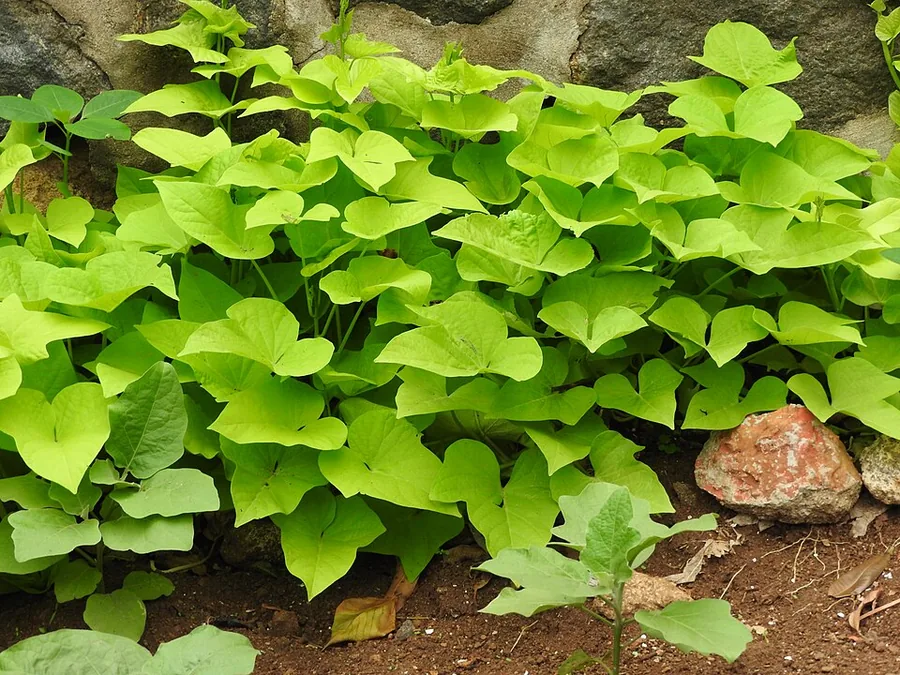
Ornamental sweet potato vine is cultivated for its foliage, not its storage roots. It is the same species as the edible crop, Ipomoea batatas, selected instead for bold foliage ranging from chartreuse to a near-black purple. Placed in a bed or container, it cascades over the margins quickly and forms a low, dense mat of color.
Being tender, it has no frost tolerance. It performs as a perennial across hardiness zones 9 to 11 and is grown as an annual in colder regions, breaking into rapid growth once soil temperatures rise and collapsing at the first hard freeze. A single plant can extend 8 to 10 feet (2.4 to 3 m) wide while remaining only inches tall, a prostrate habit that suits it to trailing over walls and container rims.
Its requirements are modest. Supplied with sun, warm soil, and consistent moisture, it grows so vigorously that containing it becomes the principal task. Flowering is sporadic, producing pale pink to violet funnel-shaped blooms, but the foliage is the whole point of the plant.
Care
The short version: full sun to light shade, evenly moist soil rich in organic matter, and warmth above frost. Feed it through the season, cut it back whenever it exceeds its space, and grow it as an annual where winters are severe.
Light
Site it in full sun to develop the deepest pigmentation in the leaves, though it accepts partial shade without harm. The dark-leaved selections rely on strong light to hold their color and shift greener as light drops, because the anthocyanin display depends on it.
Water
Consistent moisture drives the strongest growth, so keep the soil evenly moist, yet an established plant tolerates a dry interval once its roots are down. Containers lose water fastest and will wilt as a clear watering cue, so inspect pots in full sun every couple of days through summer.
Soil
Grow it in loamy, well-draining soil enriched with organic matter, which supplies both nutrition and structure. A slightly acidic pH of 5.5 to 6.5 suits it, and free drainage keeps the roots from standing in water.
Temperature
Growth runs best in the range of 50°F to 95°F (10°C to 35°C) and slows in the cold, since this is a warm-season species. Frost destroys the top growth outright, so it cannot remain outdoors through a freeze.
Humidity
Average outdoor humidity meets its needs, and no target figure applies. It tolerates muggy summer air, but moving air across the foliage helps because it shortens the leaf-wetness period that fungi exploit.
Feeding
Apply a balanced water-soluble fertilizer every two weeks through the growing season to sustain foliage production, since the fast growth draws steadily on nutrients. A high-phosphorus starter at transplanting supports early root establishment.
Pruning
Cut the vines back anytime in the growing season to check the spread and keep beds or containers in bounds. It tolerates hard cutting back and regrows readily, so pruning carries little risk to the plant.
Size & spacing
Expect a low mound of only 6 to 12 inches (15 to 30 cm) in height that spreads 8 to 10 feet (2.4 to 3 m) across. Allow room for that spread or plan to prune, because one plant covers a large area within a single season.
When to plant
This vine depends on warmth and is killed by the first frost, so timing follows soil temperature rather than the calendar alone. Start tubers or cuttings indoors a few weeks before the last frost, transplant once the soil has warmed in late spring, and allow the plants to run until cold weather ends the season.
Northern hemisphere
Southern hemisphere
Typical months for a temperate climate: start earlier in warm zones, later where spring frosts linger.
- Sow: Not typically started from seed; start tubers or root stem cuttings indoors 4 to 6 weeks before the last frost.
- Plant: Set out plants after all danger of frost has passed and soil has warmed in late spring.
- Harvest: Grown for foliage; rarely flowers (pale pink to violet funnel-shaped blooms). Tubers can be dug in fall before first frost.
Hardiness
USDA hardiness zones: 9–11
Temperature: down to -7°C
Troubleshooting
Problems on this vine register on the foliage first, whether the cause is water stress, a fungus, or a chewing insect. Most are cosmetic and simple to prevent. Match the symptom below to its cause and intervene before it advances.
Leaf spots and expanding blotches marring the foliage
These lesions point to fungal leaf diseases, which build up when the vine is replanted into the same ground year after year and inoculum carries over. Dense, humid foliage holds moisture on the leaf surface long enough for spores to germinate. Remove the affected leaves, thin the planting to speed drying, and rotate to fresh ground the following season.
Fix:
- Remove and discard affected foliage
- Improve air circulation and avoid overhead watering
Leaves going limp on a hot afternoon
This is drought stress rather than disease, and it appears soonest in containers that heat up in full sun. Transpiration outpaces the water the soil can supply, so the leaves lose turgor and go limp. Irrigate deeply until water exits the drainage holes, and raise watering frequency on containers through the peak heat of summer.
Fix:
- Water thoroughly until it drains from the bottom
- Increase watering frequency for containers in full sun
Chewed holes and fine stippling across the leaf surface
Flea beetles, thrips, and slugs all feed on this foliage, and each leaves a signature: chewed holes from beetles, fine stippling where thrips rasp the surface, and slime trails from slugs. The damage is largely cosmetic on an established vine. Hand-pick or trap slugs, monitor and treat beetles and thrips, and clear the leaf litter that shelters all three between feedings.
Fix:
- Hand-pick or trap slugs
- Monitor and treat flea beetle and thrips populations as needed
Toxicity
Pet owners can rest easy, because this vine is safe. The ASPCA classifies Ipomoea batatas as non-toxic to cats, dogs, and horses, and it presents no hazard to rabbits, livestock, birds, or people. The tubers are even edible, though blander than cultivars bred for the table.
Safe for
People · Cats · Dogs · Horses · Rabbits · Livestock · Birds
Cats None
Non-toxic to cats. The ASPCA classifies Ipomoea batatas as safe, so an exploratory nibble will not poison them.
Dogs None
The species carries no toxic compounds, and the ASPCA clears it for dogs. A dog that chews a trailing stem takes no harm.
Horses None
Horses may graze near it without effect, since the ASPCA rates the plant non-toxic to them.
Rabbits Safe
The leaves and stems hold nothing that threatens rabbits, so an incidental bite carries no risk.
Livestock Safe
Cattle, goats, and sheep can occupy the same ground without risk, as the foliage contains none of the toxins that concern producers.
Birds Safe
Pet and backyard birds are unaffected. The plant contains no compounds capable of harming them.
People Safe
Safe to handle and to grow around children. The tubers are in fact edible, though less palatable than cultivars selected for the kitchen.
Varieties
Selection turns mainly on leaf color and shape. The cultivars below are the ones encountered most often.
Blackie
Bears deeply lobed leaves in a purple so dark that it reads as near-black across a planting.
Margarita
Contributes bright chartreuse-green heart-shaped foliage that lifts the tone of a bed.
Sweet Caroline Group
Offers green, red, or dark purple selections with divided or heart-shaped leaves, allowing a match to almost any scheme.
Tricolor
Presents variegated green foliage marked with pink and white.
How to propagate
This vine propagates with little effort, either from stem cuttings of an existing plant or by dividing its stored tubers in spring.
Stem cuttingsEasy
Take 8 to 10 inch cuttings from vigorously growing terminal or middle vine sections in the warm growing season. · Roots typically develop in about 4 to 5 weeks.
Vegetative cuttings root readily and are the most reliable way to increase this vine. In the warmth of the growing season, when active growth favors rooting, take 8 to 10 inch pieces from the terminal or middle sections of a healthy vine and set them in water or moist soil, where roots emerge in about 4 to 5 weeks. Hold the rooted cuttings until the danger of frost has passed before transplanting them outdoors.
DivisionEasy
In spring after last frost, divide stored tubers into sections. · Several weeks to sprout and establish.
Stored tubers can also be divided in spring once the last frost has cleared. Cut each tuber so that every section keeps at least one eye, since each eye is a growth point that produces new shoots, then plant the divisions outdoors. Expect several weeks before they sprout and establish.
Myths
Because it belongs to the morning glory family, sweet potato vine must be toxic to cats and dogs.
The ASPCA classifies Ipomoea batatas as non-toxic to cats, dogs, and horses. The toxic-seed concern actually applies to the ornamental morning glories, Ipomoea tricolor and I. violacea, whose seeds contain LSA and other indole alkaloids. Sweet potato vine shares the family name, not the danger.
Tubers produced by the ornamental cultivars cannot be eaten.
The tubers of the ornamental cultivars are in fact edible. They simply taste blander than selections bred for eating, which is why these plants are grown for foliage rather than flavor.