Ornamental · Convolvulaceae
Morning Glory
Ipomoea purpurea
Sow a few scarified seeds at the base of a trellis and morning glory clothes it in trumpets by late summer.
Full sun
Every 5–10 days
50–95°F · 10–35°C
65–110 days
Overview
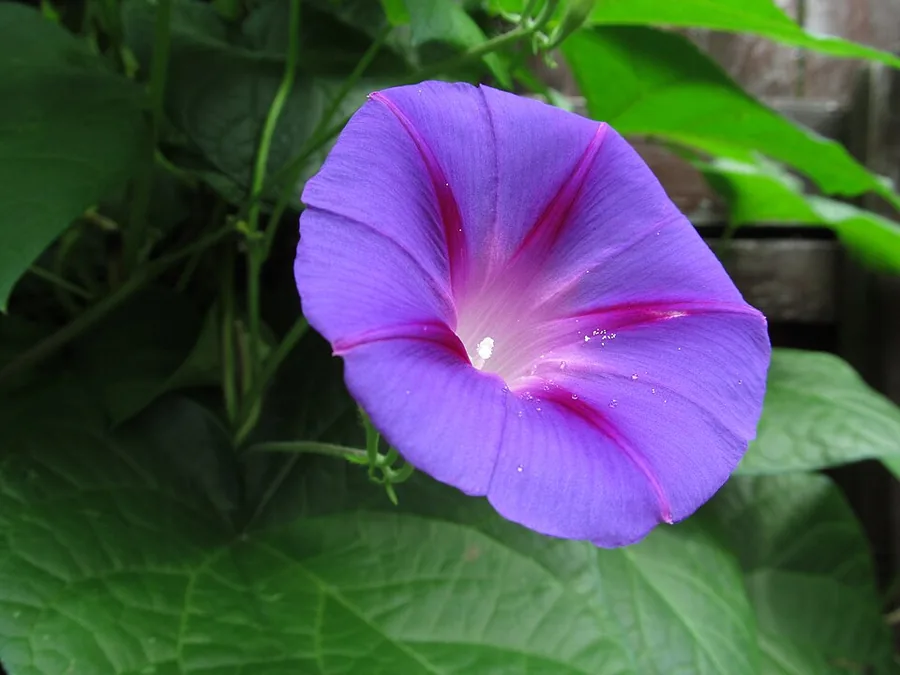
Morning glory is a fast twining annual vine whose flowers open at dawn and senesce by afternoon. Native to the warmer Americas, it ascends any available support, from a mailbox post to a chain-link fence, and a single season's growth reaches 6 to 10 feet. Sky-blue is the reference form, but purple, wine-red, white, and striped selections exist as well.
Its cultural requirements are minimal. Full sun, lean soil, and a climbing structure cover most of them, and fertile ground is counterproductive because it shifts the plant toward foliage at the expense of flowers. The one caveat is its reproductive vigor: the same growth rate that fills a trellis quickly leads to persistent volunteers for years when pods are allowed to shatter.
Two considerations precede planting. The seed contains toxic alkaloids that make it dangerous to pets, livestock, and anyone who ingests it as food. And although this ornamental annual is far less problematic than the perennial field bindweed, several Ipomoea species hold noxious-weed status, so confirm the local listing before sowing in a new region.
Care
The short version: site it in full sun and lean, well-drained soil, water once the top half dries, provide a trellis for support, and withhold fertilizer so the plant produces flowers rather than dense foliage.
Light
Provide full sun, defined as 6 or more hours of direct light daily. The vine tolerates partial shade and will still climb, but flower production falls sharply because bud initiation depends on sun and heat.
Water
Allow the top half of the soil to dry between irrigations, then water deeply, which corresponds to roughly every 5 to 10 days. Established plants are fairly drought tolerant, and saturated soil is more damaging than a short dry interval.
Soil
Lean substrate suits it best. Use average to poor, well-drained sandy soil across a pH of 5.5 to 8.0, and avoid amendment, since fertile soil promotes leaf growth at the expense of flowering.
Temperature
As a warm-season plant, morning glory performs between about 50°F to 95°F (10°C to 35°C). It has no frost tolerance, so delay transplanting until the cold has fully passed.
Humidity
Ambient outdoor humidity meets its needs, so no set point applies. Hot, dry air is more consequential as a spider-mite trigger than as direct stress on the vine.
Feeding
This plant is best left unfed. Withhold fertilizer, or apply only a low-nitrogen feed if any, because rich soil and surplus nitrogen yield vigorous vines with minimal bloom.
Pruning
Pinch young tips to promote branching, and cut back whenever the vine exceeds its allotted space. Remove the spent seed pods to limit self-sowing across the garden.
Repotting
Grown as an annual from fresh seed each season, morning glory requires no repotting. Establish it where it is meant to climb and let it complete its cycle.
Size & spacing
Anticipate a vine of 6 to 10 feet (1.8 to 3 m) within one season, spreading 3 to 6 feet (90 to 180 cm). Supply a sturdy trellis, string, or fence and adequate room for the twining stems.
When to plant
Morning glory is frost-sensitive and requires warmth to grow, so timing follows temperature rather than the calendar. Start seed indoors in early spring or sow it into warm soil after the cold has passed, and the vine flowers from midsummer to fall frost.
Northern hemisphere
Southern hemisphere
Typical months for a temperate climate: start earlier in warm zones, later where spring frosts linger.
- Sow: 6-8 weeks before last spring frost; scarify and soak seed 12-24 hours
- Plant: 1-2 weeks after last spring frost when soil is warm; or direct sow after frost
- Harvest: midsummer to fall frost (about June to October)
Hardiness
USDA hardiness zones: 2–11
Temperature: down to -46°C
Troubleshooting
Most morning glory issues reduce to poor flowering, excessive self-seeding, or infestation by mites and aphids. Identify the case below and intervene early, particularly with self-seeding, which is far more tractable to prevent than to reverse.
Heavy foliage with few or no blooms
This is a classic fertility imbalance: excess nitrogen and rich soil drive vegetative growth, so the vine invests in leaves and stems rather than setting buds. Flowering in this species is also sun-dependent, and anything under 6 hours of direct light suppresses it further. Withhold fertilizer, secure full sun, and allow immature plants to reach their midsummer flowering window.
Fix:
- Stop fertilizing and avoid nitrogen-rich amendments
- Move or grow in full sun (6+ hours)
- Be patient; blooms typically start midsummer and continue to frost
Volunteer seedlings emerging the next season
Morning glory is a prolific self-seeder, and pods that dehisce release seed across the surrounding soil, where it overwinters and germinates the following spring. The volunteers are recognizable by their heart-shaped cotyledons and juvenile leaves near the previous planting. Remove them while young and easily lifted, and cut spent pods before they mature to interrupt the seed cycle.
Fix:
- Pull unwanted seedlings while young
- Remove and discard spent seed pods before they shatter
- Deadhead flowers before seed set in areas where weediness is a concern
Stippling and webbing on the foliage
Fine webbing with a stippled, chlorotic surface indicates spider mites, which reproduce fastest under hot, dry conditions that also stress the plant. Aphids concentrate on soft new growth, and leaf miners tunnel serpentine mines within the leaf tissue. A forceful water spray dislodges mites and aphids mechanically, insecticidal soap addresses persistent populations, and consistent watering reduces the drought stress that favors mites.
Fix:
- Spray plants with a strong jet of water to dislodge mites and aphids
- Treat persistent infestations with insecticidal soap or horticultural oil
- Remove heavily mined or chewed leaves
Toxicity
This species is unsuited to households where curious pets or small children have unsupervised access. The seed is the primary hazard, containing LSA alkaloids that produce gastrointestinal upset and hallucinations on ingestion, with the foliage a milder concern. Store seed packets and dropped pods well beyond reach.
Toxic to
Cats · Dogs · Horses · Rabbits · Livestock · Birds · People
Cats Moderate
Leaf ingestion typically produces drooling and vomiting from gastric irritation. The greater concern is the seed, whose LSA alkaloids act on the nervous system to leave a cat agitated, ataxic, and disoriented.
Dogs Moderate
Chewing the foliage generally causes gastrointestinal upset and vomiting. Once a dog consumes a quantity of seed, the alkaloids take effect, producing tremors, restlessness, and a drunken, stumbling gait.
Horses Moderate
Grazing the vine irritates the gut and leaves a horse dull and off form. A larger seed dose advances into neurologic signs, with twitching and a dazed, hallucinatory state.
Rabbits Moderate
The seed alkaloids that affect cats and dogs act on rabbits by the same route, so exposure should be prevented entirely. Anorexia, a hunched posture, and unsteadiness are the signs to watch for.
Livestock Moderate
Cattle, sheep, and goats seldom select it, but ingestion of seed-laden vine can produce colic and agitated behavior. Remove volunteer morning glory from pasture fencing within reach of stock.
Birds Caution
Regard morning glory as unsuitable for pet birds. The seed carries the highest alkaloid concentration, so packets and dropped pods should be kept clear of cages and aviaries.
People Caution
No part of the plant is intended for consumption. The seed is genuinely hazardous, containing LSA alkaloids that induce nausea and hallucinations, so it must be kept from children and never handled as food.
Keep seed packets and dropped seeds away from pets and children; the seeds are sometimes abused for their hallucinogenic alkaloids.
Helpline numbers

United States
ASPCA Animal Poison Control: (888) 426-4435 (fee applies)
Poison Control: (800) 222-1222



Canada
Poison Centres: 1-844-764-7669
Varieties
Morning glory spans a broad color range along with several closely allied vines worth recognizing. The following are the selections most commonly encountered.
Heavenly Blue (Ipomoea tricolor)
The most recognized selection, bearing clear sky-blue trumpets that open from a pale white and yellow throat.
Grandpa Ott's
A deep-purple heirloom distinguished by a reddish-magenta star radiating up the center of each bloom.
Scarlett O'Hara
Notable for rich wine-red to scarlet flowers that depart from the more common blues and purples.
Flying Saucers / Pearly Gates (Ipomoea tricolor)
A complementary pair in which Flying Saucers presents swirled blue and white while Pearly Gates blooms pure white.
Moonflower (Ipomoea alba)
A night-flowering relative whose large white flowers open in the evening and emit a sweet fragrance.
Cardinal climber / Cypress vine (Ipomoea × multifida / Ipomoea quamoclit)
Allied vines cultivated for their finely divided, fern-cut foliage and small red star-shaped flowers.
How to propagate
Morning glory is raised from seed, and the essential technique is breaking dormancy in the hard seed coat.
SeedEasy
Start indoors 6-8 weeks before last frost or direct sow after frost when soil is warm · Germinates in about 1-2 weeks after scarifying/soaking; rapid growth once established
Morning glory is propagated by seed alone. Because the seed coat is hard and impermeable, scarify it with a file or sandpaper and soak the seed for 12 to 24 hours to allow water uptake and break dormancy. Sow indoors 6 to 8 weeks before the last frost, or direct sow into warm soil once frost has passed, with germination following in 1 to 2 weeks and rapid growth thereafter. Provide a trellis, string, or fence for the twining vine as soon as it emerges.
Myths
Morning glory and field bindweed are the same weedy plant.
Despite the resemblance, these are two different species. Ornamental morning glory is a warm-season annual in the genus Ipomoea, producing showy 2-inch flowers on heart-shaped leaves that are killed by frost. Field bindweed is Convolvulus arvensis, a deep-rooted perennial noxious weed bearing smaller 1 to 1.5-inch white-to-pink flowers on narrow arrowhead leaves, and it is the species responsible for the poor reputation.