Ornamental · Convolvulaceae
Moonflower
Ipomoea alba
Site it in full sun and warm soil, and moonflower opens fragrant white trumpets at dusk each evening.
Full sun
Every 3–7 days
50–90°F · 10–32°C
60–120 days
Overview
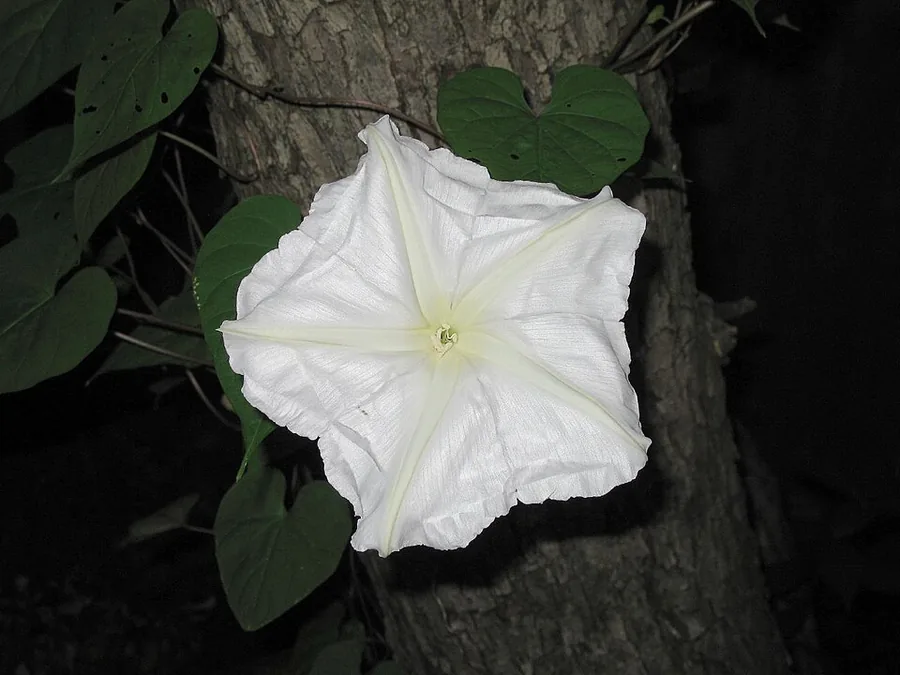
Moonflower is a fast, twining vine cultivated for its nightly flowering. At dusk the swelling buds unfurl into pure-white, fragrant trumpets as wide as a saucer, a display timed to attract the nocturnal sphinx and hawk moths that pollinate the flowers before they close by the following morning. As a member of the morning glory family, it shares the growth habit of its day-blooming relatives but reverses the bloom cycle to open after dark.
Supplied with heat and a firm support, the vine climbs rapidly and clears head height within a single growing season. It is a tender perennial where winters remain frost-free, though most growers treat it as an annual and sow fresh seed each spring. Its scented evening flowers suit porches, arbors, and any planting intended to be enjoyed after dark.
Once established the vine is undemanding. Its two real limitations are a cool, short season and excessively rich soil, since both conditions divert the plant toward leaf production and suppress flowering. Provide adequate warmth and lean soil, and the remaining task is largely furnishing a structure for it to climb.
Care
The short version: full sun, warm and average (not rich) well-drained soil, and steady moisture, with a strong trellis or fence for the vine to climb.
Light
Position moonflower in full sun, ideally 6 or more hours daily. It tolerates modest afternoon shade, but any reduction below full sun slows the vine and lowers flower production because less light limits the energy available for bloom.
Water
Maintain the soil evenly moist without waterlogging, watering roughly every 3 to 7 days according to heat and rainfall. The plant performs best under steady, medium moisture, and well-drained ground prevents the root problems that saturation would cause.
Soil
Average, well-drained soil is ideal, whether loam, clay, or sand, at a pH from 6.0 to 7.8. Avoid rich, heavily amended beds, since high fertility drives vegetative growth and delays flowering.
Temperature
This is a thermophilic vine, comfortable from 50°F to 90°F (10°C to 32°C). Growth is fastest in the heat of high summer, and the plant has no frost tolerance; a freeze ends it.
Humidity
Ambient outdoor humidity is sufficient, so no specific target applies. The vine accepts typical garden air without any additional provision.
Feeding
A light, balanced fertilizer applied about once a month during the growing season meets its needs. Restrict nitrogen in particular, because a surplus stimulates foliage at the expense of the flowers.
Pruning
Pinch the young tips early to break apical dominance and encourage the vine to branch and fill out. Otherwise, remove dead or misplaced growth and continue training the stems onto their support as they extend.
Repotting
In a container, repot once a year. Roots circling the pot, emerging from the drainage holes, or growth that has slowed all indicate that the plant has become rootbound and needs a larger pot.
Size & spacing
This is a large vine, reaching 10 to 30 feet (3 to 9 m) in a favorable season and spreading 3 to 6 feet (91 to 183 cm) wide. Provide a tall, sturdy trellis, fence, or arbor with room for its extension.
When to plant
Moonflower requires an extended warm period and is killed outright by the first frost. Scarify and soak the hard seeds, start them indoors 6 to 8 weeks before the last frost, and transplant only after the danger of cold has passed. Flowering then runs from mid-summer into fall.
Northern hemisphere
Southern hemisphere
Typical months for a temperate climate: start earlier in warm zones, later where spring frosts linger.
- Sow: 6-8 weeks before last spring frost, after nicking and soaking the hard seed coat
- Plant: 1-2 weeks after last spring frost once soil is warm
- Harvest: Mid-summer into fall; flowers open at dusk and close by morning
Hardiness
USDA hardiness zones: 10–12
Temperature: down to -1°C
Troubleshooting
Moonflower presents few genuine problems, and most trace to climate or soil conditions rather than disease. The typical complaint is abundant foliage without flowers; beyond that, the occasional pest appears. Identify the symptom below and intervene early.
Strong foliage with poor bud set
When a vine grows vigorously yet sets few buds, the cause is usually a warm season too short to reach flowering or a nutrient imbalance. Excess nitrogen favors vegetative growth over reproductive growth, so rich soil yields leaves rather than buds, and light below full sun reduces the energy available for flowering. Site the plant in full sun, withhold rich feeding, and sow early so the vine accumulates enough warm-season growth to bloom before fall.
Fix:
- Site in full sun with a sturdy support
- Avoid rich soil and high-nitrogen fertilizer
- Start seed indoors early in short-season areas to extend the warm growing window
Deformed tips, stippling, and fine webbing
Distorted shoots and stippled foliage point to aphids and spider mites, with caterpillars or leaf miners accounting for chewing and mining damage. Aphids congregate on the tender growing tips, while spider mites feed on the leaf undersides and leave the characteristic fine web over pale, stippled tissue. A forceful water spray dislodges both, insecticidal soap controls the soft-bodied species, and caterpillars are removed by hand. On a healthy vine these pests seldom reach damaging levels.
Fix:
- Dislodge aphids and mites with a strong spray of water
- Treat soft-bodied pests with insecticidal soap
- Handpick caterpillars and remove mined leaves
Toxicity
The seeds warrant real caution. In common with all morning glories, moonflower stores LSA alkaloids in its seeds, which can sicken pets, livestock, and people and produce a hallucinogenic reaction on ingestion. The foliage presents a considerably lower risk, but keep the seeds and pods well away from animals and children.
Toxic to
Cats · Dogs · Horses · Rabbits · Livestock · Birds · People
Cats Mild
The seeds concentrate the LSA alkaloids and pose the true hazard to cats. A small ingestion produces salivation and vomiting, while a larger dose acts on the nervous system to cause tremors, ataxia, and disorientation. The foliage carries far less risk.
Dogs Mild
In dogs the seeds typically cause gastrointestinal upset and vomiting. A larger quantity delivers enough alkaloid to trigger agitation, tremors, and a hallucinogenic response. Foliage alone rarely produces more than mild digestive upset.
Horses Caution
Horses rarely graze the vine, but the seeds contain the same alkaloids that affect other species. Exclude them from the seed pods and monitor for colic or dullness following any ingestion.
Rabbits Caution
Moonflower is unsuitable as rabbit forage. The seeds in particular disturb the sensitive hindgut, so keep the plant and its pods out of the hutch and run.
Livestock Caution
Cattle, goats, and sheep tend to reject the bitter vine, yet the seeds remain the point of concern. Exclude grazing stock from any plants in pod as a precaution.
Birds Caution
The seeds again warrant the most caution. Prevent pet birds from reaching dropped seeds, since ingestion can produce vomiting and a jittery, disoriented state.
People Caution
No part of the vine is edible, and the seeds are the hazard. Ingesting them causes nausea, vomiting, and hallucinogenic effects attributable to the LSA alkaloids, so keep seeds and pods beyond the reach of children.
Keep seeds out of reach of pets and children; ingestion of large amounts of seeds can cause neurologic signs.
Helpline numbers

United States
ASPCA Animal Poison Control: (888) 426-4435 (fee applies)
Poison Control: (800) 222-1222



Canada
Poison Centres: 1-844-764-7669
Varieties
The moonflower is a single species rather than a group of cultivars, though it is commonly interplanted with a day-blooming relative. The two worth distinguishing are set out below.
Ipomoea alba (species moonflower / moonvine)
This is the true species moonflower, a vine that opens fragrant, pure-white trumpets up to 4 to 6 inches across at dusk to attract its sphinx and hawk moth pollinators.
Day-blooming morning glory (Ipomoea purpurea / Ipomoea tricolor)
This related morning glory is frequently interplanted with moonflower to sustain continuous bloom, since its colorful flowers open by day rather than after dark.
Companions
Moonflower pairs naturally with its day-blooming morning glory cousins, which fill the trellis with color while the moonflower sleeps and then hand the night shift back over at dusk.
Plant near
Day-blooming morning glory (Ipomoea purpurea/tricolor): Planted together they provide round-the-clock flowers, day and night.
How to propagate
Moonflower is raised from seed, and the single critical step is rendering the hard seed coat permeable to water.
SeedEasy
Start indoors 6-8 weeks before last frost or sow outdoors after frost when soil is warm · 1-3 weeks to germinate; rapid growth once weather warms
Moonflower propagates readily from seed once the impermeable seed coat is breached to admit water. Scarify each seed by nicking it with a knife or abrading it on sandpaper, then soak it overnight to imbibe moisture before sowing. Start seed indoors 6 to 8 weeks before the last frost, or sow directly once soil has warmed; germination follows in 1 to 3 weeks, after which growth accelerates sharply with rising temperatures.
Myths
The vining moonflower is the same deadly plant as the jimsonweed or thorn apple that shares its name.
Two botanically unrelated plants share the common name moonflower. The vine described here is Ipomoea alba, a twining morning glory whose seeds contain the mildly toxic LSA alkaloids. The genuinely dangerous plant is Datura, an upright nightshade whose tropane alkaloids, atropine, scopolamine, and hyoscyamine, can prove fatal. Datura is by far the more poisonous of the two, so the shared name is no guide to toxicity.