Ornamental · Convolvulaceae
Cypress Vine
Ipomoea quamoclit
Hand it full sun and a string to grip, and cypress vine returns feathery leaves and scarlet stars.
Full sun
Every 3–7 days
59–95°F · 15–35°C
65–90 days
Overview
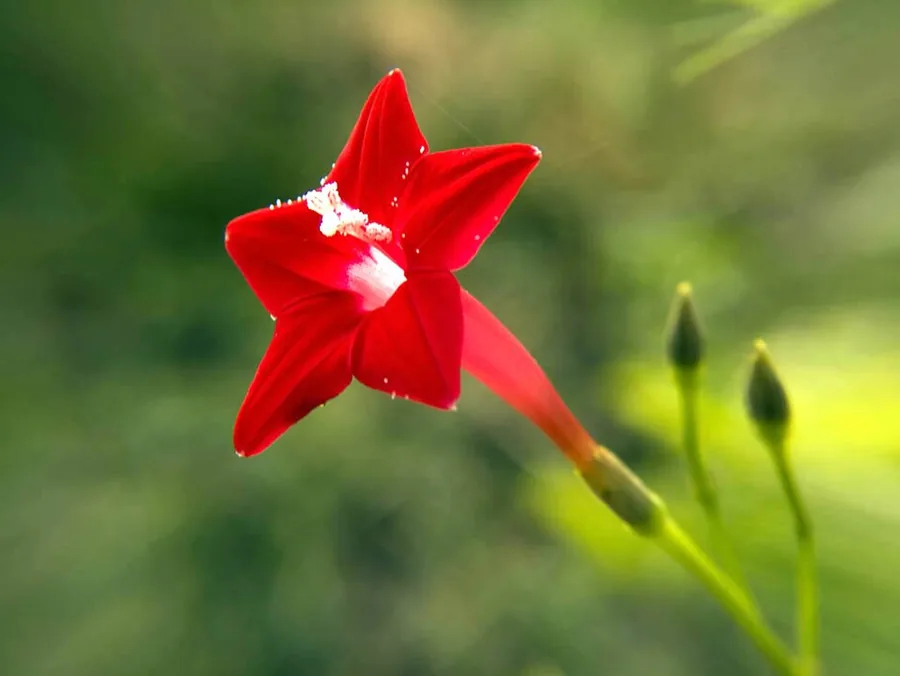
Cypress vine is a fast annual in the morning-glory family, prized for lacy, thread-fine foliage and small scarlet star-shaped flowers. Each leaf is divided so finely it reads as nearly fern-like, and the blooms pull in hummingbirds and butterflies from early summer to frost. With support it twines 6 to 20 feet (1.8 to 6 m) in one season.
Few vines are simpler to grow, which is at once its appeal and its drawback. Hand it sun and a structure to climb, and it manages itself from there. It also sheds seed without restraint, so across warm regions it naturalizes and reappears where you never sowed it.
The hard seed is what deserves your attention. Those seeds hold LSA-type alkaloids and are toxic to pets and people if swallowed, so place the vine and keep any saved seed out of reach. Grow it for the display, never for the pods.
Care
The short version: full sun, lean to average well-drained soil, and steady moisture during establishment. Hold the fertilizer, set up a trellis or string for it to grip, and clip the seedpods unless you want it sowing itself across the bed.
Light
Bloom is best under full sun, which here means 6 or more hours of direct light daily. The vine still climbs in part shade, but flowering falls off quickly as the light dims, since fewer flowers follow less sun.
Water
Hold the soil evenly moist while the roots take hold, then back off, because an established vine handles some drought. Soak it deeply in dry spells rather than topping it up with frequent shallow drinks.
Soil
Set it in average to poor, well-drained soil and resist improving it. Rich ground or added nitrogen drives leaf growth at the expense of flowers, so lean soil serves you better. It accepts a pH across 6.0 to 7.5.
Temperature
A heat lover by nature, it runs all through the warm months and collapses at frost. Its working range is roughly 59°F to 95°F (15°C to 35°C), and it stalls until the soil warms.
Humidity
Ordinary outdoor air suits it, so there is no humidity to manage. Good airflow matters more than any reading, keeping the fine foliage clear of pests and mildew.
Feeding
Feeding tends to work against this vine. It wants almost none, and high-nitrogen feed yields a thicket of leaves with scant bloom, so at most give a light low-nitrogen feed at planting where the soil is genuinely poor.
Pruning
Pinch the young tips to drive branching, and cut back stray stems to hold the vine to its space. When the season closes, clear away the spent growth and clip the seedpods to curb its heavy self-sowing.
Repotting
none
Size & spacing
On support the vine reaches 6 to 20 feet (1.8 to 6 m) tall and spreads 3 to 6 feet (91 to 183 cm) across. Provide a strong trellis, fence, or string, because it blankets its support fast once warmth arrives.
When to plant
Cypress vine is a warm-season annual with no tolerance for cold soil. Start seed indoors in late winter or sow it outdoors once frost has cleared, and the vine carries bloom from early summer until the first autumn frost ends the season.
Northern hemisphere
Southern hemisphere
Typical months for a temperate climate: start earlier in warm zones, later where spring frosts linger.
- Sow: 6-8 weeks before the last spring frost; nick and soak the hard seed coat 12-24 hours before sowing.
- Plant: After the last frost when soil has warmed; can be direct-sown at the last frost date.
- Harvest: Early summer through fall frost.
Hardiness
USDA hardiness zones: 11–12
Temperature: down to 4°C
Troubleshooting
Cypress vine asks for little and stays out of trouble most years; what does come up usually traces to overfeeding, too little sun, or a handful of pests drawn to the fine foliage. Match the sign below, then correct the cause instead of chasing the symptom.
Drifts of volunteer seedlings the next spring
This species sets and sheds seed freely, so a single plant can become a prolific self-seeder that naturalizes and turns weedy in warm regions. Expect volunteers to come up in numbers near last year's planting. Lift them young while the roots are shallow, and stay ahead of the cycle by clipping the seedpods before they ripen and scatter.
Fix:
- Pull volunteer seedlings while young
- Remove seedpods before they ripen and shed seed
Strong leafy vine that refuses to set buds
When a cypress vine puts on a wall of foliage and almost no flowers, the cause is usually fertility, not the plant. Surplus nitrogen and rich ground steer the plant's energy into stems and leaves rather than buds, and shade compounds the problem because the vine needs at least 6 hours of direct sun to flower. Cut off feeding, relocate it to full sun, and grow it lean.
Fix:
- Stop nitrogen feeding
- Move or sow in a full-sun site (6+ hours direct sun)
- Grow in average to lean, well-drained soil
Stippled, twisted leaves with webbing or sticky film
The threadlike foliage is prone to aphids, spider mites, and leaf miners, each leaving its own mark: stippling and yellowing, a sticky film, or pale winding tunnels. Turn a leaf over to read the cause, since soft clustered insects point to aphids, fine webbing to mites, and squiggly trails to miners. Hit them early with a firm water rinse and insecticidal soap, and pull off any leaves the miners have ruined.
Fix:
- Rinse foliage with a strong spray of water to dislodge mites and aphids
- Apply insecticidal soap, treating early before populations expand
- Remove and destroy heavily mined or infested leaves
Toxicity
Keep this vine out of reach of pets and small children. The seeds contain LSA alkaloids and are toxic when eaten, bringing stomach upset and, in larger amounts, hallucinations and other nervous-system effects. The leaves rate as a milder caution, but the seedpods carry the real risk, so store them and any collected seed well out of reach.
Toxic to
Cats · Dogs · Horses · Rabbits · Livestock · Birds · People
Cats Mild
A cat grazing the leaves may drool or vomit, which is the mild end of it. The seeds are where the trouble lies: their LSA alkaloids can produce agitation, tremors, disorientation, or hallucinations once a cat takes in more than a few.
Dogs Mild
A dog that chews the foliage typically vomits and runs through some stomach upset. Swallowing a load of seeds is the larger concern, because the alkaloids can set off restlessness, shaking, and an unsteady, disoriented animal.
Horses Caution
Horses seldom browse the wispy leaves, but the morning-glory seeds still belong out of reach. A mouthful could disturb the gut and, eaten in quantity, reach the nervous system.
Rabbits Caution
Rabbits should not be foraging this vine. Read the seedpods as the real risk, since the alkaloid-rich seeds can bring on digestive upset and, in larger amounts, neurologic effects.
Livestock Caution
Grazing stock generally pass the vine by, yet seed-bearing plants standing in a pasture call for caution. Consuming the seeds can lead to stomach upset and, with enough, signs of nervous-system distress.
Birds Caution
Wild birds sip nectar at the flowers without harm, but the seeds are not safe to offer. Hold collected seed away from pet birds, for whom even a little could cause problems.
People Caution
Nothing on this plant is grown for eating. The seeds are the issue: swallowing them can bring nausea and stomach pain, and a larger dose of the LSA-type alkaloids can produce hallucinations. Store seeds and pods well clear of children.
Keep seeds and seedpods away from pets; the seeds are the main concern.
Helpline numbers

United States
ASPCA Animal Poison Control: (888) 426-4435 (fee applies)
Poison Control: (800) 222-1222



Canada
Poison Centres: 1-844-764-7669
Varieties
The species itself is the scarlet-flowered benchmark, though a pair of near relatives show up beside it and are easy to confuse.
'Alba'
Trades the species' scarlet stars for pure white ones on an otherwise identical vine.
Cardinal Climber (Ipomoea × multifida)
A cross of I. coccinea and cypress vine; it carries broader, deeply lobed leaves and red trumpets with pale throats instead of the threadlike foliage of the parent.
How to propagate
Seed is the only way to raise cypress vine, and the lone technique worth mastering is softening that tough seed coat before sowing.
SeedEasy
Sow indoors 6-8 weeks before last frost, or direct-sow after the last frost when soil is warm. · Germinates in about 1-3 weeks after scarifying; establishes and climbs quickly through the warm season.
Seed is the only route, and the single step that matters is breaching that tough coat so water can reach the embryo. Nick or scarify each seed and soak it for 12 to 24 hours, then sow indoors 6 to 8 weeks ahead of your last frost or set it straight into warm ground afterward. Germination follows in 1 to 3 weeks, and the vine climbs fast once warmth holds.
Myths
Cypress vine and cardinal climber are the same plant.
These are two separate vines. Cypress vine bears very fine, feathery, thread-like leaves cut nearly to the midrib, whereas cardinal climber, the hybrid produced by crossing I. coccinea with I. quamoclit, carries broader, deeply lobed palmate leaves. The foliage is the giveaway.