Houseplant · Marantaceae
Stromanthe Triostar
Stromanthe thalia 'Triostar'
Supply low-mineral water, high humidity, and bright indirect light, and the pale variegation holds its color without scorching.
Bright indirect
USDA 10–12
2–5 ft · 0.6–1.5 m
Overview
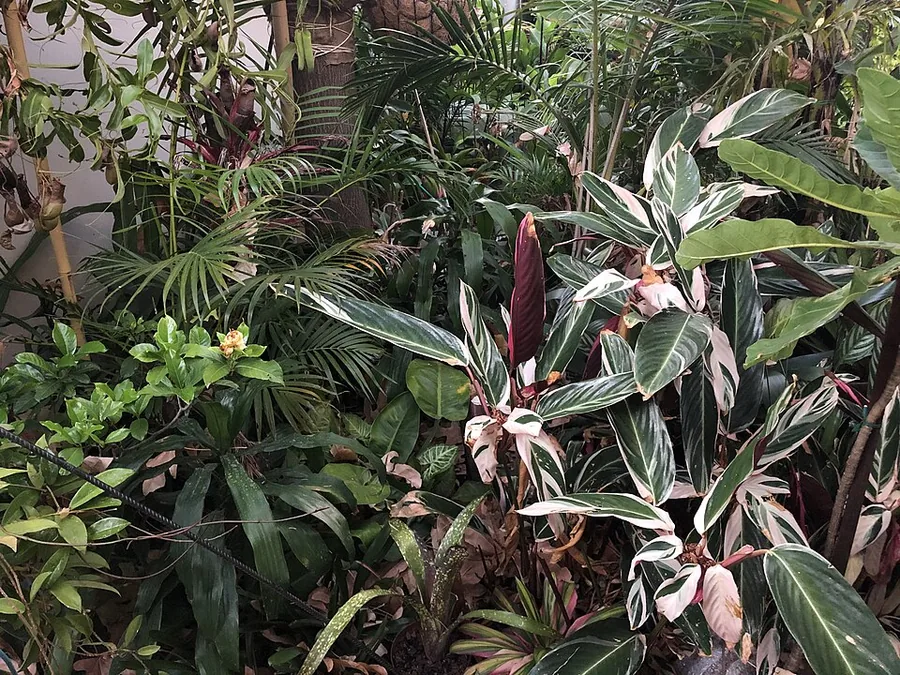
Stromanthe Triostar is grown for foliage layered in green, cream, white, and pink, each blade backed underneath with deep burgundy. It belongs to the Marantaceae, the prayer plants, and like the rest of that family it raises its leaves at night and lowers them by morning. The variegation is the draw, and it holds its quality only when the plant's cultural needs are met.
This is a demanding species with a clear reason behind the difficulty. It evolved on the warm, humid floor of Brazilian forests, so indoor conditions must approximate that steady heat and moisture. Three sensitivities follow directly from that origin: it accumulates the minerals in tap water at the leaf margins, it browns when the surrounding air is dry, and its low-chlorophyll variegation scorches in direct sun. Reading each of those responses early keeps the foliage intact.
Grown well, it develops a clumping habit of upright stems that can be divided every year or two. Because the cream and pink tissue carries little chlorophyll, the plant leans on its green areas and on correct water, light, and humidity to fuel each new tricolor leaf. Meet those three and growth stays consistent.
Care
The short version: provide bright indirect light and no direct sun, water with low-mineral filtered water, and hold the soil evenly moist. Keep humidity above 60% and temperatures warm, and feed lightly during the growing season.
Light
Provide bright indirect light, such as an east or north exposure. Direct sun bleaches and burns the pale variegation because that tissue holds little chlorophyll, while deep shade mutes the coloring, so dappled light or a sheer curtain balances the two.
Water
Hold the soil evenly moist but never waterlogged, watering freely during active growth and reducing the frequency in winter. The species accumulates fluoride, chlorine, and salts from tap water at the leaf edges, which is why filtered, distilled, or rainwater prevents the marginal scorch.
Soil
Use a fertile, organic-rich medium that retains moisture yet drains, since the roots tolerate neither drought nor standing water. The plant is indifferent to pH across a wide band, performing well anywhere from 6.0 to 8.0.
Temperature
Maintain warmth, with a floor near 59°F (15°C). As a tropical species it has no cold tolerance, so exposure to drafts, cold glass, or open doorways in winter checks growth and should be avoided.
Humidity
Humidity is the limiting factor for most growers. The plant requires 60% or higher, and dry indoor air is the direct cause of brown leaf margins. A humidifier, a pebble tray, or a grouped planting raises the local humidity around the foliage.
Feeding
Feed during the spring and summer growing season at roughly every 2 to 3 weeks. A low-nitrogen liquid fertilizer suits it, and feeding should stop in the cooler months once growth slows, when the plant cannot use the nutrients.
Pruning
No structural pruning is needed. Remove spent or damaged leaves at the base as they occur, which maintains appearance without affecting the clump.
Repotting
Repot every 1 to 2 years in spring, prompted by roots circling the pot, water passing straight through, or a visibly crowded clump. Spring repotting coincides with division, so the two operations are best combined while the root ball is exposed.
Size & spacing
Indoors the clump reaches 2 to 5 feet (60 to 150 cm) in height and 2 to 3 feet (60 to 90 cm) in spread. Allow clearance so air circulates freely around the foliage and the leaves are not crushed against a surface.
Troubleshooting
Nearly every disorder in this plant registers on the foliage, and the cause is usually cultural: water quality, ambient humidity, or light exposure. Inspect the margins, the variegation, and the root zone, and most issues can be identified while still cosmetic. Match the symptom below, then correct the underlying condition.
Rot at the roots and stem bases from waterlogged soil
Soil that stays waterlogged and poorly drained triggers root and stem rot, which the sour smell confirms. Remove the plant, excise every soft, brown root and stem so only firm tissue remains, and repot into fresh, free-draining medium. Afterward water only to keep the substrate evenly moist and ensure the container drains, since standing water restarts the process.
Fix:
- Unpot and remove all soft, rotten roots and stems
- Repot into fresh, well-draining mix
- Water only to keep evenly moist, never soggy, and ensure drainage
Webbing and yellow stippling from spider mite feeding
Hot, dry air favors spider mites, specifically glasshouse red spider mite, which colonize the leaf undersides and joints and produce the fine webbing and stippled, yellow-flecked look. Rinse the foliage and wipe the undersides to reduce numbers, then raise humidity, which suppresses the population. Apply insecticidal soap or horticultural oil and repeat on the label interval to break the breeding cycle.
Fix:
- Rinse foliage and wipe undersides
- Raise humidity, which discourages mites
- Treat with insecticidal soap or horticultural oil and repeat per label
Cottony mealybug colonies in the leaf axils and stems
The white, cottony masses are mealybugs, sap-feeding insects that settle in the leaf axils and along the stems and often leave a sticky residue. Touch each insect with a cotton swab dipped in isopropyl alcohol, then follow with insecticidal soap or horticultural oil. Isolate the plant and repeat the treatment, because residual individuals will reestablish the colony.
Fix:
- Dab insects with isopropyl-alcohol-moistened swab
- Treat with insecticidal soap or horticultural oil
- Isolate the plant and repeat treatments
Marginal browning and crisping on the leaf edges and tips
The cause is mineral accumulation: fluoride, chlorine, and dissolved salts from tap water build up at the leaf margins and tips and scorch the edges while the centres remain green. Change to filtered, distilled, or rainwater to remove the source, raise humidity above 60%, and keep the substrate evenly moist, since dry air and drought intensify the injury.
Fix:
- Switch to filtered, distilled, or rainwater
- Raise humidity to 60%+ with a humidifier or pebble tray
- Keep soil consistently moist, never bone-dry
- Trim badly browned edges for appearance only
Bleaching on the low-chlorophyll cream and pink variegation
Because the cream and pink sectors carry little chlorophyll, direct sun scorches them before the green tissue shows any damage. The pale, crisp patches concentrate on leaves exposed to midday glare. Relocate the plant to bright indirect light or an east or north aspect, and filter any unavoidable direct sun through a sheer curtain.
Fix:
- Move to bright indirect light or an east/north-facing aspect
- Filter harsh direct sun with a sheer curtain
Toxicity
For a household with animals, the record is reassuring: this is a non-toxic prayer plant with no oxalate or specific toxin documented in its tissues. NC State Extension applies a pet-friendly tag at the species level, so an incidental nibble by a cat, dog, or rabbit carries no real risk. It is not a culinary plant, and while any plant fibre can provoke a brief digestive upset in quantity, nothing in this species is poisonous.
Safe for
People · Cats · Dogs · Horses · Rabbits · Livestock · Birds
Cats None
No toxin is documented in this species, and NC State records a pet-friendly status, so ingestion by a cat presents no toxicological concern.
Dogs None
The foliage contains no identified poison for dogs. A dog that consumes a large amount of any plant material may show transient gastrointestinal upset from the fibre, but no toxin is involved.
Horses Safe
No toxicity to horses is on record. The species is cultivated indoors rather than in pasture, so contact is unlikely, and an incidental leaf poses no hazard.
Rabbits Safe
Rabbits face no documented risk from the foliage, which contains no toxin, so an occasional bite carries no toxicological consequence.
Livestock Safe
No compound harmful to grazing livestock is recorded in this plant, and as an indoor subject it seldom comes into contact with them.
Birds Safe
No hazardous constituent is documented in the leaves or stems, so pet birds are unaffected by proximity to the plant.
People Safe
The species carries no recorded toxin and is safe in any room. It is not cultivated for consumption, but no part is poisonous, so it presents no danger to children.
As with any houseplant, discourage pets from chewing foliage; ingestion of plant fibre can still cause mild, transient GI upset
Varieties
Triostar is the best known selection, but it is not the only Stromanthe grown for painted foliage. The two below are worth distinguishing.
'Triostar' (syn. 'Tricolor')
Its green blades are marked with white, cream, and pink on the upper surface, while the undersides are a uniform pink to burgundy.
'Magic Star'
This selection replaces the pink with creamy white speckling over green foliage and pairs it with deep maroon undersides.
How to propagate
One method propagates this plant reliably, division, and it coincides with the point at which a crowded clump needs repotting.
DivisionModerate
Spring, before new growth starts · Several weeks to a few months
This plant is increased by dividing the rhizome clump in spring, just before growth resumes. Each division is potted individually and held warm, humid, and evenly moist through establishment. Expect the process to take several weeks to a few months before the division roots in and resumes independent growth.
Myths
Stromanthe Triostar is simply a Calathea under another name.
Trade labels frequently read 'Calathea Triostar', yet the plant sits in a distinct genus, Stromanthe, within the same Marantaceae family. The accepted botanical name is Stromanthe thalia, with Stromanthe sanguinea treated as a synonym, which is the basis for the RHS listing of Stromanthe sanguinea 'Triostar'.