Houseplant · Marantaceae
Calathea White Fusion
Goeppertia lietzei 'White Fusion'
Match the water quality and humidity to its rainforest origins and this living watercolour holds its brushstroked leaves.
Bright indirect
61–75°F · 16–24°C
USDA 11–12
4–20 in · 10–50 cm
Overview
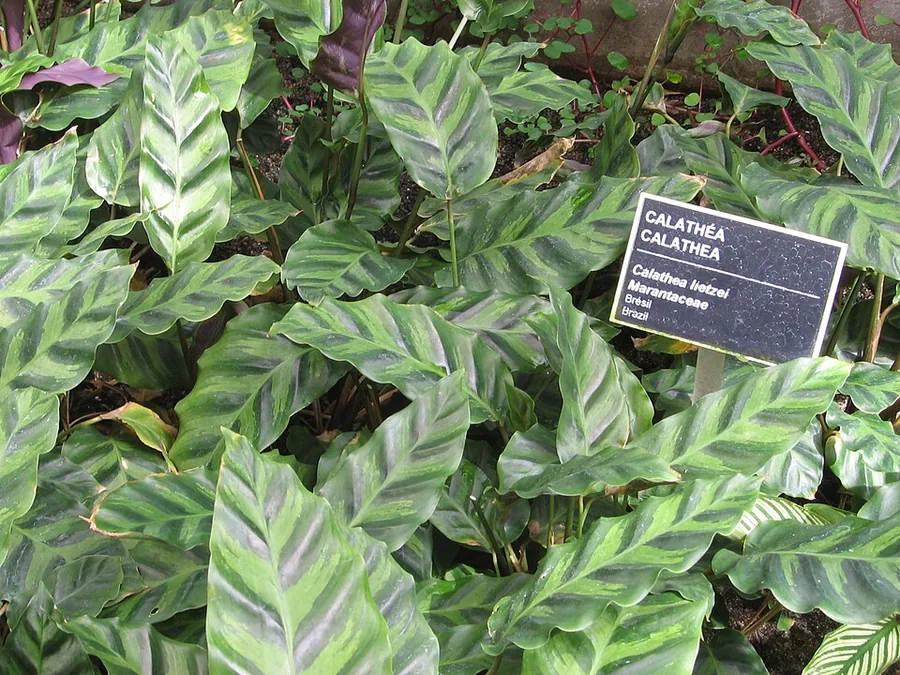
Calathea White Fusion is the most striking selection in the prayer plant family, its laminae marbled in green and white above with a lilac flush on the abaxial surface. Taxonomy now places it as Goeppertia lietzei 'White Fusion' following the segregation of the genus from Calathea, though horticulture largely retains the older name in trade. As an understorey species from the Brazilian rainforest floor, its shaded, humid origin accounts for nearly every requirement that follows.
Its difficult reputation is well founded. The white sectors of the lamina carry little chlorophyll, which renders them both ornamental and vulnerable, predisposed to photo-bleaching in direct sun and to marginal necrosis under hard water or low humidity. Combine that sensitivity with a slow growth rate and a narrow margin for error, and the cultivar suits a grower prepared to manage its conditions closely.
Beyond that exacting nature lies a genuinely rewarding plant. Its leaves rise at night and lower again by day, a circadian habit termed prayer movement that gives the family its common name. Maintain high humidity, water free of accumulating salts, and bright but indirect light, and the cultivar returns some of the most distinctive foliage available for indoor culture.
Care
The short version: provide bright indirect light with no direct sun, water low in dissolved salts rather than untreated tap, a substrate held evenly moist, and humidity sustained above 60% as steadily as conditions allow.
Light
Provide bright indirect light and exclude direct sun, which scorches the chlorophyll-poor white tissue rapidly because that tissue cannot shed excess radiant energy. The plant tolerates partial shade or medium indirect light, but under-lit growth emerges small, weak, and depleted in colour. An east or west exposure, or a position set a few feet back from a bright window, supplies the optimum.
Water
Maintain the compost evenly moist through spring and summer and reduce to just moist in winter, watering at the soil line rather than over the foliage. The decisive variable is water quality: salts, chlorine, and fluoride in tap water accumulate in the leaf and scorch the margins, so use distilled water, rainwater, or tap water stood for 24 hours.
Soil
Grow it in a moist but well-drained medium, peaty or loam-based, amended with perlite to ensure aeration; a peat-free compost performs equally well. The species tolerates a broad pH band and grows reliably across the range 6.0 to 8.0.
Temperature
Hold a warm, constant regime between 61°F and 75°F (16°C to 24°C), since cold draughts and abrupt fluctuations stress the plant. Position it away from doorways and unheated windowsills, and never allow the temperature to fall below 16°C.
Humidity
Humidity is the limiting factor for this cultivar. Sustain levels above 60%, higher where possible, because dry air drives marginal desiccation and accelerates spider mite reproduction. A humidifier delivers the most stable reading, with a pebble tray or close grouping of plants providing supplementary moisture.
Feeding
Apply a balanced liquid fertiliser monthly during the growing season, April to September, at standard dilution, and suspend feeding over winter as growth slows. Given its slow rate of development, the plant has modest nutrient demands and does not warrant heavy feeding.
Pruning
Pruning requirements are minimal. Excise any dead, browned, or damaged leaves at the base, and remove leaves bearing extensive crisp margins or scorched white tissue to preserve appearance. No further structural pruning is needed.
Repotting
Repot every few years in spring or summer, prompted by roots circling the pot or emerging from the drainage holes, by accelerated drying of the medium, or by weak new growth. Advance the plant only one container size into fresh medium. Repotting also presents the natural opportunity for division.
Size & spacing
This is a compact cultivar attaining only 4 to 20 inches (10 to 50 cm) in height and a comparable spread, reached slowly over several years. Its restrained dimensions suit a shelf, desk, or grouped arrangement where collective transpiration helps sustain humidity.
Troubleshooting
Nearly every disorder in this plant manifests on the foliage, and the majority trace to water quality, light, or humidity. Reading the early symptoms lets you correct the underlying cause before the injury progresses. Match the presentation below to identify the probable agent.
Wilting and yellowing in persistently saturated soil
A plant that wilts while the medium stays saturated is showing root rot from overwatering, since waterlogged soil starves the roots of oxygen and they decay, turning brown and soft rather than firm and pale. Once compromised they cannot take up water, hence the wilt. Reduce watering and let the pot drain completely, then repot into fresh, free-draining mix, excise the rotted roots, and use a container with drainage holes.
Fix:
- Reduce watering frequency and let excess drain fully
- Repot into fresh, well-drained mix, removing rotted roots
- Ensure the pot has drainage holes
Bleached, scorched lesions on the variegated white tissue
Because the white sectors of this cultivar contain little chlorophyll and few protective pigments, they cannot dissipate excess light energy, so direct sun bleaches and burns them well before it would harm fully green tissue. Expect the lesions on whichever leaves receive the strongest light, concentrated across the pale zones. Reposition into bright indirect light, or temper a high-intensity window with a sheer curtain.
Fix:
- Move out of direct sun to a bright spot with indirect light or light shade
- Use an east/west-facing position or diffuse strong light with a sheer curtain
Stippled, silvery foliage with fine webbing beneath
Fine webbing on the undersides and a stippled, silvery cast indicate spider mites, whose populations build rapidly in dry air because low humidity speeds their reproduction. Rinse the foliage and wipe the undersides to dislodge the colony, raise humidity to slow their cycle, and apply insecticidal soap or horticultural oil, repeating per label to catch successive generations.
Fix:
- Rinse foliage and wipe undersides of leaves
- Raise humidity, as mites thrive in dry conditions
- Treat with insecticidal soap or horticultural oil, repeating per label
Brown, crisp margins and tips on the foliage
This ranks as the most frequent disorder reported, and the root cause is usually tap water. Dissolved salts, chlorine, and fluoride accumulate in the leaf and cannot be excreted, so they concentrate at the margins and tips, where they scorch the tissue; dry air and uneven moisture compound the injury. Move to distilled water, rainwater, or tap water rested for a full day, hold humidity above 60%, and trim the worst margins for appearance.
Fix:
- Switch to distilled water, rainwater, or tap water left to stand 24 hours so chlorine evaporates
- Raise humidity above 60% with a pebble tray, grouping, or humidifier
- Keep compost evenly moist, never letting it fully dry out
- Trim severely browned edges for appearance
New foliage emerging green, undersized, and weak
Foliage that emerges greener and smaller than mature leaves signals an energy deficit from insufficient light, since under-lit Goeppertia produce poor, weak growth and tend toward sparse, etiolated stems. Raise the light level by moving the plant into a brighter position with bright indirect light, away from dim interiors, and subsequent leaves develop with proper size and colour.
Fix:
- Move to a brighter spot with bright indirect light
- Avoid deep shade or low-light corners
Toxicity
For households with animals the verdict is favourable: this is a safe species to keep. ASPCA listings record Calathea and prayer plants as non-toxic to cats and dogs, with no toxic principles, so an investigative nibble carries no poisoning risk. The single qualification is that the sap can provoke mild irritation on sensitive skin, so washing the hands after pruning is sensible.
Safe for
People · Cats · Dogs · Horses · Rabbits · Livestock · Birds
Cats Safe
The ASPCA classifies this plant as non-toxic to cats, so an exploratory bite presents no toxicological risk. A cat that consumes a large quantity of any foliage may show transient gastrointestinal upset, but no toxic principle is involved.
Dogs Safe
Dogs face no toxic compounds in the foliage. A dog that chews a leaf might drool or pass a loose stool briefly, a non-specific response to plant material rather than poisoning.
Horses Safe
Prayer plants in this family are listed non-toxic to horses, with no documented toxic principles. As an indoor tropical, it lies outside a horse's normal forage, and ingestion would carry no poisoning risk.
Rabbits Safe
A rabbit can sample the foliage without toxicological harm. No toxins are present, though a sudden large intake of unfamiliar greenery can transiently disturb the hindgut.
Livestock Safe
Grazing stock encounter no toxic constituents in this species. Cultivated indoors, it stays beyond their access, and consumption would not induce poisoning.
Birds Safe
Pet birds are unaffected, as the leaves hold no toxic compounds. A bird that perches on or pecks the foliage is exposed to nothing harmful.
People Safe
The plant is safe around children. The one qualification is that contact with the sap can provoke a mild skin irritation in sensitive individuals, so washing the hands after pruning is advisable.
Although classified non-toxic, NC State notes the sap may cause minor skin irritation/contact dermatitis in sensitive individuals; ingestion of any plant material can still cause mild gastrointestinal upset
How to propagate
A single propagation route applies here, and it integrates conveniently with routine repotting of a congested clump.
DivisionModerate
Late spring, typically at repotting · Several weeks to a few months
Division is the sole viable method, since this plant does not regenerate from stem or leaf cuttings. Schedule it for late spring, ideally combined with a routine repot. Separate the rhizomatous clump into sections, ensuring each retains its own roots and shoots, then pot them individually. Provided with warmth and humidity, the divisions establish over the next few weeks to a few months.
Myths
Calatheas, including this prayer plant, are poisonous to cats and dogs.
The evidence runs the other way. ASPCA toxicology data list both Calathea and Prayer Plant, members of the Marantaceae, as non-toxic to cats and dogs alike. The species belongs in a household with pets without concern.
The correct botanical name for this plant is Calathea lietzei.
That binomial has been superseded. Kew's Plants of the World Online records Goeppertia lietzei as the accepted name, retaining Calathea lietzei as a synonym. The reassignment reflects a wider revision that moved numerous former Calatheas into Goeppertia, Ctenanthe, and Stromanthe.
You can water a Calathea with ordinary tap water.
Tap water is in fact a primary driver of marginal browning. Its salts, chlorine, and fluoride accumulate in the leaf tissue and scorch the margins over time. Use distilled water or rainwater, or let tap water stand for 24 hours so the chlorine can off-gas before application.