Houseplant · Marantaceae
Prayer Plant
Maranta leuconeura
Match its rainforest-floor roots with soft water, even moisture, and humidity, and the prayer plant folds its leaves each night on cue.
Bright indirect
USDA 11–12
6–18 in · 15–46 cm
Overview
The prayer plant, Maranta leuconeura of the Marantaceae family, gets its name from a daily rhythm called nyctinasty. Its leaves hold flat and open in daylight, then swing upward and press together after dark, echoing a pair of praying hands. It evolved on the shaded rainforest floor of Brazil, and those low-light, humid conditions define what it needs indoors.
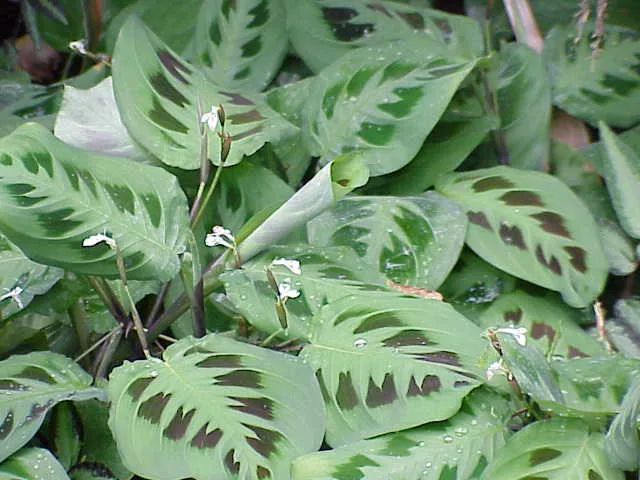
Its appeal rests in the patterned foliage. Depending on the form, leaves carry red veins arranged in a herringbone pattern or paired dark blotches over green, whether deep or pale. The plant stays small, no taller than 18 inches (46 cm), which suits it to a shelf, a hanging pot, or a desktop.
Its reputation for being difficult comes down to narrow tolerances rather than true fragility. It responds to mineral-free water, steady soil moisture, and humid air, while fluoride and dry rooms scorch the leaf margins. Meet those parameters and it performs as a dependable, pet-safe houseplant that repeats its evening leaf movement without fail.
Care
The short version: bright indirect light with no direct sun, soil held evenly moist using rainwater or filtered water to avoid mineral burn, and high humidity in a warm room kept above 60°F (15.6°C).
Light
Provide bright, indirect light and exclude direct sun, because the plant evolved under a forest canopy and its variegation bleaches while the tissue scorches under strong rays. It tolerates medium and low light, but pigment intensity drops as light falls, so a bright, filtered position preserves the strongest color.
Water
Hold the soil evenly moist through spring and summer, then reduce watering from autumn to late winter as growth slows and demand drops. The larger concern is water chemistry, since the leaves are sensitive to fluoride, chlorine, and salts that accumulate at the margins and cause burn. Rainwater, distilled, or filtered water removes that source of injury.
Soil
Use a moist, humusy, well-drained potting mix with a soil base. The medium must retain moisture yet drain freely, because oxygen-starved roots in waterlogged soil are what trigger rot.
Temperature
Keep it warm and above 60°F (15.6°C), its lower limit. Chilling injury follows exposure to cold drafts and glass-cooled windowsills, so site it away from winter doors and vents.
Humidity
The plant demands high humidity, a direct legacy of its humid native understory, and dry air draws moisture from the leaf edges faster than the roots replace it, leaving brown, crisp margins. A pebble tray, a humidifier, or grouped plants raise the local moisture and prevent that loss.
Feeding
Apply a balanced houseplant fertilizer monthly during the spring and summer growing season, then reduce sharply from autumn to late winter when uptake declines. Keep concentrations modest, because excess salts burn the foliage by the same mechanism as hard water.
Pruning
The plant needs minimal pruning. Remove damaged, faded, or brown-tipped leaves to maintain appearance, since the plant will not regreen dead margin tissue.
Repotting
Repot in spring when roots crowd the container or emerge from the drainage holes, both signs the plant is rootbound. Spring also coincides with active growth, which is why it is the ideal moment to divide the clump for propagation.
Size & spacing
Mature plants reach 6 to 18 inches (15 to 46 cm) in height and spread 6 to 24 inches (15 to 61 cm). That low, spreading form lends itself to a hanging pot or a shelf edge, where the foliage can extend past the rim.
Troubleshooting
Most prayer plant complaints register in the foliage and stem from culture, specifically water quality, light, or humidity, rather than pathogens. Because the causes are environmental, reading the early signs points straight to the correction. Identify the pattern below, then adjust the responsible factor.
Root rot from waterlogged soil
Soggy soil starves the roots of oxygen and allows root rot, seen as roots turned brown and soft rather than firm and pale. Remove the plant, excise the rotted tissue, and repot into fresh, well-drained medium. Water only on demand and eliminate standing water so the roots can breathe.
Fix:
- Remove from soggy soil and trim rotted roots
- Repot into fresh well-drained mix
- Water only when appropriate and ensure drainage
Spider mite webbing and stippled foliage
Fine webbing and pinprick yellow stippling on the leaf undersides confirm spider mites, whose populations expand fastest in hot, dry air. Rinse the foliage to dislodge them, raise humidity to suppress breeding, and treat with insecticidal soap or horticultural oil. Isolate the plant to protect the rest of the collection.
Fix:
- Rinse foliage and raise humidity
- Treat with insecticidal soap or horticultural oil
- Isolate affected plant
Marginal leaf scorch: brown, crisp tips and edges
The browning is leaf burn, driven by fluoride, chlorine, and salts in tap water that concentrate at the leaf margins where transpiration ends. Heavy feeding in dry air compounds the salt load. Change to rainwater, distilled, or filtered water, cut fertilizer inputs, and raise humidity to slow the accumulation.
Fix:
- Use rainwater, distilled or filtered/dechlorinated water
- Reduce fertilizer frequency and strength
- Raise humidity (humidified room or pot on a tray of wet pebbles)
- Trim damaged tips for appearance
Bleached variegation and scorched leaf patches
Fading color and pale, scorched areas indicate direct-sun damage. A forest-floor species carries limited protection against strong radiation, so pigment breaks down and tissue burns where sun strikes the leaf. Relocate it to bright indirect light and filter any intense window exposure to let color return on new growth.
Fix:
- Move to bright indirect light out of direct sun
- Filter strong window light
Leaves failing to fold at nightfall
Leaves that stay flat after dark reflect a disrupted nyctinastic response, usually from insufficient light or cultural stress rather than infection, and color generally remains normal. The movement depends on a clear day-night light cycle, so supply bright indirect light by day and genuine darkness at night, and correct any watering, humidity, or temperature deficit.
Fix:
- Provide adequate bright indirect light during the day and natural darkness at night
- Correct watering, humidity and temperature to reduce stress
Toxicity
For pet-owning households the verdict is clear: the prayer plant is non-toxic. The ASPCA records no toxic principles for cats, dogs, or horses, so the leaves carry nothing that poisons. Large ingestion may still irritate the gut and cause a brief, mild upset, a mechanical effect rather than toxicity.
Safe for
People · Cats · Dogs · Horses · Rabbits · Livestock · Birds
Cats None
Cats are unaffected. The ASPCA identifies no toxic principle, so the only plausible reaction is a brief, mild gastric upset if a cat consumes a large amount of foliage.
Dogs None
Dogs are equally safe, as the leaves contain no toxin. A substantial mouthful may cause short-lived queasiness through gut irritation alone.
Horses Safe
Horses are cleared by the ASPCA. With no poison present, an exploratory bite produces no toxic effect.
Rabbits Safe
The absence of toxic compounds makes the plant safe around rabbits, though it does not substitute for their normal fiber-rich forage.
Livestock Safe
Grazing livestock face no poisoning risk from the foliage, and as a tropical indoor species it rarely enters their environment.
Birds Safe
Pet birds are not endangered by this plant. The toxin-free leaves make perching and pecking harmless.
People Safe
The plant is safe around children, carrying no poisonous principle, although it is cultivated for foliage rather than consumption.
Although non-toxic, ingestion of plant material can still cause mild gastrointestinal upset in pets
Varieties
Two named forms account for most plants in cultivation, separated chiefly by leaf marking. Both are worth recognizing.
var. erythroneura (Herringbone / red-veined prayer plant)
The most ornamental form, distinguished by a bright red midrib and red lateral veins branching across dark green leaves in a herringbone arrangement.
var. kerchoveana (Rabbit's-foot / rabbit tracks)
A paler green form identified by two rows of dark blotches along each leaf, a marking horticulturists liken to rabbit tracks.
How to propagate
The plant multiplies readily, and spring is the physiological window when active growth helps new divisions and cuttings recover quickly.
DivisionEasy
Spring, at repotting · Several weeks
The most reliable method is division in spring at repotting, timed to active growth. Separate the clump into sections, each retaining its own roots and shoots, then pot them individually. Each division needs several weeks to establish before resuming growth.
Stem cuttingsModerate
Spring to summer · Several weeks to root
The plant also propagates from stem cuttings taken just below a node in spring or summer, where rooting hormone concentrates. Insert the cutting in moist medium under warmth and humidity to drive root initiation. Expect several weeks for roots to form.
Myths
The prayer plant is toxic to cats and dogs.
ASPCA records classify the prayer plant and the broader Maranta group as non-toxic to cats, dogs, and horses, listing no toxic principles. The species presents no poisoning risk in a pet household, though the physical bulk of a large ingestion can still provoke a transient stomach upset.
The leaves fold at night for religious reasons.
The nightly folding is nyctinasty, an endogenous day and night sleep movement governed by the plant's internal clock, not any spiritual act. After dark the leaves elevate and close into a form resembling praying hands, which is the origin of the common name.