Houseplant · Marantaceae
Rattlesnake Plant
Goeppertia insignis
Bold, wavy leaves that fold up at night mark a plant that pays back precise water and humidity.
Partial shade
64–75°F · 18–24°C
USDA 11–12
9–30 in · 23–76 cm
Overview
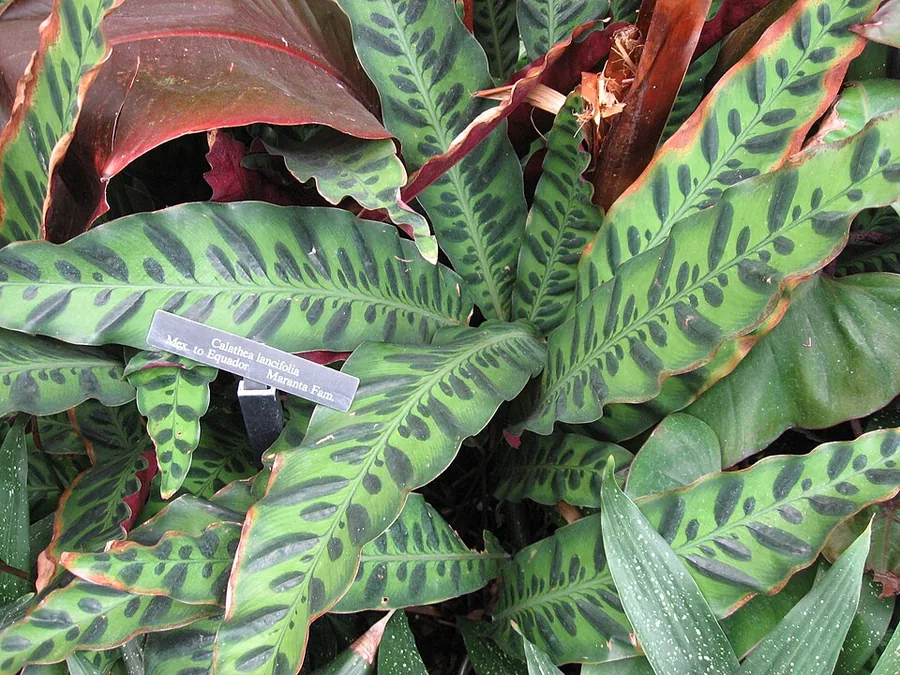
The common name traces to the leaf pattern: long, wavy blades bear dark green blotches along a bright green surface, reminiscent of a snake's dorsal markings. The undersides are a deep purple-red, a pigmentation typical of many understory Marantaceae. A member of the prayer plant family, it is native to Brazilian rainforest, where it grows on the shaded forest floor in warm, consistently humid air.
Its membership in the prayer plant group is easiest to observe over a full day. The leaves hold flat and open under daylight, then fold upward at dusk and reopen by morning, a nyctinastic movement driven by changing light. Indoors the plant stays modest, reaching 9 to 30 inches (23 to 76 cm) tall, a scale well matched to a shelf or side table.
This species is genuinely exacting. It requires soft water, steady soil moisture, and high humidity, and it registers any shortfall as browning at the leaf margins, the first visible sign of stress. Reproduce the warm, shaded, humid conditions of its native forest floor and growth is fast and full.
Care
The short version: bright shade with no direct sun, an evenly moist medium watered with rainwater or distilled water, warm room temperatures, and humidity kept as high as practical.
Light
Provide bright indirect light or partial shade, replicating the filtered light of the rainforest understory it evolved under. It tolerates fairly deep shade because it is adapted to low light beneath a canopy. Withhold direct sun, whose intensity bleaches the leaf variegation and scorches the tissue.
Water
Hold the medium evenly moist but not saturated through the April to August growth period, then reduce watering in winter as growth slows. Water source matters: use rainwater or distilled water, because fluoride and dissolved salts in tap water accumulate in the foliage and necrose the leaf margins.
Soil
Use a well-drained, peaty medium high in organic matter, which holds moisture around the roots without waterlogging them. The species is indifferent to pH across 6.0 to 8.0, from acidic to slightly alkaline, so no amendment is usually needed.
Temperature
Maintain warm room temperatures of 64°F to 75°F (18°C to 24°C), matching its tropical origin. It has no cold tolerance, so exclude it from drafty windows and cold pockets that can chill the foliage.
Humidity
Humidity is the limiting factor most growers underestimate. The plant needs high humidity, well above ambient living-room levels, supplied by a wet pebble tray, misting, or a humidified room. In dry air the leaf margins desiccate and brown, the same failure seen with hard tap water.
Feeding
Apply a balanced fertilizer monthly during the spring-to-summer active growth phase to support its fast growth rate. Suspend feeding in winter, when reduced growth means the plant cannot take up the nutrients.
Pruning
No structural pruning is warranted, as the plant builds its form from the base. Simply remove dead, damaged, or browned leaves at the base to maintain appearance and reduce disease entry points.
Repotting
Repot every 1 to 2 years in spring, or earlier once roots circle the rootball or emerge from the drainage holes, both signs of a rootbound plant. This interval also provides the correct moment to divide the clump for propagation.
Size & spacing
Indoors it remains compact, 9 to 30 inches (23 to 76 cm) in height with a 9 to 18 inches (23 to 46 cm) spread. A single specimen occupies its container fully, so select a pot offering modest room for the rhizome to expand.
Troubleshooting
Because the foliage is the plant's most sensitive tissue, nearly every problem presents there first, and the causes cluster around water quality, light exposure, and humidity. The pattern on the leaf usually identifies the disorder. Match the symptom below, then correct the underlying condition rather than the symptom.
Yellowing, wilting foliage with basal rot
The primary cause is root rot from waterlogged soil, where saturated conditions suffocate and decay the roots, though the opposite extreme of bone-dry soil can also yellow the leaves. Examine the medium and roots: soft, dark, mushy roots confirm rot, while dust-dry medium confirms underwatering. Water to keep the medium evenly moist but never saturated, ensure free drainage, and repot into fresh mix while excising rotted roots.
Fix:
- Adjust watering so soil stays evenly moist but never soggy
- Ensure the pot and mix drain freely
- Repot into fresh well-drained mix and trim rotted roots if rot is present
Fine webbing and stippled, dull foliage
This presentation indicates spider mites, which colonize the plant as humidity falls. Inspect the leaf undersides for the mites themselves and their fine webbing, alongside a stippled, matte surface where they have fed. Rinse the foliage, raise humidity to suppress them, treat with insecticidal soap or horticultural oil, and isolate the plant to prevent spread.
Fix:
- Rinse foliage and raise humidity
- Treat with insecticidal soap or horticultural oil
- Isolate the plant to limit spread
Necrotic brown margins and tips on the leaves
The mechanism is fluoride and salt accumulation from tap water: the dissolved ions concentrate in the foliage and kill the margin tissue while the interior, farther from the buildup, stays green. Low humidity compounds the desiccation. Switch to rainwater, distilled, or filtered water, raise humidity, and trim the dead margins for appearance only.
Fix:
- Switch to rainwater, distilled, or filtered water
- Raise humidity using a wet-pebble tray, regular misting, or a humidified room
- Trim badly browned edges for appearance only
Bleached variegation and scorched leaf patches
Excess light drives this. Direct sun overloads foliage adapted to the forest floor, degrading the pigments behind the variegation and desiccating tissue into brown scorch patches. Relocate the plant to partial or full shade under bright indirect light, and limit it to diffused or early-morning sun at most.
Fix:
- Move the plant out of direct sun to a partial- or full-shade location with bright indirect light only
- Provide diffused or early-morning sun at most
Toxicity
For pet owners the assessment is straightforward: this is a non-toxic houseplant. The ASPCA and NC State Extension both clear it for cats, dogs, and horses, and no compound in the foliage poses a hazard to rabbits, birds, livestock, or people. It can share floor space with a curious animal safely.
Safe for
People · Cats · Dogs · Horses · Rabbits · Livestock · Birds
Cats None
Both the ASPCA and NC State Extension classify it non-toxic to cats, so an exploratory nibble carries no toxic risk. Ingesting a large quantity of any foliage may still provoke a mild, self-limiting gastrointestinal upset.
Dogs None
The same two authorities list it safe for dogs, with no toxic constituents in the tissue. A substantial mouthful might at most cause transient drooling or a loose stool that resolves without intervention.
Horses None
The ASPCA also clears it for horses. As an indoor tropical it seldom enters a horse's environment, and an incidental taste produces no harm.
Rabbits None
No toxin in the foliage affects rabbits. It should still be treated as an ornamental rather than fodder, since sustained consumption of any ornamental foliage can disrupt a rabbit's digestion.
Livestock None
The absence of toxins means grazing stock face no real hazard. In practice this tropical houseplant almost never reaches a pasture, so exposure is negligible regardless.
Birds None
Pet birds can occupy the same room without risk, as the foliage holds no toxic parts should one take an exploratory bite.
People None
It is harmless to keep around children, and contact with the foliage causes no dermal irritation. It is not cultivated as food, so no part is intended for consumption.
How to propagate
Only one method reliably increases this plant, and it is best carried out during the routine spring repotting.
DivisionModerate
Spring, at repotting · Several weeks to a few months
This plant increases by division of the rhizome clump, not by cuttings, which makes the spring repotting the logical time to do it. Lift the plant, separate the clump into sections that each retain functional roots and several leaves, and pot each section individually. Held in warmth and high humidity, the divisions establish over several weeks to a few months.
Myths
The rattlesnake plant's correct botanical name is Calathea lancifolia.
Taxonomy has moved on. Kew's Plants of the World Online now records Goeppertia insignis as the accepted name, with Calathea lancifolia, Calathea insignis, Goeppertia lancifolia, and Maranta insignis all held as synonyms. The genus Goeppertia was segregated out of Calathea, which is why many plants long sold as Calathea now bear Goeppertia names. A pot still labeled Calathea refers to the identical species.
Like most tropical houseplants, the rattlesnake plant is toxic to pets.
That generalization does not hold here. Both the ASPCA and NC State Extension classify Calathea and Goeppertia insignis as non-toxic to cats, dogs, and horses. It can be kept at floor level beside an inquisitive animal with no toxicological concern.