Houseplant · Marantaceae
Pinstripe Calathea
Goeppertia ornata
Supply warmth, humidity, and the right water, and the pinstripe calathea responds with painted leaves that track the day.
Partial shade
65–75°F · 18–24°C
USDA 11–12
1–3 ft · 0.3–0.9 m
Overview
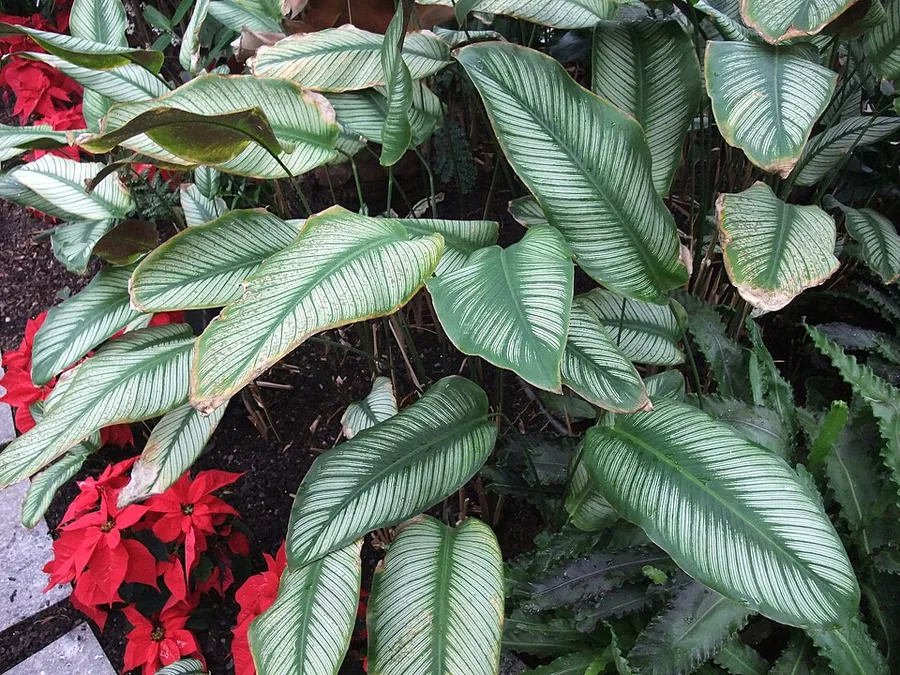
The pinstripe calathea owes its name to the fine pink and white lines ruled across each deep green leaf. The species sits in the prayer plant family, Marantaceae, and originates on the shaded forest floors of South America, from southeastern Colombia into Venezuela. That understory origin explains its cultural requirements directly: filtered light at the level a canopy would pass, steady warmth, and high humidity.
Like other members of its family, the plant performs nyctinastic leaf movement, raising its leaves at night and lowering them by day, the trait that gives the prayer plants their name. Its growth habit is clumping rather than vining, which keeps a mature specimen compact enough for a tabletop or shelf. The cost of that ornamental foliage is sensitivity, and the leaves register any shortfall in conditions quickly.
Calathea is rated a demanding houseplant, and the rating is earned through narrow tolerances. Hold water quality, humidity, and light within range and the foliage stays full and saturated in color. Allow any one of the three to drift and marginal necrosis follows, since the thin leaf tissue has little buffer.
Care
The short version: provide bright indirect light and no direct sun, keep the soil evenly moist with distilled water or rainwater, hold humidity above 60%, keep it warm, and feed lightly through the growing season.
Light
Provide bright, indirect light equivalent to what filters through a forest canopy. A few hours of diffuse light daily meets its needs, while direct sun overdrives the leaf and scorches tissue, fading the variegation as pigment breaks down. A partially shaded position near an east window matches that exposure.
Water
Keep the medium evenly moist but never waterlogged, and avoid letting the root zone dry out fully. The decisive factor is water chemistry, because calathea accumulates the fluoride, chlorine, and salts in tap water and expresses them as brown marginal necrosis. Distilled water or rainwater removes that load.
Soil
Use a well-drained, peat-based or African violet mix with a loamy structure that retains moisture without becoming anaerobic. A pH from 6.0 to 8.0 is workable, but holding it nearer 6.0 to 6.8 reduces fluoride availability to the roots and limits tip burn.
Temperature
Warmth is a hard requirement for this tropical species. Maintain 65°F to 75°F (18°C to 24°C) and keep it clear of cold drafts, chilled window glass, and air conditioning vents, since sudden temperature swings stress the foliage.
Humidity
Humidity is the most common point of failure indoors. The plant requires humidity above 60%, far above what heated or air-conditioned rooms hold, so a humidifier or pebble tray is justified, given that dry air drives transpiration past what the roots can replace and crisps the margins.
Feeding
Apply a balanced liquid houseplant fertilizer once a month through spring and summer. Withdraw feeding in fall and winter as growth slows, and keep doses light year round, because accumulated fertilizer salts add to the same osmotic stress that scorches leaf tips.
Pruning
No structural pruning is needed. Simply remove damaged, browned, or dead leaves at the base, which redirects the plant's resources and keeps the clump tidy without affecting its form.
Repotting
Repot every 1 to 2 years in spring, or earlier once it becomes rootbound. The signs are roots circling the pot or emerging from the drainage holes, water passing through without absorbing, and stalled growth. The spring lift is also the correct point to divide the rhizome.
Size & spacing
A mature clump reaches 1 to 3 feet (30 to 91 cm) in height and roughly the same in spread. Growth is lateral through rhizome expansion rather than upward, so allow a pot with room for the clump to widen.
Troubleshooting
Most calathea disorders register first in the foliage, and the underlying cause is usually water quality, light, or low humidity. Because the leaf reacts before the problem spreads, an early reading lets you correct the condition before further tissue is lost. Match the symptom below, then address the cultural factor driving it.
Collapse and yellowing paired with root decay
Wilting in saturated soil indicates root rot from overwatering rather than drought stress. Waterlogged, poorly drained mix excludes oxygen, the roots suffocate and decay, and they turn mushy, dark, and foul smelling. Unpot the plant, excise the rotted roots, repot into fresh well-drained medium, and resume watering only once the surface is no longer saturated.
Fix:
- Remove from pot, cut away rotted roots, and repot into fresh well-drained mix
- Reduce watering frequency and ensure the pot drains freely
Silken webbing plus stippled, faded leaf surfaces
Hot, dry air favors spider mites, which colonize the leaf undersides and feed on cell contents, producing fine webbing and a stippled, faded upper surface. Rinse and wipe the foliage to physically remove the population, then apply insecticidal soap or horticultural oil. Sustained high humidity suppresses reinfestation, since mites breed fastest in dry conditions.
Fix:
- Rinse foliage and wipe leaves to dislodge mites
- Treat with insecticidal soap or horticultural oil
- Raise humidity, which discourages mites
Marginal browning with crisp, necrotic leaf tips
The most common calathea disorder is marginal necrosis driven by water quality. The fluoride, chlorine, and salts in municipal tap water concentrate at the leaf margins and tips and kill the tissue there, and low humidity accelerates the loss. Move to distilled water or rainwater, raise humidity, and trim the necrotic edges, which will not regreen.
Fix:
- Switch to distilled water, rainwater, or well water instead of fluoridated tap water
- Increase ambient humidity with a humidifier or pebble tray
- Trim damaged leaf portions; keep soil pH around 6.0-6.8
- Avoid overfertilizing and flush soil periodically to remove salts
Variegation loss alongside bleached, sun-scorched areas
Excess direct light degrades the leaf pigments, washing out the pink-and-white striping and bleaching scorched patches into the lamina. The species evolved under canopy shade and lacks protection against full-strength sun. Return it to partial shade or bright indirect light, where a few hours of filtered exposure supply energy without photodamage.
Fix:
- Move plant out of direct sun to a partial-shade or bright-indirect location
- Provide filtered light (2-6 hours indirect light daily)
Toxicity
For households with animals, the verdict is clear: the pinstripe calathea is completely non-toxic. The ASPCA lists it as safe for cats, dogs, and horses, so an exploratory nibble poses no toxic risk. It ranks among the safest foliage plants for homes with pets or small children.
Safe for
People · Cats · Dogs · Horses · Rabbits · Livestock · Birds
Cats None
The ASPCA classifies calathea as non-toxic to cats, so an inquisitive bite will not poison a cat. A large mouthful of any foliage can still irritate a sensitive stomach and prompt some drooling or vomiting, but the reaction is mechanical, not toxic, since the plant contains no poison.
Dogs None
Dogs share the same safe status. The foliage contains nothing poisonous, though a dog that swallows a sizable piece may cough or experience brief gastric upset from the fibrous plant matter itself.
Horses None
The ASPCA also clears calathea for horses. As a tender tropical houseplant it rarely enters a horse's environment, and no part of it carries a toxin.
Rabbits None
Nothing in the plant harms a rabbit. Foliage outside a rabbit's accustomed diet can loosen the gut, so treat an incidental nibble as a one-off rather than a regular food.
Livestock None
Goats, sheep, and cattle encounter no toxin from this species. As an indoor tropical it remains well outside their reach in practice.
Birds None
Pet birds can perch among the broad leaves without risk, as the foliage holds no poison. A bird that shreds a leaf may simply leave debris behind.
People None
Calathea is safe to keep around children. It is not cultivated for consumption and has no edible parts, but a leaf reaching a small mouth gives no cause for concern.
Varieties
The named pinstripe-type calatheas separate mainly by the color and width of their leaf striping. The selections below are the ones most often offered.
'Albolineata'
This selection replaces the typical pink with thin stripes in white to light green.
'Beauty Star'
A compact cultivar at roughly 2 feet tall, distinguished by bright silvery venation.
'Roseolineata'
Its striping presents in a soft, pale pink.
'Sanderiana'
Fine pink stripes run across the upper leaf surface, set against a purplish flush below.
How to propagate
One method reliably increases a pinstripe calathea, and the most efficient time to use it is when the plant is already lifted for repotting.
DivisionModerate
Spring, before new growth starts, typically at repotting · Several weeks to a few months to root and resume growth
Division is the only reliable means of increase, because the species will not regenerate from a stem or leaf cutting as many houseplants do. Perform it in spring before new growth begins, ideally during the repotting lift, and separate the rhizome clump into sections that each retain roots and foliage so each can support itself. Hold the divisions warm with steady moisture, and expect several weeks to a few months for them to root out and resume active growth.
Myths
Prayer plants such as calathea carry compounds poisonous to dogs and cats.
This claim circulates widely but is not supported. The ASPCA lists both calathea and the prayer plant as non-toxic to dogs, cats, and horses, and NC State Extension records the same for Goeppertia ornata. The species is genuinely pet-safe.
The valid Latin binomial for this species is Calathea ornata.
Plant tags retain that name, but the taxonomy has been revised. Kew's Plants of the World Online now treats Goeppertia ornata as the accepted name and retains Calathea ornata only as a homotypic synonym. The organism is unchanged, so a label reading Calathea is still correct horticulturally.