Houseplant · Marantaceae
Calathea Orbifolia
Goeppertia orbifolia
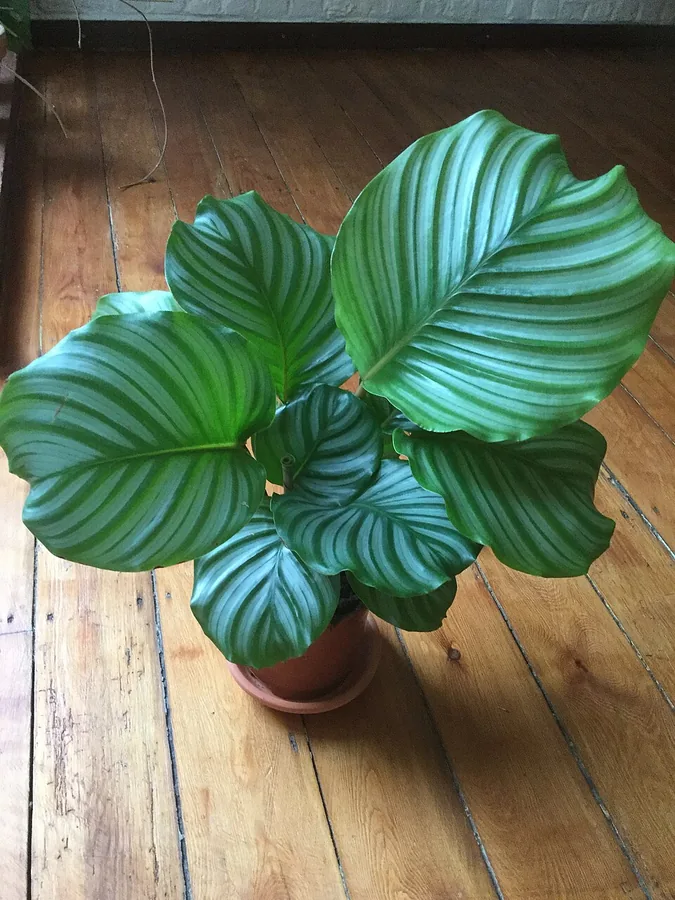
Broad, orbicular leaves marked with fine ribbon striping that closes at dusk, a nyctinastic habit typical of the prayer plants.
Bright indirect
65–75°F · 18–24°C
USDA 11–12
2–3 ft · 0.6–0.9 m
Overview
Calathea orbifolia is cultivated strictly as a foliage subject. The leaf blade is broad and nearly circular, washed in silver-green and banded with fine ribbon-like striping, and at nightfall the plant raises and presses its foliage together, the nyctinastic movement that gives the prayer plants their name. Its origin on the rainforest floor of eastern Brazil accounts for almost every cultural requirement that follows.
Taxonomically it belongs to the Marantaceae, the prayer plant family, and its accepted name is now Goeppertia orbifolia following the 2012 revision that transferred many Calathea species into the genus Goeppertia. The reclassification altered the nomenclature alone; the plant is unchanged, and most growers and the trade still apply the Calathea name.
This is a demanding species, and the reasons are physiological. Its native understory conditioned it to clean water and consistently humid air, so it responds poorly the moment either is withdrawn. Supply the correct light, water chemistry, and humidity, however, and it grows fast and densely, producing some of the most distinctly patterned foliage available indoors.
Care
The short version: bright indirect light with no direct sun, irrigation using distilled water or rainwater to hold the substrate evenly moist, room temperatures of 65°F to 75°F (18°C to 24°C), and relative humidity of at least 60%.
Light
Provide bright, indirect light and exclude direct sun, whose intensity bleaches the variegated pattern and scorches the lamina. The plant tolerates partial shade, but reduced irradiance slows growth and dulls coloration in a dim position. Limit any direct exposure to early-morning or well-diffused sun.
Water
Maintain the substrate evenly moist but never saturated, reducing frequency through winter as growth decelerates. Water chemistry is as consequential as volume, so irrigate with distilled water or rainwater. Fluoride and dissolved salts in tap water accumulate at the leaf margins and produce the characteristic brown tips and edges.
Soil
Use a moist yet free-draining medium, a loamy or peaty mix that retains moisture without compacting into mud. A slightly acidic to neutral pH between 5.5 and 7.0 is appropriate. The objective is a substrate that stays damp between irrigations while still shedding excess water.
Temperature
Hold warm, stable room temperatures of 65°F to 75°F (18°C to 24°C). The species has no tolerance for cold drafts or abrupt temperature drops, so position it away from doorways, vents, and chilled window glass.
Humidity
Humidity is the decisive variable for this plant. Target at least 60% relative humidity, which exceeds most domestic interiors, with a humidifier as the primary means of supply. A pebble tray and grouping with other plants offer supplementary benefit, while dry air is the fastest route to crisped tips and leaf rolling.
Feeding
During the growing season, spring through summer, apply a balanced houseplant fertilizer monthly at standard dilution. Suspend feeding over winter dormancy. It is not a heavy feeder, and excess fertilizer deposits salts that scorch the leaf margins.
Pruning
Pruning requirements are minimal. Simply excise damaged, browned, or yellowing leaves at the base as they occur, which maintains appearance and redirects resources toward sound growth.
Repotting
Repot every 1 to 2 years in spring, or earlier if roots circle the container, water passes straight through, and growth slows. Advance by a single pot size into fresh medium, since the species resents an excessive soil volume around its roots.
Size & spacing
Indoors it attains 2 to 3 feet (61 to 91 cm) in height with a spread of 12 to 24 inches (30 to 61 cm). Allow adequate spacing so the large blades can expand fully and air can circulate around them.
Troubleshooting
Nearly all complaints with this species present on the foliage, and nearly all reduce to one of three variables: water quality, humidity, or light. The leaf surface effectively reports the underlying fault. Identify the symptom below, then correct the causal factor rather than removing the visible damage alone.
Wilt, chlorosis, and softened roots
Persistently wet soil excludes oxygen from the root zone and induces root rot, rendering the roots brown and soft rather than firm and pale. Remove the plant, excise all rotted tissue, and repot into fresh, well-drained medium. Thereafter irrigate only enough to keep the substrate evenly moist, never allowing it to remain saturated.
Fix:
- Remove plant and cut away rotted roots
- Repot into fresh well-drained mix
- Water only to keep evenly moist, never soggy
Faded variegation with scorch lesions
Excess irradiance bleaches the variegated pattern and burns pale lesions into the most exposed leaves, with direct afternoon sun the typical agent. Relocate the plant to bright indirect light or partial shade, and subsequent growth emerges with the pattern fully restored.
Fix:
- Move to bright indirect light or partial shade
- Avoid direct afternoon sun
Webbing with fine feeding stipple
Low ambient humidity favors spider mites, which colonize the abaxial leaf surface and leave faint webbing alongside fine stippling from their feeding. Rinse the foliage, then treat with insecticidal soap or horticultural oil and repeat until the population is cleared. Sustained high humidity is the most effective deterrent against reinfestation.
Fix:
- Rinse foliage
- Treat with insecticidal soap or horticultural oil
- Raise humidity
Marginal browning and tip necrosis
This is almost invariably the tap water. Fluoride, chlorine, and dissolved salts accumulate and necrose the leaf margins while the interior remains green, a classic marginal scorch. Convert to distilled water or rainwater, raise relative humidity to at least 60%, and trim the necrotic edges if their appearance concerns you.
Fix:
- Switch to distilled water or rainwater
- Raise humidity to at least 60% with a humidifier or wet-pebble tray
- Trim damaged edges if desired
Leaves curling or rolling inward
Inward leaf rolling is a water-conservation response to air that has turned too dry or substrate that has run short of moisture, frequently accompanied by marginal browning. Raise humidity to at least 60% with a humidifier or pebble tray and maintain consistent soil moisture. The leaves generally re-expand once the plant's water status is restored.
Fix:
- Increase humidity to at least 60%
- Keep soil consistently moist
Brown or rusty spots dotting the leaves
Discrete spots appearing after irrigation indicate water resting on the foliage. Apply water at the substrate rather than overhead, and discontinue misting that leaves the lamina wet. Improved air movement around the plant accelerates surface drying and limits recurrence.
Fix:
- Water at the soil level and avoid wetting leaves
- Improve air circulation
Toxicity
For pet owners the profile is favorable, since this is among the safest plants you can house. The ASPCA classes Calathea and the prayer plant family as non-toxic to cats, dogs, and horses, and NC State Extension records the same status for Goeppertia orbifolia specifically. Ingestion by a curious cat or dog will not produce poisoning.
Safe for
People · Cats · Dogs · Horses · Rabbits · Livestock · Birds
Cats None
The ASPCA classes this plant as non-toxic to cats, so an exploratory bite warrants no concern. A cat that consumes a large quantity of any houseplant may regurgitate it, but that reflects gastric volume rather than toxicity.
Dogs None
It is non-toxic to dogs, with both the ASPCA and NC State Extension assigning it that status. No barrier is necessary, and no veterinary intervention is indicated should a dog ingest a portion.
Horses None
Horses may graze in its vicinity without hazard, as the ASPCA rates the prayer plant family non-toxic to horses.
Rabbits None
No toxic principle is present that would affect a rabbit. Even so, leafy houseplants have no place in a rabbit's diet, so any contact should remain an incidental nibble rather than fodder.
Livestock None
Goats, sheep, and other livestock are not subject to poisoning by this plant, which contains none of the toxins responsible for the field hazard posed by many ornamentals.
Birds None
A pet bird that samples a leaf is at no risk, since the plant holds no toxic compounds, although fertilizer or leaf-shine residue should be kept off foliage accessible to birds.
People None
Handling and an inadvertent taste present no risk of poisoning to children or adults. It is not a culinary plant, but it is firmly classified as non-toxic.
How to propagate
Propagation is limited to one technique, vegetative division of an established clump. The species does not root from cuttings, so a spring division is the only reliable method.
DivisionModerate
Spring · Several weeks to establish after potting up divisions
Division is the sole means of increase, as the species will not regenerate from a leaf or stem cutting. Perform it in spring: lift the rootball, separate it into clumps that each retain their own roots and foliage, and pot the divisions individually. Held under warm, humid, evenly moist conditions for several weeks, each division establishes and resumes independent growth.
Myths
Calathea orbifolia represents the currently valid botanical name.
It is now a synonym. Kew's Plants of the World Online lists the accepted name as Goeppertia orbifolia, an outcome of the 2012 revision that transferred numerous Calathea species into the genus Goeppertia. The organism is identical; only its formal name has been updated.
Prayer plants of this type are hazardous to dogs and cats.
The evidence contradicts that. The ASPCA classes Calathea and the broader prayer plant family as non-toxic to dogs and cats, and NC State Extension confirms the same for Goeppertia orbifolia by name. It ranks among the safest plants to keep around companion animals.