Houseplant · Marantaceae
Never-never Plant
Ctenanthe burle-marxii
Get the light, humidity, and water right and this prayer plant rewards you with bold, patterned leaves that fold up each night.
Bright indirect
50–84°F · 10–29°C
USDA 10–12
2–3 ft · 0.5–1 m
Overview
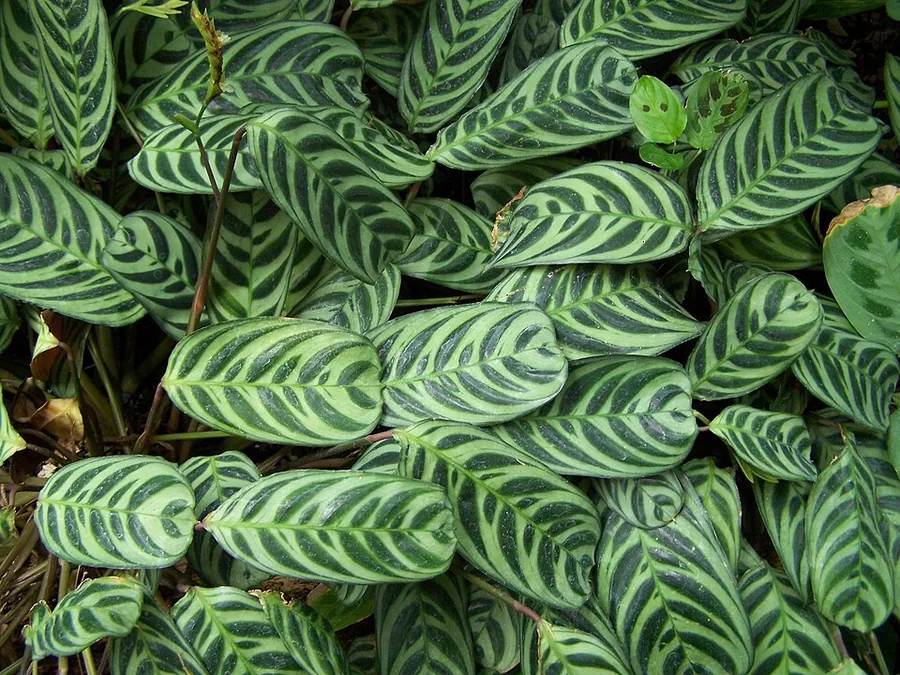
Ctenanthe earns its place through foliage rather than flowers, and the foliage is exceptional. The markings range from creamy-white variegation to dark green fishbone barring, frequently set against a purple or wine-red reverse. A member of the prayer-plant family native to the seasonally dry forests of southeast Brazil, it carries a genuinely tropical character into a bright interior position.
As a prayer plant, ctenanthe shares the nyctinastic habit of its calathea and maranta relatives: the leaves hold horizontal to intercept light during the day, then rise and fold at night, driven by changes in cell pressure at the leaf base. Growth is clumping rather than climbing or trailing, so the plant builds outward as a perennial mound that fills its container over time.
That display comes with real horticultural demands. Ctenanthe is a demanding plant that requires sustained warmth, high atmospheric humidity, and irrigation water free of dissolved minerals. Provide those and it holds dense, well-marked foliage, but allow the air to dry or irrigate with hard tap water and the plant registers the stress quickly as marginal browning.
Care
The short version: bright indirect light and no direct sun, paired with sustained warmth and high humidity. Hold the compost evenly moist with distilled or filtered water, grow it in a rich, well-drained mix, and feed monthly through spring and summer.
Light
Position ctenanthe in bright, indirect light and shield it from direct sun, which bleaches the variegation and scorches the lamina. It accepts partial shade and medium light, so an east- or west-facing aspect set back from the glass meets its requirements without risk of burn.
Water
Hold the compost evenly moist through spring and summer and reduce watering in winter, never permitting it to dry out fully or remain waterlogged. Water quality is the decisive variable: use distilled, filtered, or rainwater, since ctenanthe cannot tolerate the dissolved minerals and salts in tap water and expresses that intolerance as brown leaf tips.
Soil
Grow it in a rich, well-drained potting mix based on loam and humus, opened with orchid bark and perlite so it retains moisture while shedding excess. Any pH across the 6.0 to 8.0 range is acceptable, so structure and organic content matter more than precise acidity.
Temperature
Ctenanthe performs in warmth, broadly 50°F to 84°F (10°C to 29°C), and resents cold drafts. Maintaining it toward the upper part of that range supports the strongest growth, while exposure to chilled windows and doorways in winter checks it.
Humidity
The plant requires high humidity, exceeding the ambient level of most homes. Stand the pot on a moist gravel tray, group it with other plants to raise local humidity, or run a humidifier nearby, because dry air induces brown tips and favors spider mites.
Feeding
Apply a general liquid houseplant fertilizer monthly through spring and summer, the active growth cycle. Withhold feeding through autumn and winter, when slowed growth reduces nutrient demand considerably.
Pruning
Pruning requirements are minimal. Simply cut away damaged, browned, or yellowing leaves at the base to keep the clump tidy and to direct the plant's resources into healthy foliage.
Repotting
Repot once a year, ideally in late spring or early summer, advancing one pot size once roots crowd or circle and growth stalls. The annual change of medium also leaches out the accumulated salts to which this species is sensitive.
Size & spacing
Ctenanthe reaches roughly 1.5 to 3 feet (50 to 100 cm) in height with a clumping spread of 4 to 20 inches (10 to 50 cm). Growth is moderate, so allocate a container and a position that leave headroom for the clump to develop.
Troubleshooting
The foliage records nearly every cultural fault, and most faults trace to water quality, light, or humidity. Reading the early symptoms lets you correct the underlying cause before the damage advances. Match the sign below to its diagnosis, then act while intervention still helps.
Yellowing leaves over soft, mushy roots
Yellowing of the older leaves alongside saturated soil is the signature of root rot driven by overwatering, in which waterlogged mix starves the roots of oxygen and lets rot pathogens take hold. Sound roots remain firm and pale, while affected ones turn dark, soft, and foul-smelling. Halt watering and let the mix drain, then unpot the plant, excise the blackened roots, and repot into fresh well-drained mix in a container that drains.
Fix:
- Stop watering and let the mix drain
- Unpot and trim soft, blackened roots
- Repot into fresh well-drained mix in a pot with drainage
Fine webbing and a stippled, bronzed look to the leaves
Fine webbing on the undersides with a speckled, bronzed upper surface indicates spider mites, which feed on cell contents and breed fastest in dry air. Rinse and wipe the foliage to dislodge the colony, then raise humidity, because the higher moisture suppresses their reproduction. Persistent infestations respond to insecticidal soap or horticultural oil applied per the label.
Fix:
- Rinse foliage and wipe leaves
- Raise humidity to discourage mites
- Treat with insecticidal soap or horticultural oil per label
Fuzzy gray mold on the leaves
A fuzzy gray coating on the foliage is Botrytis gray mold, a fungus that colonizes leaf tissue when high humidity coincides with still, stagnant air and the surface stays wet long enough for spores to germinate. Remove the infected foliage promptly to cut the inoculum. Improve air movement and keep the leaves dry, since the requirement is humid air rather than persistent surface moisture.
Fix:
- Remove affected foliage
- Improve air circulation
- Avoid wetting foliage and reduce standing moisture
Brown, crispy tips and margins on the leaves
These crisped edges point to mineral and salt accumulation from tap water, because ctenanthe lacks the tolerance for the fluoride, chlorine, and dissolved salts that tap supplies carry, and those salts concentrate at the leaf margins where transpiration ends. Dry air compounds the loss. Move to distilled, filtered, or rainwater, trim the dead margins, and raise humidity around the plant to slow the rate at which salts draw to the edges.
Fix:
- Switch to distilled, filtered, or rainwater
- Trim off dead brown edges
- Raise humidity (tray of moist gravel, group plants, or humidifier)
Faded markings and bleached patches on the leaves
A washed-out pattern with pale, scorched patches signals photodamage from direct sun, which degrades the leaf pigments and burns the tissue most exposed to the light. Ctenanthe carries no tolerance for direct rays. Return it to bright indirect light or partial shade, and remove the worst-scorched leaves, since burnt tissue will not recover and only drains the plant.
Fix:
- Move to bright indirect light or partial shade
- Remove the worst-scorched leaves
Leaves that curl, wilt, or droop
Curling and wilting over dry soil reflect underwatering, as the leaf loses turgor faster than the roots can replace the water, and the margins brown once moisture runs short. Water thoroughly with distilled or filtered water to rehydrate the rootball. Then maintain an even moisture level, since wide swings between dry and wet stress the plant more than steady moisture ever would.
Fix:
- Water thoroughly with distilled/filtered water
- Resume keeping the compost evenly moist
Toxicity
For owners with pets, the verdict is reassuring: ctenanthe is a prayer plant in the non-toxic Marantaceae family, alongside calathea and maranta, and it carries no known toxin. It is safe to keep among cats, dogs, and children without precaution. Ingestion of a large quantity of any houseplant may produce mild gastric upset, but nothing poisonous is present here.
Safe for
People · Cats · Dogs · Horses · Rabbits · Livestock · Birds
Cats Safe
A cat may brush against or sample the foliage with no toxic consequence, since the plant contains no recognized poison. Should a cat ingest a large quantity, the likely result is transient gastric upset, the nonspecific response to any quantity of plant matter.
Dogs Safe
Dogs face no toxic hazard from ctenanthe, as the leaves hold nothing poisonous. A chewed specimen amounts to a disturbed pot rather than a clinical emergency.
Horses Safe
The plant contains no compound that would poison a horse. As a tender indoor species it rarely enters a horse's environment, yet exposure would carry no risk.
Rabbits Safe
Rabbits incur no toxic risk from ctenanthe, the foliage being harmless. An incidental nibble warrants no concern.
Livestock Safe
Grazing animals such as goats and sheep would suffer no poisoning, as the plant carries no toxic compound. Its indoor habit keeps it well outside the grazing range in any case.
Birds Safe
Pet birds are unaffected by the foliage, since nothing in ctenanthe is toxic to them. A bird that perches on or pecks at it comes to no harm.
People Safe
Cultivated for its patterned foliage rather than for consumption, the plant nonetheless contains no toxin and presents no hazard to adults or children who handle or taste it.
Safe to keep around pets and children; the foliage contains nothing harmful if nibbled
Varieties
Ctenanthe spans several species and cultivars that differ chiefly in leaf pattern and ultimate size. The selections below are the ones most often offered in cultivation.
Ctenanthe oppenheimiana 'Tricolor' (never-never plant)
Its lance-shaped, leathery leaves bear irregular creamy-white variegation over pale and dark green, underlaid by a wine-red flush on the reverse.
Ctenanthe burle-marxii (fishbone prayer plant)
Dark green herringbone bars cross its pale green leaves in a fishbone arrangement, and the purple undersides become visible as the leaves fold upward at night.
Ctenanthe lubbersiana (bamburanta)
A vigorous grower attaining 2 to 3 feet tall and 3 to 4 feet wide, its yellow-and-green variegated foliage gives it the most pronounced markings of the group.
Ctenanthe amabilis
A more compact and notably frost-tender species reaching roughly 4 to 20 inches in height and spread, best confined to indoor cultivation.
How to propagate
Propagation is most dependable by dividing an established plant, timed to coincide with spring repotting.
DivisionModerate
Spring (or late spring to early summer at repotting) · Several weeks
The most reliable method is vegetative division in spring, performed conveniently while repotting in late spring or early summer. Lift the plant and separate the clump into sections, each retaining its own root mass and several leaves so it can support itself. Hold the divisions warm, humid, evenly moist, and out of drafts while they regenerate roots, which takes several weeks. Seed propagation is also possible from a warm spring sowing at 66°F to 75°F (19°C to 24°C).
Myths
Ctenanthe is just a calathea by another name.
Ctenanthe is a distinct genus rather than a calathea, despite the close resemblance and their shared membership in the prayer-plant family. From a safety standpoint the confusion carries no weight, because calathea, maranta, and ctenanthe all belong to the non-toxic, pet-safe Marantaceae family. The nomenclature differs, yet a curious pet remains unharmed around any of them.
Ordinary tap water is fine for prayer plants.
Ctenanthe cannot process the minerals and salts that accumulate from tap water, and the earliest diagnostic sign is brown, crispy leaf tips. Distilled, filtered, or rainwater keeps the foliage clean by removing the offending solutes. Where brown margins have already developed, correcting the water source is what reverses the trend.
Sources
- Plants of the World Online, Royal Botanic Gardens Kew
- Plants of the World Online, Royal Botanic Gardens Kew
- NC State Extension Gardener Plant Toolbox
- NC State Extension Gardener Plant Toolbox
- Royal Horticultural Society (RHS)
- ASPCA Animal Poison Control
- ASPCA Animal Poison Control
- Royal Horticultural Society (RHS)