Houseplant · Cactaceae
Star Cactus
Astrophytum asterias
Match its desert origins with bright light, gritty mineral soil, and a full dry-down between waterings, and this spineless cactus needs little more.
Bright indirect
Every 14–21 days
USDA 9–11
1–2 in · 3–6 cm
Overview
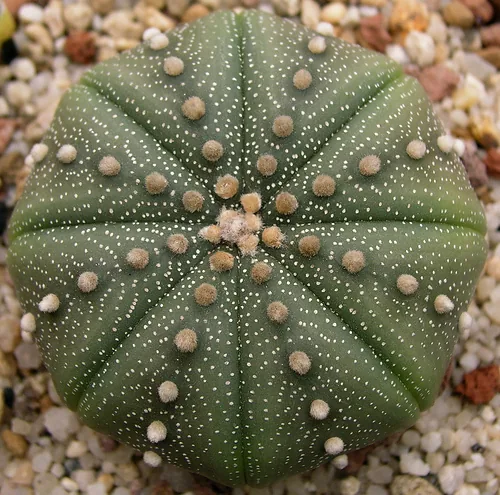
Astrophytum asterias is a diminutive desert cactus, a spineless, ribbed dome that flattens against the ground much like a sand dollar. Its native range spans only a narrow corridor of south Texas and northern Mexico, where it grows nearly flush with the rocky soil. Growth is slow enough that a specimen the size of a coin may be years old. The pale woolly flecks distributed over its green body produce the starry pattern that names it.
It belongs to the family Cactaceae yet departs from type by bearing no spines whatsoever, which makes it simple to handle. That smooth surface underlies its long confusion with peyote, a resemblance that has fueled heavy illegal collection across its range. In late spring it produces yellow flowers with red throats borne directly on the crown of the body.
The plant demands little, provided the care it does receive is correct. It ranks among the most heavily protected of all cacti, endangered in habitat and closely regulated in trade, so any cultivated specimen should originate from a nursery. Get the substrate and the watering regime right, and the rest follows without intervention.
Care
The short version: supply bright light and a sharply draining mineral mix, irrigate deeply only after the substrate has dried through completely, and withhold water almost entirely across winter dormancy.
Light
Bright light is the first requirement. The species performs best in bright, indirect light and tolerates some direct sun, but any transition into strong sun should be gradual, since a plant acclimated to shade will scorch if moved abruptly to a hot window.
Water
Water is where most specimens are lost. Irrigate deeply only once the gritty mix has dried through completely, which under active growth in spring and summer falls at roughly every 14 to 21 days. Through winter keep the plant nearly dry, because in the cold the fleshy body rots quickly if it is left wet.
Soil
Use a fast-draining mineral mix, sandy or gravelly and low in organic matter. A near-neutral pH of 6.5 to 7.5 is appropriate. The grit matters because it moves water past the roots before saturation can set rot in motion.
Temperature
The species tolerates a broad range, roughly 23°F to 95°F (-5°C to 35°C), though the lower figure holds only for a plant kept bone dry. Warmth drives active growth, whereas the combination of cold and moisture is what causes real damage.
Humidity
Keep humidity low, in the region of 20% to 40%. As a desert species it is adapted to dry air, and stagnant humid conditions favor the rot and fungal problems it resists poorly.
Feeding
Fertilize sparingly and only during the spring-summer growth period. A dilute, low-nitrogen cactus feed once monthly suffices, since excess nitrogen forces soft, weak growth prone to splitting and rot.
Pruning
No formative pruning is warranted. Use a sterile blade solely to remove spent flowers or rotted tissue, never to shape the plant.
Repotting
Repot every 2 to 3 years, or earlier if roots emerge from the drainage holes or the body occupies the whole pot. Transfer it into fresh gritty mix and withhold water for a few days so that disturbed roots can callus and heal.
Size & spacing
This is a small species. Mature height reaches only 1 to 2 inches (3 to 6 cm), with a spread of about 2 to 6 inches (5 to 15 cm), and its slow rate means it remains comfortable in a small pot for years.
Troubleshooting
Nearly every disorder in cultivation traces to the water regime, and it registers on the body itself. Learn to distinguish soft tissue, a shrunken body, and cottony infestations, and you can intervene before minor error becomes fatal. Match the sign below and respond promptly.
Soft, dark, mushy lesions on the body or near the base
This is rot, and in a star cactus it nearly always originates from excess water or a mix that retains it. It commonly begins at the soil line, where persistent moisture rests against the fleshy body. Cease watering at once, excise back to firm green tissue with a sterile blade, allow the wound to callus in dry, airy shade, and repot into fresh gritty mineral mix.
Fix:
- Stop watering immediately
- Cut away all rotted tissue with a sterile blade until only firm green tissue remains
- Let the cut surfaces callus in dry, airy shade
- Repot into fresh fast-draining mineral mix and water only sparingly once healed
A wrinkled, shrunken, or flaccid body
A shriveled body indicates one of two conditions. If the substrate is bone dry and the roots remain sound, the plant is simply dehydrated, and a thorough soak restores turgor. If the substrate is still moist, suspect root loss to rot and manage it accordingly, cutting back to healthy tissue and re-rooting in dry mineral mix.
Fix:
- If dehydrated, give a thorough soak and resume regular dry-down watering
- If roots are rotted, treat as rot: cut back to healthy tissue, callus, and re-root in dry mineral mix
White cottony tufts in the areoles with weak, off-colour growth
Those cottony masses are mealybugs, sheltering in the woolly areoles where detection is difficult. Test one by probing it: the insect smears, whereas the plant's own white wool and flecks do not. Isolate the specimen, treat each insect with a swab of 70 percent isopropyl alcohol, then repeat weekly and examine the roots, since root mealybugs also conceal themselves below the soil.
Fix:
- Isolate the plant
- Dab visible insects with a cotton swab dipped in 70 percent isopropyl alcohol
- Repeat weekly and inspect the roots, drenching with an appropriate insecticide if root mealybugs are present
Toxicity
On safety the record is clear: Astrophytum asterias is non-toxic to pets and people. It contains no toxin, and despite the peyote nickname it carries no mescaline. Being spineless, it presents no mechanical injury to a curious nose, though it is not cultivated as an edible.
Safe for
People · Cats · Dogs · Horses · Rabbits · Livestock · Birds
Cats None
Safe to keep in a shared room. A cat that samples the body may drool or regurgitate slightly, an effect of plant matter on the stomach rather than any toxin.
Dogs None
No poisoning hazard applies. A dog that chews a fragment may experience transient stomach upset from the fibrous tissue, and the absence of spines means no injury to the mouth.
Horses Safe
The cactus contains nothing toxic to horses, so proximity poses no risk.
Rabbits Safe
Non-toxic to rabbits. It holds no harmful compound, though it is not forage and should not feature in their diet.
Livestock Safe
Cattle, goats, and sheep may graze in its vicinity without poisoning, as the plant contains no harmful constituents.
Birds Safe
No toxic risk to birds. A bird that pecks the flesh sustains no chemical harm.
People Safe
Safe to handle and to keep near children. It contains no mescaline despite the peyote association, but it is not grown as food and should not be eaten.
Though spineless, handle this rare protected plant minimally and wash hands after contact with any houseplant; keep out of reach of pets or children inclined to chew it.
Varieties
Collectors maintain a handful of named selections, most distinguished by how their white flecks and areolar wool are expressed across the body. The following are the ones worth knowing.
'Super Kabuto'
A selected cultivar so densely covered in large white woolly flecks that they can nearly obscure the green body beneath.
var. nudum
A naturally fleckless form presenting a smooth, unmarked green body, recognized by Kew as a distinct variety.
'Ooibo Kabuto'
Distinguished by the unusually large, raised wool spots seated on its areoles.
How to propagate
Two methods are used in practice, neither of them quick. Seed preserves the plant's genetic diversity, while grafting onto a stronger rootstock accelerates development.
SeedDemanding
Spring, in warmth · Several months to germinate and establish; years to reach flowering size
Seed is the principal method and the one that best conserves genetic diversity. Sow fresh seed in spring onto a sterile gritty mix and maintain warmth and humidity until germination. The seedlings grow slowly and are prone to rot, so harden them off in stages and expect a long timeline, since establishment takes several months and flowering size takes years.
GraftingModerate
Spring-summer, during active growth · A few weeks for the graft union to take
Grafting onto a vigorous rootstock is used to accelerate growth and bypass the rot that claims many seedlings, and it is favored for prized cultivars. Performed in spring or summer during active growth, the graft union unites within a few weeks.
Myths
Star cactus is peyote and a source of mescaline.
The species is confused with peyote frequently enough that star peyote persists as a common name, yet the two are distinct plants and this one contains no mescaline. That misidentification alone sustains illegal collection of an already endangered cactus.
Because it lacks spines, it is durable and tolerates the watering of a leafy houseplant.
A spineless body has no bearing on the plant's water requirement. Its succulent tissue decays rapidly under frequent irrigation and requires the same dry-down cycle and gritty substrate as any desert cactus.
Wild star cactus may be legally collected or purchased.
The species is federally endangered and listed on CITES Appendix I, so removing plants from habitat or trading wild-sourced material is unlawful. Only nursery-propagated specimens may be lawfully held.