Shrub · Rosaceae
Japanese Spirea
Spiraea japonica
A tough, fast, forgiving shrub, Japanese spirea carries flat pink flower clusters and shifting foliage color from spring through fall.
Full sun
Every 5–10 days
USDA 3–8
4–6 ft · 1.2–1.8 m
Overview
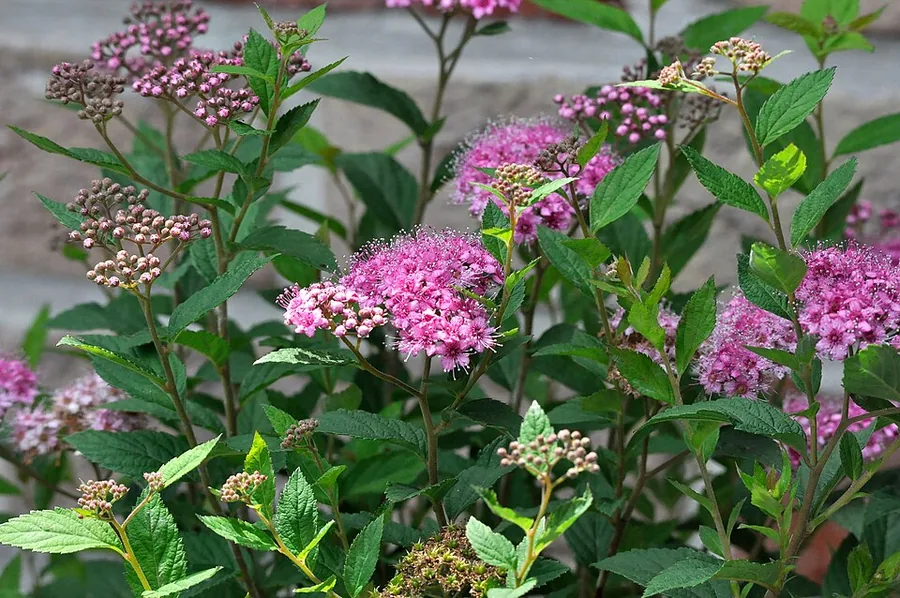
Spiraea japonica is a deciduous shrub in the rose family that develops a low, rounded mound near 4 to 6 feet (122 to 183 cm) tall. A fast growth rate lets it reach that size within a season or two, and it opens flat-topped clusters of pink flowers in early summer. Many named selections were chosen for leaf color and carry gold, lime, bronze, or red foliage in addition to the flowers.
Its appeal rests on genuine toughness: cold hardiness to zone 3, tolerance of clay and shallow rocky soils, and a habit of flowering on new wood, which is why pruning stays uncomplicated. The flowers attract butterflies during bloom, and the foliage often colors reddish before leaf drop. Few shrubs return this level of performance for so little maintenance.
One caveat carries real weight. Spiraea japonica seeds freely and spreads by suckers, and across much of the eastern and southeastern US it has naturalized out of cultivation and become invasive, displacing native flora. In those areas a sterile cultivar or a regionally native shrub is the sounder selection.
Care
The short version: site it in full sun and well-drained soil, water through the establishment season and during drought afterward, apply a light spring feeding, and prune in late winter so the flowers form on the current season's wood.
Light
Spirea flowers most freely and holds the deepest foliage color in full sun, since bloom and pigment both depend on strong light. It tolerates partial shade, but reduced light yields fewer flowers and a looser, leggier framework.
Water
Keep the soil evenly moist while a young shrub roots in, watering about every 5 to 10 days until it establishes. After that it withstands short dry spells on its own. Persistently wet soil is the hazard, because saturated ground deprives roots of oxygen and rots them.
Soil
The plant adapts to nearly any soil, from clay to shallow rocky ground, which underlies its reputation for toughness. It performs best in rich, well-drained loam high in organic matter, and it accepts a broad pH range of 6.0 to 8.0.
Temperature
Cold hardiness is a defining trait: the shrub endures winter lows to -35°F (-37°C) and summer highs to 95°F (35°C). That breadth of tolerance explains its performance across so much of the country.
Humidity
Ambient humidity is not a factor outdoors, so no target figure applies. Air circulation matters more, because still, humid conditions around dense foliage favor leaf spot fungi.
Feeding
Fertility needs are low. A balanced shrub fertilizer or compost in early spring is sufficient, and heavier feeding is counterproductive, since this is a low-feeding shrub that declines on rich diets.
Pruning
Because flowering occurs on new wood, the main pruning belongs in late winter to early spring, before growth resumes, so no flower buds are lost. Shearing spent clusters after the first bloom often triggers a second flush within the same season. Bumalda selections require lighter pruning than the larger species.
Repotting
In the landscape the shrub is never repotted. Container specimens can be potted up or root-pruned every 2 to 3 years, with circling roots and water passing straight through the medium indicating the need.
Size & spacing
Allow for a mounded habit of 4 to 6 feet (122 to 183 cm) in height and a wider spread of 5 to 7 feet (152 to 213 cm). Adequate spacing sustains air movement through the canopy and limits leaf spot.
When to plant
This is an outdoor landscape shrub, reliably hardy across USDA zones 3 to 8. Set out container or balled-and-burlapped stock in spring or fall, and expect flat pink flower clusters from June to July, with limited intermittent rebloom thereafter.
Northern hemisphere
Southern hemisphere
Typical months for a temperate climate: start earlier in warm zones, later where spring frosts linger.
- Sow: Seed is rarely used by home gardeners; if started, sow indoors in late winter, though cultivars do not come true from seed.
- Plant: Plant container or balled-and-burlapped shrubs in spring or fall.
- Harvest: Showy pink (or white to red in some cultivars) flat-topped flower clusters from June to July, with sparse intermittent rebloom possible.
Hardiness
USDA hardiness zones: 3–8
Temperature: down to -40°C
Troubleshooting
Japanese spirea is difficult to kill, and its problems are few and readable. A spring pest, a wet-weather leaf disease, and waterlogged soil account for nearly all of them, and only the last does lasting damage. Identify the symptom below and intervene early.
Wilting and dieback in saturated soil
A spirea that wilts and declines in soggy ground is developing root rot, in which waterlogged soil starves the roots of oxygen until they turn brown and soft. Improving drainage or relocating the shrub, along with reduced watering, addresses the cause. Lost roots do not regenerate, so a severely affected plant cannot be saved, which makes prevention decisive.
Fix:
- Improve drainage or relocate the shrub to a better-drained site
- Reduce watering and avoid wet, compacted soil
- Remove severely affected plants
Sticky, distorted new growth colonized by insects
Soft-bodied insects massing on the tender shoots are aphids, which concentrate on the flush of spring growth. A strong jet of water dislodges most colonies, and insecticidal soap or horticultural oil handles the heavier ones. Preserved lady beetles and lacewings suppress the remainder as natural predators.
Fix:
- Knock aphids off with a strong jet of water
- Treat heavier infestations with insecticidal soap or horticultural oil
- Encourage and preserve natural predators such as lady beetles and lacewings
Bordered leaf spots progressing to yellowing
Discrete spots with defined dark margins indicate fungal leaf spot, which advances when foliage stays wet and air movement is poor. Removing fallen leaves, thinning crowded stems, and watering at the base to keep foliage dry all interrupt the cycle. The damage is largely cosmetic and seldom endangers an established shrub.
Fix:
- Remove and dispose of fallen and heavily spotted leaves
- Improve air circulation by thinning crowded stems
- Water at the base to keep foliage dry
Toxicity
For pet owners the record is reassuring: Japanese spirea is not toxic. It is absent from the ASPCA poison list and has no documented toxic principle, so cats, dogs, and livestock can occupy the same garden without risk. Ingesting a large quantity of any non-food plant may cause brief gastric upset, but nothing beyond that.
Safe for
People · Cats · Dogs · Horses · Rabbits · Livestock · Birds
Cats None
No toxic compound is recorded in spirea, so it is safe for cats. A leaf sampled out of curiosity poses no threat, though a large quantity of any plant can produce transient drooling or mild gastric upset.
Dogs None
Dogs face no toxicity from this shrub. The likely outcome of chewing is mild, self-limiting digestive upset from the fiber, not poisoning.
Horses Safe
No toxicity is documented in horses, so a planting adjacent to a paddock carries no real risk. As with any non-forage shrub, consuming a large amount may cause minor digestive disturbance.
Rabbits Safe
Rabbits are unaffected by spirea, which contains no known toxin. It is not a forage plant, so limit consumption to occasional browsing rather than a dietary staple.
Livestock Safe
Cattle, goats, and sheep can graze near spirea safely, as it holds no recognized poison. Heavy consumption of any woody shrub may unsettle the digestive tract, which is the extent of the concern.
Birds Safe
Spirea is harmless to birds, and its summer flowers draw butterflies and other pollinators. Backyard poultry can forage beneath it without concern.
People Safe
No toxic principle is documented for humans, so the shrub is safe around children. It is not cultivated for consumption, so treat it strictly as ornamental.
As with any non-food plant, ingestion of large amounts of plant material may cause mild, transient stomach upset; no specific toxic principle is documented.
Varieties
Most spirea sold at retail are named cultivars, selected as much for foliage color as for flower. The following are the ones worth recognizing.
Goldmound
A compact, mounding selection that combines bright golden-yellow foliage with soft pink flowers.
Limemound
Bears lime-green to golden leaves on a low mound that color reddish in fall above pink blooms.
Goldflame
Emerges bronze-red to orange in its new growth before maturing, set against deep pink flowers.
Froebelii
A vigorous Bumalda type recognized for deep carmine-pink flowers and reddish new foliage.
Double Play Candy Corn
Unfolds candy-apple-red leaves that mature to pineapple-yellow and then green, above purple-red flowers.
How to propagate
Japanese spirea propagates with unusual ease, which is one mechanism behind its spread in the wild. It roots from cuttings, divides from suckering clumps, and grows from seed, though seed rarely preserves a cultivar's traits.
Stem cuttingsEasy
Take softwood stem cuttings in late spring to early summer. · 4 to 8 weeks to root under suitable conditions.
Softwood cuttings taken in late spring to early summer root readily, striking in 4 to 8 weeks under suitable conditions. That same rooting ease contributes to the plant's aggressive spread in the wild.
DivisionEasy
Divide established clumps or rooted suckers in early spring or fall. · One growing season to become established.
Because spirea produces suckers, rooted offshoots can be lifted and separated from an established clump in early spring or fall. Replanted divisions need a full growing season to establish.
SeedModerate
Sow seed in late winter to early spring. · Several months to a full season; seedlings of named cultivars do not come true to type.
Prolific self-seeding underlies the species' invasive behavior, and deliberately sown seed takes several months to a full season to yield a plant. Named cultivars do not come true from seed, so vegetative propagation preserves their traits.
Myths
Japanese spirea is a safe, harmless ornamental you can plant anywhere in the eastern United States.
Pet safety is accurate, but it does not settle the question. Spiraea japonica seeds heavily and has escaped cultivation across the eastern and southeastern US, where it is classified as invasive and outcompetes native plants. In those regions a native shrub is the responsible choice.
Prune Japanese spirea in fall or immediately after bloom to increase next year's flowers.
Because the shrub flowers on new wood, the principal pruning belongs in late winter to early spring, before growth begins. Removing only the spent flower heads after bloom is what prompts a second flush. Mistime the hard pruning and the season's display is forfeited.