Vegetable · Brassicaceae
Rutabaga
Brassica napus subsp. rapifera
Sow in summer heat and let autumn cold convert root starch into sugar, the mechanism behind rutabaga's sweet, long-storing fall harvest.
Full sun
Every 3–7 days
41–77°F · 5–25°C
90–100 days
Overview
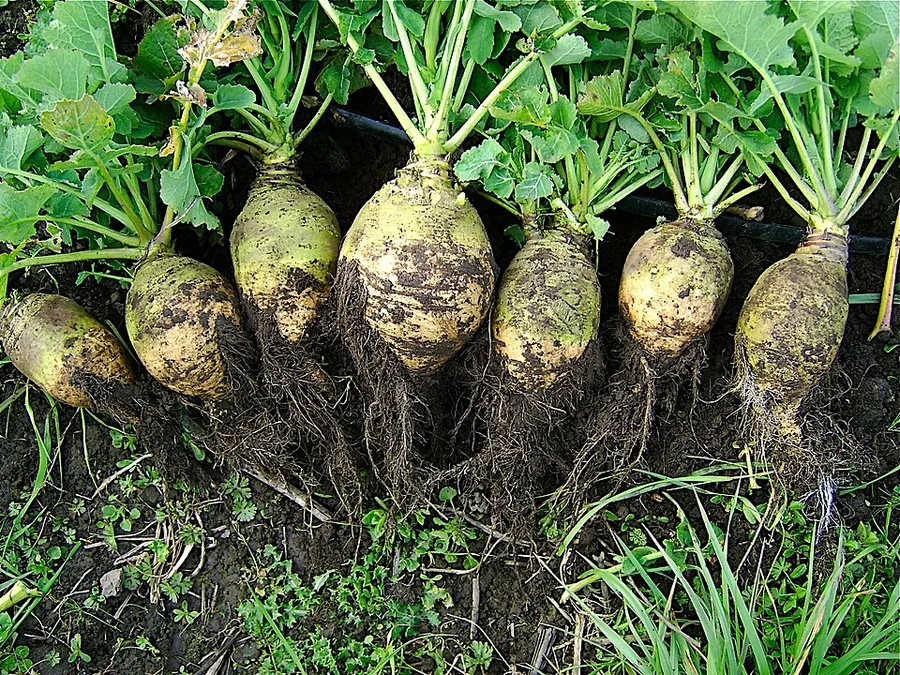
Rutabaga is a cool-season root crop within the Brassicaceae, cultivated for the swollen, yellow-fleshed storage organ that develops at the soil surface. The species most likely originated as a hybrid of turnip and wild cabbage, and it has supplied both northern households and overwintered livestock for centuries. It circulates under the names swede and Swedish turnip, and it performs best in regions of mild summers and genuinely cold autumns.
The defining requirement is time in cool conditions. Rutabaga needs a long, cool season of around 90 to 100 days, considerably longer than a turnip, and it develops most efficiently as temperatures decline into fall. Because the dense roots hold in a cool cellar for months, the crop functioned as a winter staple well before mechanical refrigeration existed.
Cultural demands are modest once the crop is established. Provide deep, loose soil, maintain even moisture, and allow adequate spacing for the root to expand, then rely on falling temperatures to finish it. Several hard freezes convert the root's starch to sugar, which is why a root lifted in late fall is markedly sweeter than one harvested prematurely.
Care
The short version: rutabaga needs full sun and deep, loose, well-drained soil, with roughly an inch of water weekly to prevent the woody, bitter roots that dry spells produce. Direct sow in summer, thin to 8 inches apart, and harvest in fall once one or more hard frosts have raised the sugars.
Light
Rutabaga performs best under full sun, meaning roughly 6 or more hours of direct light daily, because ample photosynthesis drives root bulking. It tolerates partial shade, but reduced light slows sizing and limits final root diameter.
Water
Maintain even soil moisture, on the order of an inch of water per week, particularly during root enlargement. Inconsistent moisture, alternating drought with saturation, produces woody, cracked, and bitter roots, so the goal is uninterrupted supply rather than heavy irrigation.
Soil
Grow rutabaga in deep, loose, fertile loam that drains freely and carries abundant organic matter, cleared of stones so the taproot can descend without deflection. A pH of 6.0 to 7.0 is suitable, and holding near the upper limit also suppresses clubroot, whose pathogen is less active in near-neutral soil.
Temperature
As a cool-season crop, rutabaga grows within 41°F and 77°F (5°C to 25°C) and accumulates sugars as conditions cool. Elevated temperatures toughen the flesh and sharpen the flavor, whereas autumn frost triggers the enzymatic conversion of starch to sugar.
Humidity
Ambient outdoor humidity meets the crop's needs, so no target value applies. More relevant are consistent soil moisture and free air movement through the canopy, which reduce the leaf wetness that foliar pathogens exploit.
Feeding
Side-dress with nitrogen, such as calcium nitrate or a balanced fertilizer, about 3 to 4 weeks after planting to build leaf area before the root enters its bulking phase. Where compost was incorporated pre-plant, that reserve supplies much of the requirement.
Pruning
No pruning is warranted. Thin the stand to about 8 inches apart so each root has the volume it needs to size fully, and remove diseased foliage to limit inoculum in the bed.
Size & spacing
Foliage reaches roughly 12 to 18 inches (30 to 45 cm) in height, with the enlarged root seated at the soil line. Allotting about 8 inches (20 cm) per plant supplies the room required for a root to reach full girth.
When to plant
Rutabaga is sown in summer warmth and matured into cold, a scheduling that exploits its cool-season physiology. Direct sow from late spring through mid-summer, allow the full cool interval it requires to size the root, and delay lifting until one or more hard frosts have driven the starch-to-sugar conversion.
Northern hemisphere
Southern hemisphere
Typical months for a temperate climate: start earlier in warm zones, later where spring frosts linger.
- Plant: Direct sow in late spring to early summer (late May to early June in northern gardens; mid-summer to early fall in the South) for a fall harvest
- Harvest: Harvest in fall after one or more hard frosts, which sweetens the roots
Hardiness
USDA hardiness zones: 3–9
Temperature: down to -40°C
Troubleshooting
The most consequential rutabaga problems develop below ground or on emerging seedlings, where they escape early notice. Learning to interpret the aboveground symptoms lets you intervene before a soil pest or disorder compromises the crop. Match the presentation below and respond while intervention still changes the outcome.
Brown tunnels boring through the root with wilting outer leaves
Channels excavated through the flesh near the crown, together with wilting outer foliage, indicate cabbage maggot, whose larvae feed within the root. Because feeding damage is irreversible, lift and destroy infested roots rather than composting them. A floating row cover applied at sowing excludes the egg-laying flies, and rotating brassicas onto fresh ground each season denies the pest a host.
Fix:
- Remove and destroy infested roots
- Avoid planting brassicas in the same bed in successive years
Stunted plants with swollen, club-shaped roots
Swollen, distorted roots accompanied by midday wilting are diagnostic of clubroot, a soil-borne pathogen that persists in the ground for years. No treatment reverses infection, so remove and destroy affected plants without composting them. Maintaining pH near 7.0, improving drainage, and rotating away from cabbage-family crops each reduce the pathogen's activity and spread.
Fix:
- Remove and destroy infected plants
- Do not compost infected material
Small round shot-holes across the young leaves
Numerous small round perforations, concentrated on seedlings during warm, dry weather, are the feeding scars of the flea beetle; tapping the foliage dislodges the tiny black beetles, which spring away. Since seedlings are most vulnerable, a row cover from emergence physically excludes the beetles, and steady watering sustains growth that outpaces the damage.
Fix:
- Cover seedlings with row cover
- Keep plants well watered and vigorous to outgrow damage
Brown, watery core within an outwardly normal root
A grey-brown, corky or watery center beneath sound skin, often with a bitter taste, is brown heart, a disorder caused by boron deficiency. Sectioning a root confirms internal breakdown while the exterior appears intact. Because boron is toxic in excess, correct it only on the basis of a soil test, and hold moisture steady on lighter soils where the deficiency is more likely.
Fix:
- Apply boron-containing fertilizer only per a soil test
- Maintain even soil moisture
Toxicity
Rutabaga is a food crop, and all parts are safe for humans and animals. The roots and foliage have a long record of human consumption and livestock feeding; the only caveat is the glucosinolate content, which warrants moderation in large raw quantities.
Safe for
People · Cats · Dogs · Horses · Rabbits · Livestock · Birds
Cats None
Rutabaga, cooked or raw, is non-toxic to cats, although most show little interest. A small quantity of root or foliage produces no adverse effect.
Dogs None
Plain rutabaga is a suitable occasional treat for dogs, and many accept a cooked portion. Limit the amount, since the added fiber can disturb a sensitive digestive tract.
Horses Safe
Horses tolerate rutabaga without difficulty. Cut it into small pieces rather than offering an intact root, which presents a choking risk.
Rabbits Safe
Both the root and the leafy tops are safe for rabbits within a varied diet. Introduce any new vegetable gradually to allow the gut flora to adapt.
Livestock Safe
Rutabaga has a long history as winter fodder for cattle and sheep, roots and tops alike. Sustained heavy grazing of the raw brassica can depress thyroid function through its glucosinolate goitrogens, so it should be balanced with other forage.
Birds Safe
Chickens and other backyard poultry consume both the root and the greens without harm. Chopping it finely makes it easier to ingest.
People Safe
Rutabaga is a nutritious culinary vegetable, suited to roasting, mashing, or stewing. Both the roots and the young leaves are edible and safe for consumption.
Like other brassicas, rutabaga contains glucosinolate goitrogens; very large raw quantities may affect thyroid function, so it is best fed in moderation and cooked.
Varieties
Commercial catalogs list only a small set of rutabaga cultivars, and they differ modestly in appearance and storage behavior. The following are the ones worth distinguishing.
American Purple Top
The predominant standard cultivar, producing globe-shaped roots with purple shoulders over yellow flesh that turns orange on cooking.
Laurentian
A uniform purple-top selection whose fine-grained, sweet yellow flesh makes it a preferred cultivar for fall storage.
Joan
An early, smooth-skinned purple-top notable for its useful tolerance to clubroot.
How to propagate
Rutabaga is propagated exclusively by seed sown in situ. Its taproot resents disturbance, so transplanting sets the crop back and offers no advantage over direct sowing.
SeedEasy
Direct sow outdoors in late spring to mid-summer for a fall crop · Seedlings emerge in 1 to 2 weeks; roots mature in about 90 to 100 days
Direct sow rutabaga in situ, placing seed about a quarter to half an inch deep from late spring to mid-summer for a fall crop. Emergence follows within a week or two, after which the stand is thinned to roughly 8 inches apart so each root can expand to full size over the ensuing 90 to 100 days. Transplanting is inadvisable, as the species resents root disturbance and establishes more reliably when sown where it will mature.
Myths
Rutabaga and turnip are the same vegetable.
They are distinct species with distinct growth habits. Rutabaga is the larger, yellow-fleshed, sweeter root that requires a long cool season, whereas turnip is a faster, smaller, white-fleshed crop harvestable within weeks of sowing.
Rutabagas should be harvested before frost to prevent spoilage.
Frost improves rather than harms the crop. One or more hard freezes convert the root's starch to sugar, so flavor increases after frost, and the highest-quality harvest follows a spell of cold nights.