Shrub · Rosaceae
Rugosa Rose
Rosa rugosa
Built for salt spray and severe cold, the rugosa rose flowers through summer and closes the year in a load of red hips.
Full sun
Every 7–14 days
USDA 2–7
4–6 ft · 1.2–1.8 m
Overview
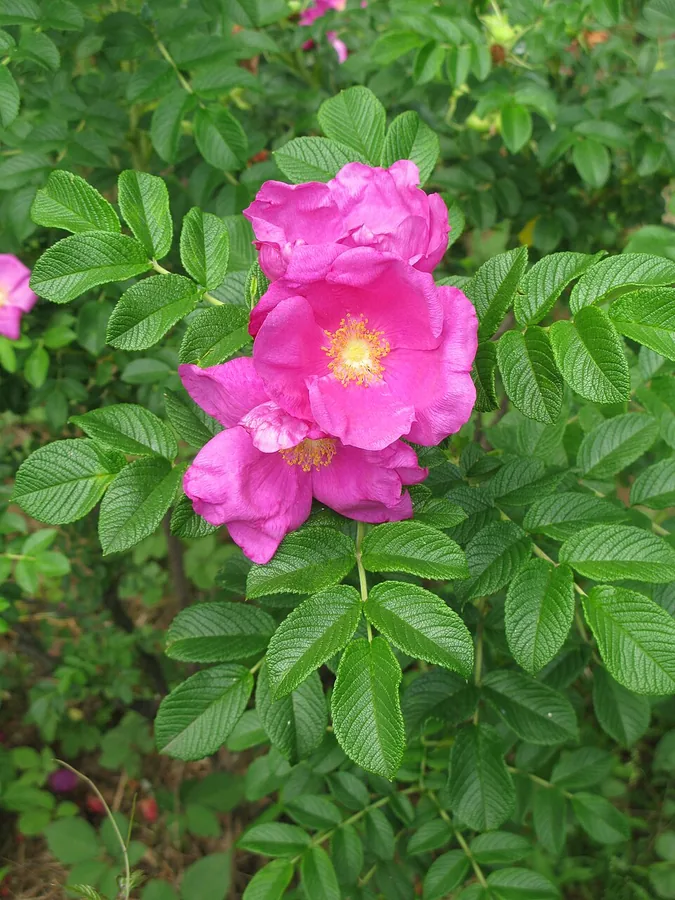
Rosa rugosa stands among the most durable shrub roses in cultivation, a species that demands little yet returns fragrant flowers and a heavy set of hips. Native to the coasts of eastern Asia, it adapted to maritime exposure so thoroughly that the common names beach rose and saltspray rose stuck. Its wrinkled, leathery foliage and densely prickled canes distinguish it at a glance from the more refined garden hybrids.
The species owes its standing to real resilience. It withstands salt spray, drought, and extreme cold near the floor of its range, and its spreading root system stabilizes banks and dunes, the reason it appears so often in coastal plantings. It also carries strong resistance to the fungal diseases that plague other roses. Blooms range from white through pink to deep reddish purple, single or double, and release a scent that carries on open air.
That vigor carries a horticultural cost worth understanding. The plant spreads by suckers and rhizomes into dense thickets, and along parts of the North American coast it has naturalized and displaced native vegetation. Sited where its spread can be contained, it remains among the least demanding roses available, and the hips that follow the flowers are edible and high in vitamin C.
Care
The short version: full sun and nearly any soil, sandy or saline included, drive the best performance. Water deeply during establishment, since a mature plant is drought tolerant, then feed sparingly and prune in late winter to shape it and check the suckering spread.
Light
Full sun drives the heaviest flowering and the strongest disease resistance, because direct light and the fast drying it brings keep foliar pathogens in check. The shrub tolerates partial shade, but shaded, crowded sites hold moisture on the foliage and raise the incidence of leaf spotting.
Water
Water deeply and regularly through establishment to drive roots downward; once mature the plant is drought tolerant and rarely needs irrigation. Apply water at the base in the morning rather than overhead, because wet foliage and soggy soil favor the fungal infections the species otherwise resists.
Soil
Adaptability is the point here: the species performs in sandy, gravelly, clay, and poor coastal soils alike, which underlies its use for dune and bank stabilization. It prefers moist, well-drained, slightly acidic loam at a pH of 6.0 to 7.5, though it rarely insists on it.
Temperature
Cold hardiness defines this rose, with a working range of -51°F to 86°F (-46°C to 30°C). That extreme low-temperature tolerance is precisely what allows Rosa rugosa to succeed in the far north where hybrid roses fail.
Humidity
Ambient outdoor humidity is sufficient, so no target applies. Air circulation is the operative variable, since still, congested air keeps foliage wet long enough for fungal spores to establish.
Feeding
This species is adapted to lean soils and needs little feeding, so a single application of balanced or rose fertilizer in spring is enough. Feed sparingly, because additional fertility does the plant no good and is easily overdone.
Pruning
Prune in late winter to early spring, before growth resumes, to shape the shrub and clear dead or weak canes. Remove suckers in the same operation, because the species spreads laterally by them and will widen its footprint if they are left.
Repotting
As a large landscape shrub, Rosa rugosa is seldom containerized and rarely needs repotting. In a pot, up-pot when roots circle the base or exit the drainage holes, or when the plant wilts soon after watering, both indicating the roots have outrun the volume.
Size & spacing
Expect a rounded shrub reaching 4 to 6 feet (120 to 180 cm) in both height and spread, and space accordingly. Account also for lateral expansion, since the suckering roots will extend the plant beyond its nominal footprint.
When to plant
Plant Rosa rugosa in spring or fall, when soil moisture supports rapid root establishment. Flowering begins in late spring and continues through summer, and by late summer the hips color up and persist on the canes into winter.
Northern hemisphere
Southern hemisphere
Typical months for a temperate climate: start earlier in warm zones, later where spring frosts linger.
- Plant: Spring or fall
- Harvest: Blooms late May to July with intermittent rebloom until frost; showy red-orange hips ripen August into winter.
Hardiness
USDA hardiness zones: 2–7
Temperature: down to -46°C
Troubleshooting
Given the species' resistance, serious problems are uncommon, and most complaints reduce to suckering spread or foliar spotting. The notes below explain what each early sign indicates so intervention comes before the disorder advances.
Distorted red witches broom with excessive prickles
A congested broom of malformed red shoots bearing abnormal prickles indicates rose rosette disease, a virus vectored by eriophyid mites for which no cure exists once a plant is infected. Excavate and destroy affected specimens promptly to protect surrounding roses. Comparable but milder clustering can stem from aphids, scale, thrips, or spider mites, which respond to a forceful water spray or removal of the worst canes.
Fix:
- Promptly remove and destroy plants showing rose rosette symptoms to protect nearby roses
- Treat heavy insect infestations with a strong water spray or appropriate control
- Remove and dispose of badly infested canes
Shoots emerging at a distance from the crown
New canes appearing well away from the crown reflect the species' suckering and rhizomatous habit, the mechanism behind its rapid thicket formation. Shallow roots and rhizomes generate these shoots, so sever and excavate them as they appear, or confine the plant within a root barrier from planting. Where natural dune systems are nearby, a named cultivar with more restrained growth is the sounder selection.
Fix:
- Cut and dig out suckers as they appear
- Install a root barrier or plant in a contained bed
- Choose a better-behaved named cultivar instead of the straight species
Foliar spotting and pustules with early leaf drop
Although Rosa rugosa resists most rose pathogens, rust, black spot, and powdery mildew can establish under damp, shaded, or crowded conditions that keep foliage wet. Remove symptomatic leaves and clear fallen debris to deny the spores an overwintering site. Thin the canes to improve air movement and irrigate at the base in the morning, since drying the foliage interrupts infection.
Fix:
- Remove and dispose of affected leaves and fallen debris
- Improve air circulation by thinning canes
- Water at the base in the morning rather than overhead
Toxicity
The verdict here is straightforward. All parts of Rosa rugosa are non-toxic to cats, dogs, horses, and people, and the hips are edible and high in vitamin C. The only real risk is mechanical, the needle-like prickles that arm every cane, so the sensible precaution is gloves rather than concern over poisoning.
Safe for
People · Cats · Dogs · Horses · Rabbits · Livestock · Birds
Cats None
No toxic principle is present, so a cat that samples a petal or leaf is unaffected. The only consideration is the sharp prickles, which can scratch a paw or the mouth.
Dogs None
A dog may chew the leaves, flowers, or ripe hips with no risk of poisoning. Keep it away from the thorny canes, since a bristling stem is the sole physical hazard.
Horses None
Horses graze rose foliage and hips without ill effect. The dense prickles are the caveat, capable of pricking a soft muzzle that reaches into the canes.
Rabbits None
Rabbits browse the leaves and stems safely, and the hips are a suitable treat. No part of the plant is toxic to them.
Livestock None
Cattle, goats, and sheep graze the shrub without harm. The thorny canes function more as a browsing deterrent than as a source of injury.
Birds None
Birds consume the red hips and disperse the seed widely, a process that contributes to the plant's invasive spread. Ingesting any part presents them no danger.
People None
The hips are edible and high in vitamin C, used in teas, jams, and syrups, and the petals are edible as well. Gloves are advisable near the canes, since the sharp prickles are the one part that injures.
Stems are densely covered in sharp, needle-like prickles that can cause scratches and puncture wounds; wear gloves and long sleeves when handling or pruning.
Varieties
Nearly all rugosa roses in commerce are named cultivars, selected for flower color, fragrance, or a more restrained habit. The following are the ones most often encountered.
Hansa
A vigorous selection producing double, reddish-purple flowers of strong fragrance, followed by large red hips.
Blanc Double de Coubert
A tough, disease-resistant cultivar bearing semi-double, pure white flowers of intense fragrance.
Frau Dagmar Hastrup
A compact selection whose single, silvery-pink flowers mature into a heavy crop of large red hips.
F.J. Grootendorst
A cultivar with small red flowers fringed like a carnation, borne in clusters in nearly continuous bloom.
How to propagate
Rosa rugosa propagates readily by three routes, each suited to a different aim: division of its abundant suckers, summer cuttings, or seed extracted from the ripe hips.
DivisionEasy
Late winter to early spring or fall · 1 to 2 seasons
Because rugosa grows on its own roots and suckers freely, the most direct method is to sever a rooted sucker from the parent and transplant it in late winter to early spring or in fall. Allow the division a season or two to establish, after which it grows on as a clone of the parent.
Stem cuttingsModerate
Summer (softwood or semi-hardwood) · Several weeks to root, then 1 to 2 seasons to establish
Commercial propagation relies on cuttings taken in summer from healthy current-season wood, as softwood or semi-hardwood. Rooting occupies several weeks, followed by a season or two before the plant develops into a substantial shrub.
SeedModerate
Sow cleaned seed from ripe hips in fall, or stratify and sow in spring · 1 or more years
Each ripe hip contains 20 to 120 seeds, so seed is abundant, though germination tests patience. Sow cleaned seed in fall or cold-stratify and sow in spring, then anticipate slow, uneven emergence and a year or more before seedlings gain size.
Myths
The rugosa rose is a well-behaved native suitable for planting anywhere along the coast.
The species originates in eastern Asia, not North America, and has escaped cultivation to naturalize invasively along the coasts of New England, Virginia, and parts of Canada. In those settings it forms dense thickets that displace native dune vegetation, the basis for its listing on Maine's advisory list and the case for keeping it away from wild ground.
Because roses are non-toxic, the entire plant is completely safe to handle.
The leaves, flowers, and hips are genuinely edible and harmless to pets, so ingestion poses no toxic threat. The hazard is purely physical: the canes carry dense, needle-like prickles that scratch and puncture, which makes gloves and long sleeves the appropriate precaution during pruning.