Vegetable · Brassicaceae
Romanesco
Brassica oleracea var. botrytis
Timed for a cool fall, Romanesco sets a firm head that spirals into repeating green fractals.
Full sun
Every 5–7 days
50–70°F · 10–21°C
75–100 days
Overview
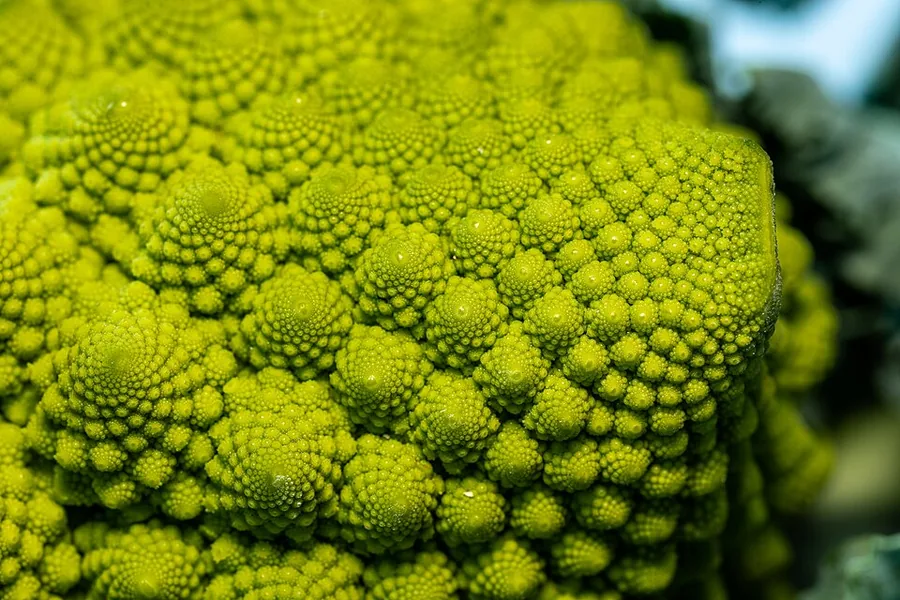
Romanesco is a cultivar of Brassica oleracea placed in the cauliflower and broccoli group, and its edible head is a fractal arrangement of lime-green cones that repeat at smaller and smaller scales toward the apex. It has been selected and grown in Italy for generations. On the plate it behaves like cauliflower, with a sweeter, nuttier character.
Among the brassicas this is the most demanding to bring to a clean head, and the reason is physiological: the curd forms properly only under sustained cool conditions. Steady moisture and a fertile, organic-rich soil keep growth uninterrupted, because any stall pushes the plant toward premature heading. Drive it through summer heat and the curds separate into a loose, grainy mass, which is why growers schedule it as a fall crop so heading falls in cooling weather.
With the timing settled, the remaining requirements are straightforward. Full sun develops the pigment in the curd, even moisture and adequate fertility hold off buttoning, and spacing that lets air move through the canopy limits disease. Cut the head while the curd is still firm and tight, before the spiral separates, and the crop rewards the effort.
Care
The short version: site it in full sun with rich, evenly moist soil and a feed every two weeks, then schedule the planting so the curd matures under cool fall temperatures rather than summer heat.
Light
Romanesco requires full sun, and the exposure is functional: light drives the development of the head's chartreuse color. Partial shade is tolerated, but the leaves must never be tied over the curd as they are for white cauliflower, since shading the head suppresses that pigment.
Water
Hold the soil evenly moist, at roughly an inch of water per week, because inconsistent moisture is a direct trigger for buttoning and malformed heads. A drought check stalls growth and pushes the plant into premature heading. Water in the morning so foliage dries quickly and leaf disease has less opportunity to establish.
Soil
Grow it in a fertile, well-drained, moisture-retentive soil amended with compost or well-rotted manure, which supplies both the nutrition and the steady moisture the crop demands. Hold the pH between 6.0 and 7.0; the upper, near-neutral end additionally suppresses the clubroot pathogen.
Temperature
Temperature is the controlling factor. The optimum sits between 50°F and 70°F (10°C to 21°C), the range in which the curd sets firm. Sustained heat into the mid-80s disrupts curd formation, and the head loosens into a grainy texture.
Humidity
No humidity target applies, since ambient outdoor moisture is sufficient. Air movement matters far more than any reading, because a crowded, damp canopy favors the fungal and bacterial diseases common to brassicas. Adequate spacing addresses this directly.
Feeding
This is a heavy feeder. Apply a balanced or low-phosphorus fertilizer every two weeks, guided by a soil test, and side-dress nitrogen such as calcium nitrate once plants reach about 4 inches tall. Consistent nutrition sustains the uninterrupted growth that a clean head depends on.
Pruning
No structural pruning is warranted. Leave the curd exposed to sunlight, which is what develops its color, and remove only outer leaves that have become diseased or pest-damaged. Cutting sound foliage serves no purpose.
Size & spacing
Mature plants stand 2 to 3 feet (60 to 90 cm) tall and occupy 18 to 30 inches (45 to 75 cm) of width. Allowing the full spread keeps air moving among the large outer leaves, which lowers the humidity in the canopy and, with it, disease pressure.
When to plant
Scheduling governs success with Romanesco, because the curd will only set well while temperatures stay cool. Sow indoors 6 to 8 weeks before transplanting, then set plants out in cool early spring or, preferably, from mid to late summer so that head formation coincides with the cooling temperatures of fall.
Northern hemisphere
Southern hemisphere
Typical months for a temperate climate: start earlier in warm zones, later where spring frosts linger.
- Sow: Start seed indoors 6-8 weeks before the intended transplant date.
- Plant: Transplant in cool early spring, or (preferred) in mid- to late summer for a fall harvest; Romanesco is best grown as a fall crop.
- Harvest: Cut the head when it is full-sized, firm and tight, before the fractal spiral curds begin to separate or loosen.
Hardiness
USDA hardiness zones: 3–10
Temperature: down to -40°C
Troubleshooting
Most Romanesco disorders share a single cause: an interruption to steady growth, or heat arriving while the curd is forming. The head and the foliage register the earliest evidence, so inspect them first. Identify the symptom below and intervene before the disorder becomes fixed.
The head fails to firm, or opens into a loose, ricey curd
The primary cause is thermal: the curd separates once daytime temperatures exceed 86°F (30°C) during head formation. A boron deficiency compounds the problem, browning the curd and preventing it from staying compact. Schedule the crop so heading occurs in cool weather, and correct boron only where a soil test confirms the shortage.
Fix:
- Time the crop so heads mature during cool weather
- Correct boron deficiency per soil test
Wilting, stunted plants with swollen, galled roots
Lifting a declining plant reveals the swollen, distorted roots of clubroot or maggots feeding in the root zone. An infected plant cannot be salvaged and should be removed and destroyed. Raising the soil pH toward neutral suppresses the clubroot organism, and a multi-year rotation away from brassicas prevents inoculum from accumulating.
Fix:
- Remove and destroy affected plants
- Raise soil pH toward neutral to suppress clubroot
A small head sets prematurely on an undersized plant
This disorder is buttoning, the plant's response to almost any check on growth, whether transplant shock, nutrient shortage, or moisture stress. Seedlings set out too old or held through prolonged cold are the common triggers. Sustain even moisture and fertility, and transplant young stock at the correct time, so growth never stalls into early heading.
Fix:
- Maintain even moisture and adequate fertility
- Avoid transplanting overgrown or cold-stressed seedlings
Foliage chewed into holes, with green caterpillars present
The chewing is usually the work of velvety green cabbageworms and cabbage loopers, while tiny flea beetles produce shot-hole damage on young seedlings. Handpicking the caterpillars and installing floating row covers early exclude both. Where a caterpillar population runs heavy, Bacillus thuringiensis controls it selectively without affecting other insects.
Fix:
- Handpick caterpillars
- Use floating row covers
- Apply Bacillus thuringiensis for caterpillars if needed
Toxicity
Romanesco is an edible brassica and carries no toxin in any part, so it is safe to cultivate around people and animals alike. Cats, dogs, rabbits, and poultry can share the garden with it without hazard. The only qualification is digestive: raw brassica eaten in quantity can produce gas in some animals.
Safe for
People · Cats · Dogs · Horses · Rabbits · Livestock · Birds
Cats None
No compound in the leaves, stems, or head is toxic to cats. A nibble presents no risk beyond mild digestive gas.
Dogs None
Dogs face no toxin from this plant. Plain cooked florets serve as a sound treat, though raw brassica consumed in quantity can cause flatulence.
Horses Safe
Non-poisonous to horses. Because brassicas fall outside their natural diet, restrict intake to small quantities to avoid digestive upset.
Rabbits Safe
The leaves and florets are non-toxic and suitable forage for rabbits. Introduce them gradually so the digestive tract adjusts.
Livestock Safe
Safe as forage, with no acute toxicity. The single caveat is that sustained heavy grazing of brassicas allows their natural goitrogens to accumulate.
Birds Safe
Non-toxic to backyard poultry, which readily consume the leaves and curd. No part of the plant presents a hazard.
People Safe
A nutritious vegetable eaten raw or cooked. The entire head and the tender leaves are edible and require no precaution.
Safe to handle and grow around pets and children. Note that brassica glucosinolate goitrogens are mainly a concern for heavily-grazed livestock, not household pets.
Varieties
Few Romanesco selections reach the seed trade, and the two below both express the characteristic spiral. Their differences are noted here.
Veronica
A widely grown hybrid that produces uniform lime-green fractal heads with sharply defined spirals.
Romanesco Italia
An open-pollinated heirloom bearing classic apple-green pointed spirals on tall plants over an extended season.
How to propagate
Romanesco is propagated by seed alone. It does not root from vegetative cuttings, so each plant is raised from seed in a tray before transplanting.
SeedModerate
Sow indoors 6-8 weeks before transplanting; transplant when seedlings have 4-5 true leaves. · About 4 weeks from sowing to transplant-ready seedling, then 75-100 days to a mature head.
Romanesco is raised exclusively from seed, since it is not cloned in home conditions, and every plant therefore originates in a seed packet. Sow indoors 6 to 8 weeks ahead of transplanting and move seedlings out once they have developed 4 to 5 true leaves, approximately 4 weeks after sowing. Head development then requires a further 75 to 100 days before the crop is ready to cut.
Myths
Romanesco heads must be blanched by tying the leaves over them as with white cauliflower.
Blanching applies to white cauliflower, whose curd stays pale only when shaded, and Romanesco has the opposite requirement. Its chartreuse curd develops color only in full sun, so the leaves are left untied and the head kept exposed to light.
Romanesco is a genetically engineered hybrid of broccoli and cauliflower.
It is a traditional Italian cultivar of Brassica oleracea, classified in the same cauliflower and broccoli group as those crops. It is a longstanding heirloom, not a GMO, and has been cultivated for generations.