Houseplant · Cactaceae
Prickly Pear
Opuntia ficus-indica
Full sun, gritty drainage, and restraint with water are what keep prickly pear firm, upright, and rot-free.
Full sun
USDA 8–11
3–16 ft · 1–5 m
Overview
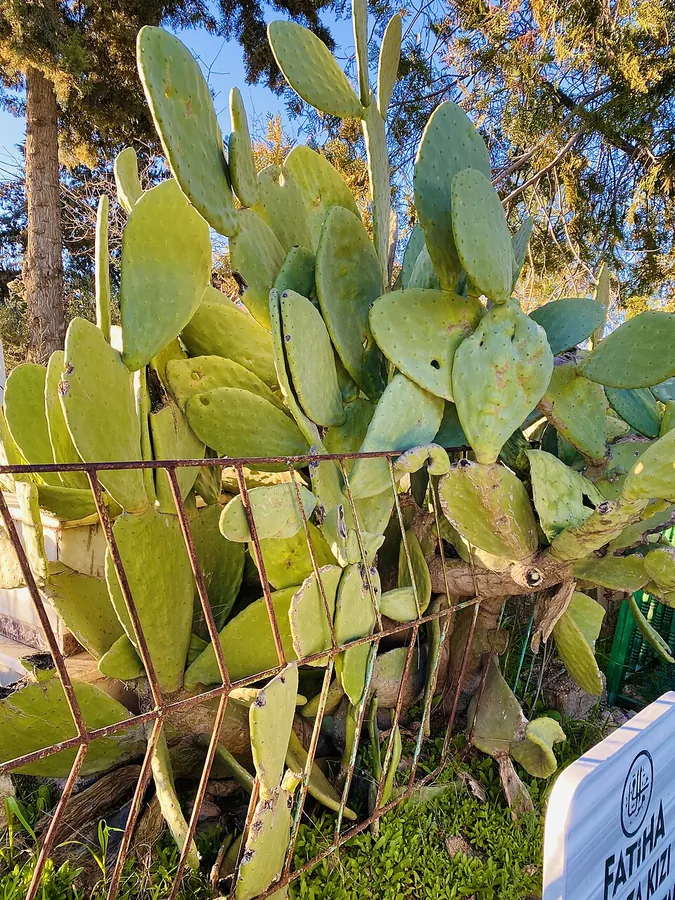
Prickly pear ranks among the most drought-hardy plants a grower can keep, a paddle-stemmed cactus native to the Americas and now naturalized across warm regions worldwide. The flat green pads are modified stems, not leaves, and they store the water reserves that carry the plant through prolonged dry periods. In a bright window indoors or a hot, exposed site outdoors, its demands stay minimal because its whole structure is built to conserve moisture.
The species earns its place as a crop as much as an ornamental. Its young pads are eaten as nopales and its ripe red fruit as tunas, both established foods in Mexican and southwestern cuisine. Flowering runs from late spring into summer in cups of yellow, orange, or pink, with fruit following in late summer.
Its defenses warrant real caution. In addition to conspicuous large spines, each pad bears glochids, minute barbed bristles that detach at the slightest contact and embed in skin, where extraction is difficult. Because the bristles travel so easily, position the plant clear of walkways and animals and handle it only with thick gloves and tongs.
Care
The short version: full sun, a gritty fast-draining medium, and irrigation withheld until the mix is bone dry. The plant tolerates drought far better than saturation, so the failure to guard against is rot, not thirst.
Light
Provide full sun, the highest light available, because strong light is what keeps the pads thick and the growth compact. Under weaker light the pads thin and pale and the plant stretches, losing its rigidity and leaning.
Water
Water deeply, but only after the mix has dried completely, and reduce it sharply through the cool months when growth halts. The reason for the restraint is direct: the roots and stems rot readily in standing moisture, so erring dry protects the plant.
Soil
Use a gritty, sharply drained sandy or cactus mix that sheds water fast, since retained moisture around the roots is the primary cause of rot. A pH of 6.0 to 7.5 is suitable, though drainage governs success far more than the reading does.
Temperature
The species withstands 23°F to 104°F (-5°C to 40°C), an unusually broad range for a cactus and evidence of real cold hardiness. That tolerance has limits, however, and a hard frost will still damage the exposed pads.
Humidity
Low humidity matches the plant's native conditions, so dry indoor air presents no difficulty. The concern is damp, stagnant air, which favors the rot and pest problems the plant otherwise resists.
Feeding
Fertilize only during the spring and summer growth phase, and keep concentrations low. A dilute, low-nitrogen cactus fertilizer applied occasionally suffices, because excess nitrogen produces soft, structurally weak pads.
Pruning
Remove damaged or crowded pads with a clean knife to maintain form and airflow through the plant. Thick leather gloves and tongs are mandatory, since the spines and readily detaching glochids make unprotected handling hazardous.
Repotting
Repot only every 2 to 4 years, or once the plant is severely rootbound and unstable, because frequent disturbance offers little benefit to a slow, moisture-conserving grower. Return it to dry medium and delay watering several days so that disturbed roots can seal before exposure to moisture.
Size & spacing
At maturity the plant reaches 3 to 16 feet (1 to 5 m) in height and 3 to 10 feet (1 to 3 m) in spread. Allocate space accordingly, both for the eventual mass and to keep the spined pads well away from circulation routes.
Troubleshooting
Most disorders in prickly pear stem from water balance, with pests accounting for the remainder. The pads register the problem directly, softening when saturated and shriveling when depleted, which makes diagnosis straightforward. Read the symptom below and intervene early, since rot advances quickly once it takes hold.
Soft, mushy pads discolored at the base
Soft, mushy pads that yellow or blacken from the base indicate root and stem rot, a condition that follows overwatering or a pot that retains water. Halt irrigation, remove the plant from its container, and excise all soft, discolored tissue with a clean blade. Allow the cut surfaces to callus, then reset the remaining firm pads in dry, gritty medium to reestablish.
Fix:
- Stop watering immediately
- Unpot and cut away all soft, rotted tissue with a clean blade
- Let cuts callus, then repot healthy pads in dry gritty mix
Wrinkled, thinning pads that have lost turgor
Wrinkled, thin, shriveled pads signal underwatering or root loss during an extended drought, both of which reduce the plant's stored moisture. A single deep soak usually restores turgor within a day or two as the tissue rehydrates. Afterward, let the medium dry completely before the next application, and confirm that the roots remain firm rather than rotted.
Fix:
- Water deeply once
- Let the mix dry completely before watering again
- Check that roots are intact and not rotted
White cottony colonies that crush to crimson
White, cottony colonies that release a crimson stain when crushed are cochineal scale, a sap-feeding insect sheltered beneath a waxy secretion. Dislodge the colonies with a strong jet of water, then apply insecticidal soap or horticultural oil to the pads. Repeat at roughly weekly intervals until the infestation clears, since a single treatment rarely reaches every insect.
Fix:
- Blast off colonies with a strong jet of water
- Treat with insecticidal soap or horticultural oil
- Repeat treatments until clear
Toxicity
Prickly pear carries no chemical toxicity. Its pads and fruit are routine human foods and pose no poisoning risk to animals that sample them. The hazard is entirely mechanical: the spines and barbed glochids can injure a mouth, paw, or eye, so restrict access for pets and children and handle the plant deliberately.
Safe for
People · Cats · Dogs · Horses · Rabbits · Livestock · Birds
Cats Non-toxic
No compound in prickly pear will poison a cat, so ingestion of the flesh carries no chemical risk. The exposure that matters is mechanical: a cat that paws at a pad can acquire spines or fine glochids in the paw, lip, or tongue.
Dogs Non-toxic
A dog may chew or swallow a fragment without chemical consequence. The injury comes from the spines and barbed glochids, which anchor in the mouth and gums and resist removal.
Horses Non-toxic
Horses graze prickly pear without signs of poisoning, and singed pads serve as stock feed in arid regions. The limiting factor is the raw spines and glochids, which lodge in the lips and mouth.
Rabbits Non-toxic
The pads are safe for a rabbit to consume and contain no toxin. Remove every spine and glochid beforehand, since a rabbit's delicate mouth offers no defense against the barbs.
Livestock Non-toxic
Cattle, goats, and sheep consume prickly pear readily, and ranchers burn off the spines to render it safe winter forage. Untreated, the spines and glochids injure the mouth and digestive tract.
Birds Non-toxic
Birds consume the ripe fruit and disperse the seeds with no toxic effect. Only the spines and glochids present a risk, which is why they confine themselves to the soft, ripe pulp.
People Non-toxic
Both the pads, sold as nopales, and the fruit, the tunas, are common and entirely safe foods. The sole hazard is handling: scrub or singe off the spines and glochids before the tissue reaches skin or mouth.
The real danger is physical, not chemical: besides large spines, prickly pear bears glochids, tiny barbed bristles that detach easily and lodge painfully in skin, eyes, and mouth, where they are very hard to remove. Always handle with thick gloves and tongs.
Varieties
Opuntia is a large genus, but a small number of forms dominate cultivation and casual encounters. The three below are the ones you are most likely to identify.
Opuntia ficus-indica (spineless forms)
These near-spineless cultivars are the forms grown commercially for nopal pads and tuna fruit, yet even the smooth selections retain glochids that require scrubbing before use.
Opuntia microdasys (bunny ears)
A compact, widely sold houseplant, it carries dense clusters of white or yellow glochids across its soft-looking pads, which makes it far more hazardous to touch than its appearance suggests.
Opuntia stricta
An upright species recognized chiefly as an aggressive invasive weed through parts of Australia and Africa.
How to propagate
Few succulents propagate as readily as prickly pear, and a single detached pad is enough to start a new plant.
Stem cuttingsEasy
Spring to summer · 4 to 8 weeks to root
Rooting a pad is the reliable method and is best undertaken from spring through summer, when active growth supports establishment. Detach a healthy pad, allow the cut surface to dry and callus over several days to reduce rot risk, then set it upright in dry, gritty medium, where it roots in 4 to 8 weeks. Wear thick gloves throughout, because the glochids remain a hazard during handling.
SeedModerate
Spring · Several months to a year
Seed propagation, carried out in spring, is the slower option. Germination is uneven and a seedling may require several months to a year to establish, which is why most growers root a pad instead.
Myths
A cactus this spiny must be poisonous.
The assumption is unfounded, as prickly pear is non-toxic and consumed routinely worldwide. The pads are marketed as nopales and the fruit as tunas, both dietary staples. The genuine hazard lies in the spines and glochids, not in any internal toxin.
A pad without large spines is safe to handle bare-handed.
The large spines are conspicuous, but they are not the principal risk. A smooth-appearing pad still bears glochids, minute barbed bristles that release on contact and embed in the skin. Handle prickly pear with thick gloves and tongs regardless of the visible spines.