Shrub · Rosaceae
Shrubby Cinquefoil
Potentilla fruticosa
Hardy to the extremes and blooming from June to September, shrubby cinquefoil performs on soils that defeat most shrubs.
Full sun
Every 7–14 days
USDA 2–7
2–4 ft · 0.6–1.2 m
Overview
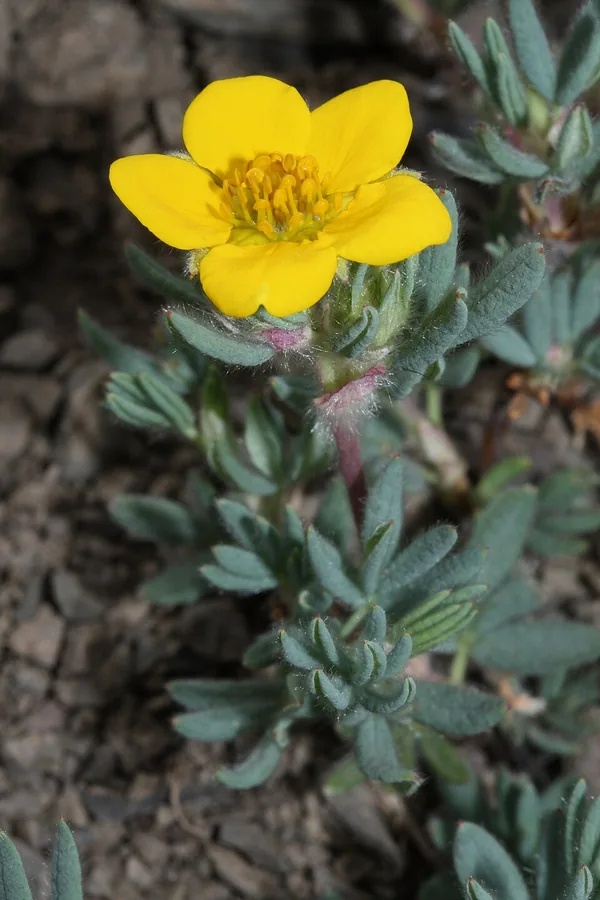
Shrubby cinquefoil is a small, deciduous, rounded shrub of the family Rosaceae, valued for an exceptionally long flowering period. Its five-petaled flowers, classically buttery yellow, open in succession over fine-textured foliage from June through September, which is what gives the plant its garden value. Mature height runs to only 2 to 4 feet (61 to 122 cm), so it works as border edging, a low informal hedge, or a specimen for a hot, exposed site.
The species is remarkable for its stress tolerance. It is hardy to USDA zone 2, and because it evolved on lean, open ground it accepts poor, alkaline, sandy, and heavy clay soils that would check less adaptable shrubs. Its drought tolerance develops with maturity: once the root system is established, it draws on deeper moisture and needs little supplemental water. Selection work has extended the color range beyond yellow to white, pink, and orange cultivars.
One climatic limit governs where it performs best. High summer temperatures fade the flower color and stress the plant, which is why it flowers most reliably in northern gardens and cool-summer climates. Full sun, free drainage, and an annual hard cut satisfy nearly all of its requirements.
Care
The short version: full sun, average well-drained soil, and a hard renewal cut in late winter to early spring. Feeding is largely unnecessary, established plants withstand drought, and a cool summer yields the longest, cleanest bloom.
Light
Site the plant in full sun, because flower initiation is light-driven and bloom density falls as irradiance drops. It tolerates partial shade and partial sun, but reduced light produces fewer flowers and an open, drawn habit as stems stretch toward the light.
Water
Irrigation needs fall sharply with age. Young plants require steady moisture while rooting, whereas an established shrub is notably drought tolerant and needs water only through a prolonged dry spell. Allowing the top half of the profile to dry between waterings favors the well-drained conditions the roots prefer.
Soil
Soil is rarely the limiting factor here. The plant grows in average, well-drained soil and adapts to clay, loam, sand, and poor or alkaline ground, tolerating a broad pH span of 5.5 to 8.0, so amendment is seldom warranted on all but waterlogged sites.
Temperature
Cold hardiness is exceptional, running from -49°F (-45°C) to about 86°F (30°C). The constraint sits at the warm end: prolonged summer heat fades the flowers, so cool-summer climates give the most reliable color.
Humidity
Low humidity suits it, and the reason is pathological rather than nutritional. Dry air with good circulation keeps the canopy free of the leaf spot and powdery mildew that establish in humid, stagnant conditions, so airflow matters as much as the moisture level itself.
Feeding
Feeding requirements are minimal because the plant is adapted to lean ground. A balanced general-purpose fertilizer or a light dressing of compost in early spring is sufficient, and flowering holds up on poor soil even without it.
Pruning
Timing follows the flowering habit. Because the shrub blooms on new wood, a hard cut or shear in late winter to early spring removes old growth before bud break and forces the vigorous current-season shoots that carry the flowers, while also holding the compact form. Remove leggy or ragged stems in the same operation.
Repotting
In open ground the plant never requires repotting, and in containers it does so rarely. Pot up only when the record's rootbound indicators appear: roots circling or emerging from the drainage holes, water passing straight through with little uptake, or stalled growth.
Size & spacing
Expect a mounded habit of 2 to 4 feet (61 to 122 cm) in height and a wider spread of 3 to 5 feet (91 to 152 cm). Spacing plants at roughly their mature spread lets the rounded canopy close without crowding that would restrict airflow.
When to plant
This is a cold-hardy woody shrub suited to a long northern season. Plant it out in spring once frost risk has passed, or in early fall while the soil is still warm, and cut it back hard in late winter so the current season's growth carries flowers from June into September.
Northern hemisphere
Southern hemisphere
Typical months for a temperate climate: start earlier in warm zones, later where spring frosts linger.
- Sow: Late winter (stratified seed), 8-10 weeks before last frost
- Plant: Spring after last frost, or early fall
- Harvest: June to September
Hardiness
USDA hardiness zones: 2–7
Temperature: down to -46°C
Troubleshooting
Problems on shrubby cinquefoil are few, and most trace to a single cause: heat, humidity, or the loss of vigor that follows a skipped spring pruning. Identify the symptom on the foliage or flowers below, then correct the underlying condition rather than the symptom alone.
Stippling and bronzing with fine webbing
Stippled, bronzing foliage under fine webbing indicates spider mites, which build up in hot, dry, stagnant air and feed on cell contents, draining leaf color. Confirm the diagnosis by tapping a branch over white paper and watching for moving specks. A forceful water spray to the leaf undersides, improved air movement, and insecticidal soap or horticultural oil for heavy infestations address both the pest and the conditions that favor it.
Fix:
- Spray foliage with a strong jet of water, focusing on leaf undersides
- Improve air movement and avoid hot, stagnant, dry locations
- Apply insecticidal soap or horticultural oil if infestation is heavy
Discrete leaf spots or a powdery white coating
Discrete dark lesions indicate fungal leaf spot, and a powdery white film indicates powdery mildew, both favored by humid, poorly ventilated conditions. Remove and destroy affected foliage to reduce inoculum, keep water off the leaves, and thin the canopy so air moves through it, after which the problem generally subsides.
Fix:
- Remove and dispose of affected foliage
- Avoid overhead watering and wetting foliage
- Thin or prune to improve air circulation
Faded color on a leggy, open framework
Washed-out color paired with a woody, open base reflects summer heat degrading the bloom compounded by the loss of flowering wood when spring pruning is skipped. Cut the shrub back hard in late winter to early spring to regenerate the current-season growth that flowers. In warm regions, pink and red cultivars are the sounder choice because they retain color better under cool conditions.
Fix:
- Shear or prune hard in late winter to early spring to renew flowering wood
- Site in cooler, sunny locations; pink and red cultivars hold color better in cool climates
Toxicity
This shrub carries no toxicity concern. The ASPCA classifies cinquefoil as non-toxic to cats, dogs, and horses, and no part of the plant presents a documented hazard to other animals or to people. It can be sited freely in gardens used by pets and children.
Safe for
People · Cats · Dogs · Horses · Rabbits · Livestock · Birds
Cats None
Non-toxic to cats; ingestion of foliage or flowers produces no poisoning.
Dogs None
Non-toxic to dogs, whether the plant is chewed or merely brushed against.
Horses None
Classified by the ASPCA as non-toxic to horses, which may graze nearby without harm.
Rabbits Safe
Rabbits can browse the foliage with no toxicological concern.
Livestock Safe
Cattle, goats, and sheep graze around the shrub without risk of poisoning.
Birds Safe
Birds foraging on the shrub encounter no toxic compounds.
People Safe
Safe to handle and to grow around children, though it is ornamental and not a food crop.
No special handling precautions for toxicity; wear gloves if desired when pruning woody stems.
Varieties
Breeding has broadened this durable garden species well past its original yellow. The cultivars below are the ones most often offered.
'Abbotswood'
A compact cultivar bearing pure white flowers against distinctly cool blue-green foliage.
'Goldfinger'
A compact mound producing large, deep golden-yellow flowers across a notably long season.
CHEESEHEAD ('SMPFMY')
A bright yellow selection valued for its dense, mounded habit.
Happy Face Pink Paradise
A pink cultivar selected for superior color retention through cool summers.
How to propagate
Shrubby cinquefoil propagates readily by several routes, each exploiting a different part of its biology: vegetative cuttings, division of the crown, or stratified seed where variation is acceptable.
Stem cuttingsEasy
Softwood cuttings in late spring to summer · 4-8 weeks to root
Vegetative cuttings are the most dependable method. Softwood or semi-hardwood material taken in late spring to summer, held under humidity to limit water loss before roots form, establishes in roughly 4 to 8 weeks.
SeedModerate
Sow stratified seed in late winter to early spring · Several weeks to germinate; cultivars do not come true from seed
Seed is viable but slower and less predictable. The seed requires cold stratification to break dormancy, sown in late winter to early spring for germination over several weeks, and because named cultivars do not come true from seed, seedlings vary from the parent.
DivisionEasy
Spring or early fall · One growing season
Established clumps can be divided in spring or early fall. Lift the plant or a rooted sucker, separate a section with its own roots, and replant it, allowing one growing season for re-establishment.
Myths
Shrubby cinquefoil, like many ornamental shrubs, is toxic to pets.
The record does not support that. The ASPCA classifies cinquefoil, Potentilla spp., as non-toxic to cats, dogs, and horses, so no toxic principle is present, and incidental browsing carries no risk of poisoning.
Potentilla should be pruned immediately after flowering, as spring-blooming shrubs are.
Applying that rule here removes the following season's flowers, because the shrub blooms on new wood rather than on old. The correct practice is a hard cut in late winter to early spring, which maximizes the flowering shoots produced that year.