Ornamental · Papaveraceae
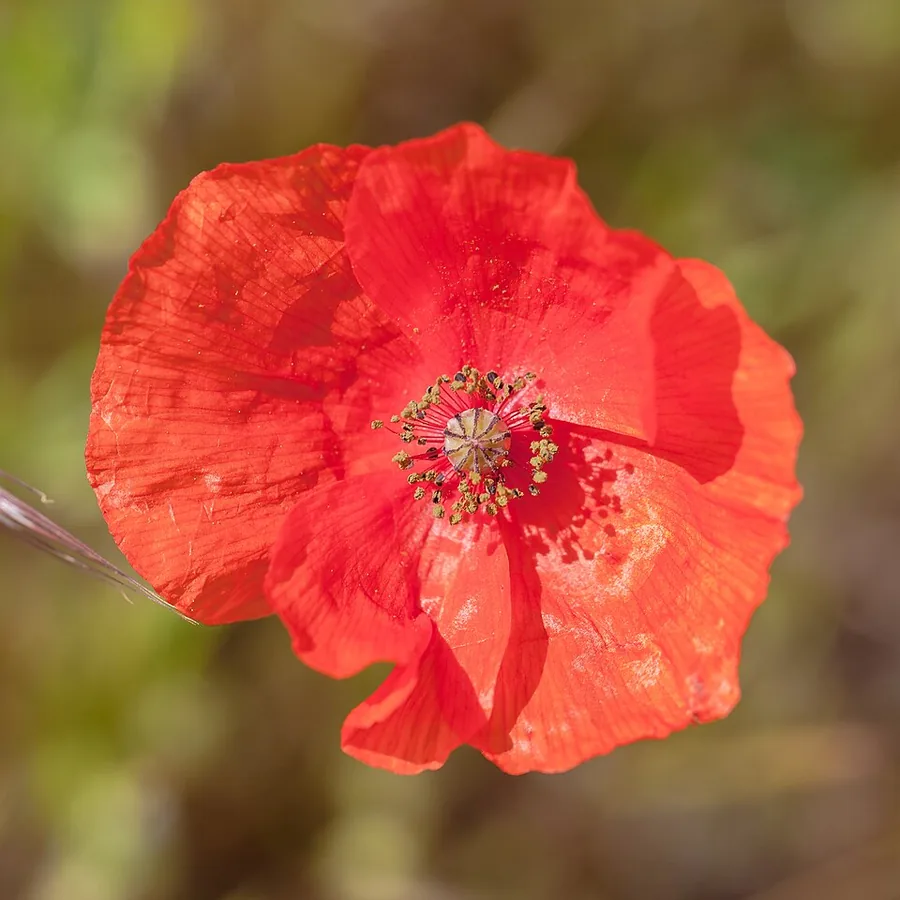
Corn Poppy
Papaver rhoeas
Direct-sow it in place, satisfy its demand for full sun and fast drainage, and Papaver rhoeas repays you with silky scarlet bloom.
Full sun
Every 5–10 days
30–75°F · -1–24°C
60–90 days
Overview
The corn poppy, Papaver rhoeas, is a quick-cycling annual in the family Papaveraceae, best known for the papery scarlet flowers tied to the fields of Flanders. It colonizes disturbed ground across Europe and beyond, a pioneer habit that explains both its vigor and its readiness to self-sow. In cultivation it stays modest, 9 to 18 inches (23 to 46 cm) tall, and its needs reduce to sun and free-draining soil.
Each plant sends up slender, bristly stems, and every bud opens a single bowl-shaped flower that lasts only a day or two before the next follows. Bloom carries from late spring into mid-summer, after which the ovary matures into a dry, papery seed capsule and the plant declines. Because the life cycle closes in one season, it is resown yearly, though the free-shedding capsules make voluntary return the norm.
Its cultural requirements are specific but few: full sun, a cool establishment period, and soil that never remains saturated. The decisive constraint is its intolerance of root disturbance, which is why sowing in the final flowering position, rather than transplanting, is the only dependable approach. Move it and it fails.
Care
The short version: full sun, steady but moderate moisture, and free drainage, direct-sown into cool soil and left undisturbed, since transplanting reliably kills it.
Light
Site it in full sun, which drives the strongest and most sustained flowering. Light afternoon shade is acceptable in hot climates, but under deep shade the stems stretch into weak, floppy growth and bloom falls off sharply.
Water
Hold the soil at light, even moisture, letting the upper half dry before rewatering, on the order of every 5 to 10 days. The species tolerates neither extreme: sustained drought reduces stand density, while saturated ground, especially over winter, drives the root rot that kills it.
Soil
Grow it in free-draining loam with some organic enrichment, though average garden soil serves provided water moves through the profile. It performs across a pH of 6.0 to 7.5. Drainage governs success far more than fertility, since standing water at the roots is the primary risk.
Temperature
This is a cool-season species, functioning between 30°F to 75°F (-1°C to 24°C). Germination and vegetative growth proceed best in the cool of spring or autumn, and sustained summer heat pushes it into rapid flowering and decline.
Humidity
It suits low humidity, and no target range applies. Air movement does the meaningful work, because a still, damp, congested canopy is the precondition for powdery mildew and gray mold.
Feeding
Nutrient demand is minimal. A light dressing of balanced fertilizer or compost at sowing suffices, and rich ground needs even less. Excess feeding shifts the plant toward foliar growth at the expense of flower, so a heavy hand is counterproductive.
Pruning
Deadhead spent flowers to redirect resources from seed set back into further bloom. Removing developing capsules before they ripen also checks the abundant self-sowing that otherwise fills the bed with volunteers.
Repotting
No repotting applies. The plant is direct-sown and left in place because it resents root disturbance, and it is not maintained in containers over the long term.
Size & spacing
Mature height stays compact at 9 to 18 inches (23 to 46 cm). Space or thin to roughly 6 to 12 inches (15 to 30 cm) so the canopy dries quickly and air moves through, which limits the fungal problems that follow congestion.
When to plant
Timing follows the plant's cool-season biology and its refusal to be moved, so the aim is to place seed where germination and establishment can occur before heat. Sow in late fall where winters remain mild, or in early spring at higher latitudes. Flowering follows from late spring into mid-summer, roughly 60 to 90 days from sowing.
Northern hemisphere
Southern hemisphere
Typical months for a temperate climate: start earlier in warm zones, later where spring frosts linger.
- Sow: Not recommended; seedlings resent transplanting. Sow seed directly in place.
- Plant: Direct-sow in late fall in mild/southern regions or early spring in northern regions; seed needs light, cover no more than 1/8 inch.
- Harvest: Late spring to mid-summer (June to August)
Hardiness
USDA hardiness zones: 3–10
Temperature: down to -40°C
Troubleshooting
Nearly every disorder here is a moisture or airflow problem expressed through the plant. Excess soil water drives root disease, while stagnant humid air favors fungal growth on the canopy. Identify the mechanism below, correct the underlying condition, and intervene before it advances.
Yellowing, wilting collapse traced to rotted roots
Yellowing, wilting, and sudden collapse point to root rot, a soilborne response to prolonged saturation, most often over winter or under excess irrigation. Excavating the crown reveals softened, brown roots in ground that stays wet. The mechanism is oxygen starvation and pathogen activity in anaerobic soil, so the correction is drainage: reduce watering, improve the site, and remove failing plants to limit further spread.
Fix:
- Improve drainage and stop supplemental watering
- Remove and discard severely affected plants
- Avoid replanting poppies in the same poorly drained spot
Gray sporulating mold on flowers and foliage
Cool, wet, still air over a crowded planting favors botrytis, the gray mold that colonizes aging petals and leaves and spreads into healthy tissue. The diagnostic sign is grayish sporulation on decaying parts during damp weather. Because the fungus needs surface moisture and stagnant air, the response is sanitation and ventilation: excise infected tissue, widen spacing, and keep the canopy dry.
Fix:
- Remove and destroy affected plant parts
- Increase air circulation through spacing and thinning
- Avoid overhead watering
Powdery white colonies coating the upper leaves
A powdery white bloom on the upper leaf surface is powdery mildew, a fungus favored by humid air and weak circulation. It rubs partly away, which distinguishes it from residue. Since infection tracks humidity at the leaf surface, the remedy is airflow: thin the stand, strip the worst leaves, and stop crowding so the canopy stays dry.
Fix:
- Improve air circulation
- Remove heavily infected foliage
- Avoid overcrowding plantings
Self-sown volunteers establishing throughout the bed
Corn poppy is a prolific self-seeder, and each ripe capsule releases fine seed that disperses well beyond the parent. The result is a flush of unsown seedlings around last season's plants. Because dispersal begins at capsule maturity, the control point is earlier: remove the capsules before they ripen and rogue out the volunteers you do not want.
Fix:
- Remove seed pods before they mature and shed seed
- Pull unwanted volunteer seedlings
Toxicity
Caution is warranted on chemical grounds. All tissues exude a white to yellowish latex containing isoquinoline (opium-type) alkaloids, which act on the central nervous system and render the living plant toxic to cats, dogs, horses, and other animals, and unfit for human consumption. The dried culinary seeds are safe once processed, but the sap, stems, and immature capsules should stay away from pets and children.
Toxic to
Cats · Dogs · Horses · Rabbits · Livestock · Birds · People
Cats Toxic
In cats, the opium-type alkaloids of the latex and capsules produce sedation and unsteadiness, commonly with heavy drooling and reduced appetite. Substantial ingestion can depress respiration and induce profound sedation.
Dogs Toxic
A dog ingesting foliage or capsules typically shows drooling, poor appetite, and progressive drowsiness with an unsteady gait. Larger doses exert a stronger effect on the central nervous system and can suppress breathing.
Horses Toxic
Grazing induces sedation and incoordination in the horse, accompanied by colic-type abdominal discomfort. The narcotic alkaloids act centrally, so even limited intake is worth preventing.
Rabbits Toxic
The opium-type alkaloids that affect cats and dogs are equally active in rabbits, and the small body mass narrows the margin of safety. The plant, its latex, and the capsules should be kept entirely out of reach.
Livestock Toxic
Cattle, sheep, and goats can develop sedation and staggering after grazing, with salivation and depressed gut and respiratory function. Stock generally reject the bitter foliage, but hungry or naive animals remain at risk.
Birds Toxic
The narcotic latex and alkaloids permeate every green tissue, so caged and poultry birds should not consume any part. Cut stems and dropped capsules belong well away from cages and runs.
People Caution
The milky latex of stems and immature capsules holds opium-type alkaloids capable of causing drowsiness and gastrointestinal upset, so the fresh plant is not edible. The dried, processed seeds used in baking are safe, but children should be kept from the sap and green seed heads.
All parts contain a white to yellowish latex and alkaloids; keep cut stems, seed pods, and plant debris away from pets.
Helpline numbers

United States
ASPCA Animal Poison Control: (888) 426-4435 (fee applies)
Poison Control: (800) 222-1222



Canada
Poison Centres: 1-844-764-7669
Varieties
Selection has widened the species well beyond its wild scarlet, chiefly through seed strains fixed for color and flower form. The three below are the most widely offered.
Shirley Series
A fixed strain in single and double forms carrying red, pink, white, and picotee coloration, and bred to lack the dark basal blotch of the wild type.
American Legion
A single-flowered selection in clear scarlet-red, long adopted as the standard cultivar for remembrance plantings.
Falling in Love
A semi-double to double mixture in bicolor and pastel tones spanning pink, salmon, and white.
How to propagate
Propagation is limited to seed sown in the flowering position, because the seedlings will not survive being lifted and moved.
SeedEasy
Direct-sow in late fall in mild/southern climates or early spring in northern climates · Germinates in about 7 to 28 days depending on soil temperature; blooms the same season
Corn poppy is raised from seed sown directly at its final position, since the seedlings resent disturbance and transplant poorly. Sowing falls in late fall in mild-winter regions or early spring where winters are severe. The seed is light-dependent for germination, so it is pressed to the surface and covered by no more than 1/8 inch of soil, then kept moist. Emergence takes roughly 7 to 28 days according to soil temperature, and flowering follows within the same season.
Myths
Corn poppy is the opium poppy that yields narcotics.
The two are distinct species. Corn poppy is Papaver rhoeas, whereas the opium poppy is Papaver somniferum. Its alkaloid profile runs to isoquinolines such as rhoeadine rather than the substantial morphine content of P. somniferum. They belong to the same genus but are not one plant.
Poppies pose no risk to pets because they are ordinary garden plants.
Horticultural familiarity is no measure of toxicity. Poppy is toxic to cats and dogs, since the opium-type alkaloids act on the nervous system and can produce drooling, sedation, and incoordination after ingestion of plant material.