Ornamental · Papaveraceae
Bleeding Heart
Lamprocapnos spectabilis
Give it shade, steady moisture, and rich soil, and bleeding heart suspends its rows of pink hearts along arching stems each spring.
Partial shade
Every 3–7 days
USDA 3–9
2–3 ft · 0.6–0.9 m
Overview
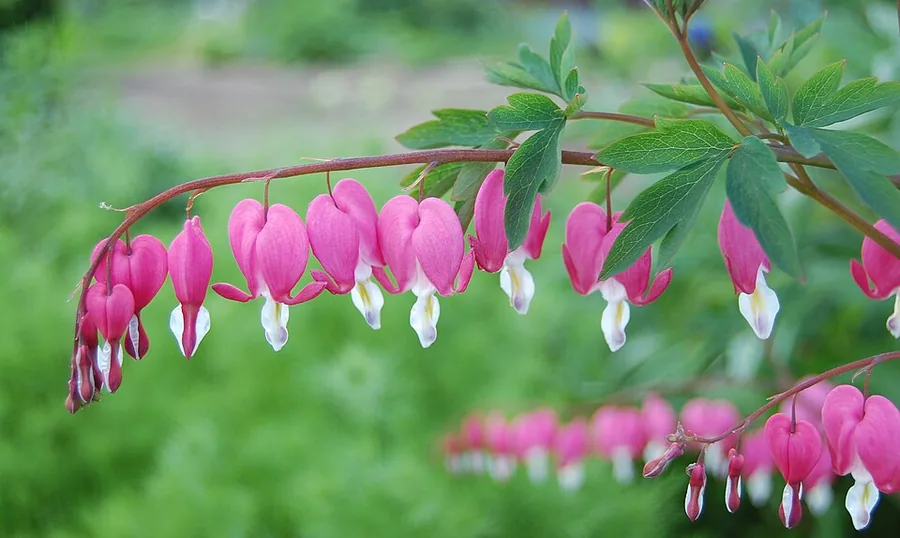
Bleeding heart is the archetypal spring woodland perennial, named for the rank of plump heart-shaped flowers suspended along each arching stem, each marked by a small white drop at its tip. It sits within the poppy family and originates in the woodlands of eastern Asia, where it occupies the cool, dappled understory beneath taller canopy trees. That native habitat explains its garden preference for a shaded, sheltered position.
This is a hardy perennial that persists for years from a long-lived rootstock and tolerates winters down to USDA zone 3. Flowering opens in spring, frequently in advance of full leaf expansion, and continues through April and May. By midsummer the plant performs a phenological shift that surprises growers unfamiliar with the species.
As heat accumulates, the foliage yellows and senesces and the plant enters summer dormancy until the following spring. The rootstock remains alive and functional underground throughout. Anticipating that interval and pairing it with later-emerging neighbors yields a low-input perennial once it is established.
Care
The short version: site it in partial to full shade in rich, humus-rich soil, maintain even soil moisture through spring and summer, and ensure it never stands in saturated ground over winter.
Light
Provide partial to full shade, replicating the cool, dappled understory light of its native woodland. A little morning sun is acceptable, but intense afternoon sun scorches the foliage and accelerates the onset of dormancy.
Water
Maintain evenly moist soil through spring and summer, since the species cannot withstand summer drought. Consistent moisture also delays foliage senescence, holding the leaves longer. Do not allow it to stand in saturated, waterlogged ground, particularly over winter, or the roots will rot.
Soil
Establish it in moist, well-drained soil rich in humus, the loose, organic medium characteristic of a woodland floor. It is indifferent to acidity and performs across the range from pH 6.0 to 8.0, so incorporate ample compost.
Humidity
Ambient garden humidity is adequate, so no target level is required. The species responds to soil moisture rather than atmospheric moisture.
Feeding
It is a light feeder, supported well by compost or organic matter incorporated each spring, or a balanced fertilizer applied through the growing season. Soil already rich in humus frequently meets its requirements without supplementation.
Pruning
No structural pruning is warranted. Remove the spent flower stems to maintain appearance, then cut back the yellowing foliage as it senesces in midsummer. Leave the rootstock undisturbed and growth resumes the following spring.
Size & spacing
A mature clump attains 2 to 3 feet (61 to 91 cm) in height and a spread of 18 to 30 inches (46 to 76 cm). Space accordingly, and allow for the void it leaves once it enters dormancy in summer.
When to plant
Bleeding heart follows a spring-driven calendar. Establish dormant roots or divisions in spring or fall, expect flowering in April and May, and anticipate foliage senescence by midsummer as the plant enters dormancy for the season.
Northern hemisphere
Southern hemisphere
Typical months for a temperate climate: start earlier in warm zones, later where spring frosts linger.
- Sow: Seed is slow and difficult; division is preferred over indoor sowing.
- Plant: Plant dormant roots or divisions in spring or fall in a shaded, woodland-type site.
- Harvest: Blooms in spring, typically April to May, often before leaves fully emerge.
Hardiness
USDA hardiness zones: 3–9
Temperature: down to -40°C
Troubleshooting
Bleeding heart is an undemanding species with only a handful of idiosyncrasies, and most are not pathological. The principal one, midsummer dieback, is a normal phase that requires no remedy. Match the symptom below before intervening.
Crown rotting, collapsing, or failing to re-emerge
Soft, mushy roots point to root rot driven by waterlogging, since saturated soil starves the roots of oxygen and lets rot organisms take hold, and winter wet is the most damaging because the dormant crown cannot transpire the excess. Amending with organic matter improves structure and drainage so water moves through rather than pooling, and relocating to a site that never holds standing water removes the underlying cause. The species needs steady moisture during active growth but sharp drainage once it goes dormant.
Fix:
- Improve drainage by amending with organic matter
- Relocate to a well-drained site
Foliage yellowing and senescing in midsummer
What looks like decline is summer dormancy, a programmed retreat rather than death. As temperatures climb after the spring bloom and the soil dries, the plant withdraws resources into its rootstock and lets the top growth senesce, repeating the cycle each year. Holding the soil moist slows that senescence and keeps the foliage longer, interplanting with hostas or ferns masks the gap, and leaving the roots intact allows the crown to flush again the following spring.
Fix:
- Keep soil moist to prolong foliage
- Interplant with hostas or ferns to fill the gap
- Leave roots undisturbed; growth resumes the following spring
Distorted, sticky new growth carrying small insects
The soft-bodied insects massed on the succulent spring shoots are aphids, and the sticky film is honeydew they excrete as they feed on sap, which is why the new growth twists and distorts. A forceful jet of water dislodges the colonies, and insecticidal soap clears any that recolonize. Because aphids favor the flush of tender tissue that high nitrogen drives, restraining nitrogen reduces the soft growth they exploit.
Fix:
- Spray off with a strong stream of water
- Apply insecticidal soap if needed
Toxicity
Treat this as a plant to keep out of reach of mouths. Every part contains isoquinoline alkaloids, concentrated most in the roots and foliage, and it is classified as toxic to cats, dogs, and horses and a documented poison of grazing livestock. It is not edible for people either, and contact with the foliage can irritate sensitive skin, so wear gloves and prevent children and animals from chewing it.
Toxic to
Cats · Dogs · Horses · Rabbits · Livestock · Birds · People
Cats Mild
In cats, nibbling the foliage typically produces drooling and vomiting followed by diarrhea. A larger ingestion delivers enough alkaloid to progress to tremors and even convulsions.
Dogs Mild
Dogs that chew the foliage commonly show drooling, vomiting, and loose stools. A sufficient dose of the alkaloids can advance to shaking and seizures, so a large ingestion warrants veterinary attention.
Horses Moderate
Horses respond more strongly than the small companion animals. Grazing the plant brings drooling, gastrointestinal upset, and diarrhea, while a heavier intake can trigger trembling and convulsions.
Rabbits Toxic
Rabbits often avoid the plant, but the identical alkaloids saturate the leaves and roots, so it should be regarded as toxic and kept out of reach.
Livestock Toxic
The species is a documented poison of grazing stock including cattle, sheep, and goats. Animals consuming a quantity can develop staggering and convulsions, so exclude it from pasture.
Birds Toxic
The alkaloids that injure mammals make the foliage and roots equally unsuitable for birds. Prevent poultry and pet birds from pecking any portion of the plant.
People Caution
No part of bleeding heart is edible, and ingesting a quantity can sicken a person through the isoquinoline alkaloids. Handling the foliage alone can irritate sensitive skin, so wear gloves and prevent children from placing it in their mouths.
Contact with the foliage can cause skin irritation in sensitive people; wear gloves when handling.
Helpline numbers

United States
ASPCA Animal Poison Control: (888) 426-4435 (fee applies)
Poison Control: (800) 222-1222



Canada
Poison Centres: 1-844-764-7669
Varieties
The species itself is the form most often cultivated, though several named selections deliver an alternative flower color or marginally improved heat tolerance. The following are worth knowing.
Alba
A pure white selection with marginally better tolerance of summer heat than the species.
Gold Heart
Selected for golden-yellow foliage that provides a strong contrast against the rose-pink flowers.
Valentine
Bears red-and-white flowers on dark red stems, yielding a deeper, more saturated effect.
How to propagate
Bleeding heart is propagated by division rather than seed, which germinates slowly and unreliably. Dividing an established clump produces established plants that flower considerably sooner than seedlings.
DivisionModerate
Divide the clump in spring or fall while dormant or just emerging. · Reaches mature size within about 2 to 3 seasons.
Division is the dependable means of propagation, carried out in spring or fall while the clump is dormant or just emerging and root disturbance is least disruptive. Because the roots are brittle and fleshy, lift and separate them carefully, then replant without delay into moist, shaded, humus-rich soil so the divisions do not desiccate. Expect each division to require 2 to 3 seasons to establish and attain full size.
Myths
Bleeding heart poses no risk to pets because it is merely an ornamental flower.
The record contradicts this: every part contains isoquinoline alkaloids, and the ASPCA classifies the plant as toxic to cats, dogs, and horses. Ingestion induces drooling, vomiting, and diarrhea, and a large dose can advance to tremors and convulsions. Ornamental value confers no safety, so exclude pets and livestock from grazing it.
The plant has died once its foliage yellows and disappears in summer.
That dieback is the species' normal phenology, not mortality. The rootstock remains viable underground throughout the dormant period, and the entire plant re-emerges the following spring without intervention.