Houseplant · Euphorbiaceae
Pencil Cactus
Euphorbia tirucalli
A tough, sun-driven succulent spurge whose milky sap bites back, so precise handling matters.
Full sun
Every 14–28 days
50–86°F · 10–30°C
USDA 10–12
Overview
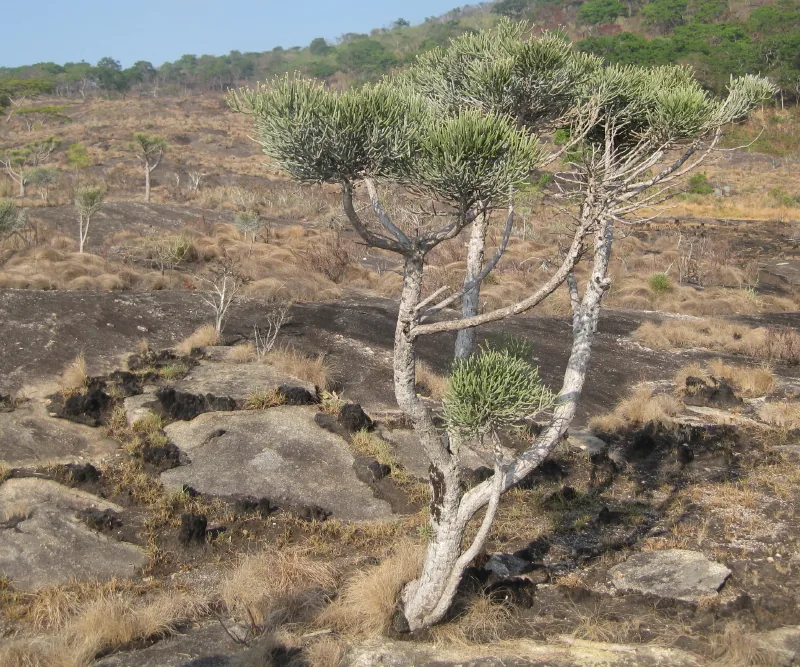
Botanically the pencil cactus belongs to the spurge genus Euphorbia, not the cactus family, and it originates in East and southern Africa. It grows as a branching mass of slim, pencil-thick green stems that carry out most of the photosynthesis themselves, which is why the plant runs almost leafless. Indoors that habit reads as a clean architectural form, and its needs stay modest once light and watering are correct.
The defining feature is the caustic milky latex held under pressure in every stem. Any break or cut releases a white exudate rich in diterpene esters that burns skin and can inflict serious ocular injury, and that single property governs siting and every act of handling. Treating the sap as the primary hazard, rather than an afterthought, is the sound approach.
Given suitable conditions the plant tolerates neglect and reaches 2 to 10 feet (60 cm to 3 m) in height over successive seasons. Supply strong light, a gritty substrate that drains freely, and extended dry intervals between irrigations, and the most common failure remains root or stem rot induced by excess water.
Care
The short version: full sun or the brightest available window, a gritty free-draining substrate, and a thorough soak only once the medium has dried through. Reduce watering in winter, and wear gloves and eye protection whenever you handle it.
Light
Position it in full sun at a south-facing window, or the brightest indirect light available. Higher irradiance keeps the stems stocky and rigid, whereas a dim location drives the thin, elongated growth described under etiolation.
Water
Let the substrate dry through completely before a deep watering, an interval that generally settles near every 14 to 28 days. Reduce sharply in winter, when metabolism slows. Standing moisture is the reliable killer here, since it induces the stem and root rot the record flags.
Soil
Use a gritty, fast-draining cactus or succulent mix so water passes quickly and never accumulates at the roots. A pH between 6.0 to 7.5 is suitable, and a container with a functioning drainage hole is a requirement rather than an option.
Temperature
Its working range runs 50°F and 86°F (10°C to 30°C), and it has no frost tolerance. Hold it above 50°F (10°C) through winter, because low temperature combined with wet substrate is the precise condition that precipitates rot.
Humidity
Low ambient household humidity matches its native tolerance, so no target figure applies and misting is counterproductive. Dry air actively suppresses the stem rot to which the plant is prone.
Feeding
Apply a dilute balanced or low-nitrogen cactus fertilizer monthly through spring and summer during active growth. Suspend feeding through autumn and winter as growth slows, and withhold it from any specimen that is stressed or recently repotted.
Pruning
Prune only to manage size or form, and never without gloves and eye protection, because cut stems bleed caustic latex that burns skin and can injure the eyes. Cut into a bag, keep the plant away from your face, and wash tools and hands immediately afterward.
Repotting
Repot every 2 to 3 years, or once roots circle the container and crowd the drainage holes. A specimen that has grown top-heavy and unstable is a further indication. Wear gloves and eye protection, since repotting almost inevitably nicks a stem and initiates sap flow.
Size & spacing
Under cultivation indoors it attains 2 to 10 feet (60 cm to 3 m) in height and a spread of 2 to 6 feet (60 to 180 cm) over time. Allow lateral room for the branching habit, and anchor a tall specimen in a heavy container to counter its raised center of gravity.
Troubleshooting
This species is resilient, so the two disorders that account for most decline are excess moisture and insufficient light, and both register in the stems before anywhere else. Read the tissue rather than guessing at the cause. Identify the pattern below and intervene early, before a soft lesion advances.
Soft, mushy stems collapsing at the base
The disorder here is rot, and it follows from water lingering around roots in a mix that drains too slowly, since saturated media starve the roots of oxygen and let pathogens take hold. Cold on top of damp only accelerates the collapse. Working in gloves and eye protection, excise back to firm green tissue, callus the sound pieces, and reset them in dry, gritty mix.
Fix:
- Cut away all soft, discolored tissue back to firm green growth using gloves and eye protection
- Allow healthy cuttings to callus, then replant in dry, gritty mix
- Withhold water until the plant is clearly established and the mix is dry
Thin, pale stems stretching toward the window
This is etiolation, the growth response of a plant receiving less light than it evolved to use, so the stems elongate and lean toward the strongest source in the room. The new tissue comes in narrow and pale because the plant is investing in reach rather than girth. Relocate it to a position with several hours of direct sun, and raise the exposure in steps so unhardened tissue does not scorch.
Fix:
- Move to a brighter location with several hours of direct sun
- Acclimate gradually to stronger light to avoid scorch
Toxicity
Regard this plant as a genuine chemical hazard rather than a benign houseplant. Every stem holds a caustic milky latex that produces a stinging dermatitis on skin and, on the eye, causes intense pain, swelling, and even temporary blindness. No part is edible, and the exudate is toxic to cats and dogs and irritating to other animals, so position it well clear of pets, children, and unprotected hands.
Toxic to
Cats · Dogs · Horses · Rabbits · Livestock · Birds · People
Cats Toxic
In a cat, the latex triggers drooling, mouth pawing, and vomiting once a stem is bitten, because it irritates the oral and gastric lining directly. Sap deposited on the coat inflames the skin to a red, sore state, and ocular contact from grooming can produce painful swelling and injury.
Dogs Toxic
A dog that chews a stem shows drooling, oral pain, and gastric upset as the diterpene esters act on soft tissue. The latex raises blisters along the gums and lips, and any that reaches the eye is corrosive enough to warrant immediate veterinary attention.
Horses Toxic
Browsing exposes a horse to caustic sap that inflames the mouth and gut, the same irritant mechanism seen in smaller animals scaled up. Direct contact leaves the muzzle and lips sore and reddened where the latex settles.
Rabbits Toxic
Because a rabbit's oral and digestive tissue is highly sensitive, even a slight nibble irritates the mouth and gut. These grazers investigate novel objects by biting, so reliable containment out of reach is the only dependable safeguard.
Livestock Toxic
In goats, sheep, and cattle, browsing the stems delivers enough latex to burn the mouth and unsettle the stomach. The exposure scales with intake, so fencing the plant away from grazing ranges removes the pathway entirely.
Birds Toxic
The caustic sap irritates a bird's beak, mouth, and crop, tissues poorly equipped to buffer a corrosive compound. A bird that pecks a stem also risks transferring latex onto its feathers and eyes during preening.
People Caution
No part is edible, and the milky sap carries the real risk rather than ingestion. On skin it produces a stinging chemical dermatitis, and in the eye it causes intense pain, swelling, and even temporary blindness, which is why gloves and eye protection are non-negotiable.
Always wear gloves AND eye protection when handling, cutting, or repotting. Never touch your face or rub your eyes. If latex contacts skin, wash thoroughly; if it contacts the eyes, flush immediately with copious water and seek urgent medical or veterinary care.
Helpline numbers

United States
ASPCA Animal Poison Control: (888) 426-4435 (fee applies)
Poison Control: (800) 222-1222



Canada
Poison Centres: 1-844-764-7669
Varieties
The type species is uniformly green, but one pigmented cultivar reaches the retail trade far more often than the plain form.
'Firesticks' / 'Sticks on Fire' (Euphorbia tirucalli 'Rosea')
Its juvenile stems develop coral, orange, and red pigment in place of plain green, an expression that intensifies under cool temperatures and strong sun.
How to propagate
Pencil cactus propagates readily from its own stem tissue, so a single specimen yields many. The one complication is the caustic exudate, which makes protected handling the substance of the procedure.
Stem cuttingsEasy
Late spring to summer during active growth · 3 to 6 weeks to root
Vegetative stem cuttings taken in late spring or summer, while the plant is metabolically active, root most reliably. Wear gloves and eye protection, since the severed ends bleed caustic latex on cutting. Rinse the exudate from the wound, allow the cut face to callus over several days so it seals against rot, then insert it into dry, gritty mix, where roots form in 3 to 6 weeks.
Myths
The pencil cactus is a true cactus.
The name reflects habit, not lineage, so the plant is no cactus. Euphorbia tirucalli is a pencil-stemmed succulent spurge, and the diagnostic feature is the caustic latex it bleeds, a trait absent from the true Cactaceae. Convergent form, not shared ancestry, explains the resemblance.