Houseplant · Euphorbiaceae
Croton
Codiaeum variegatum
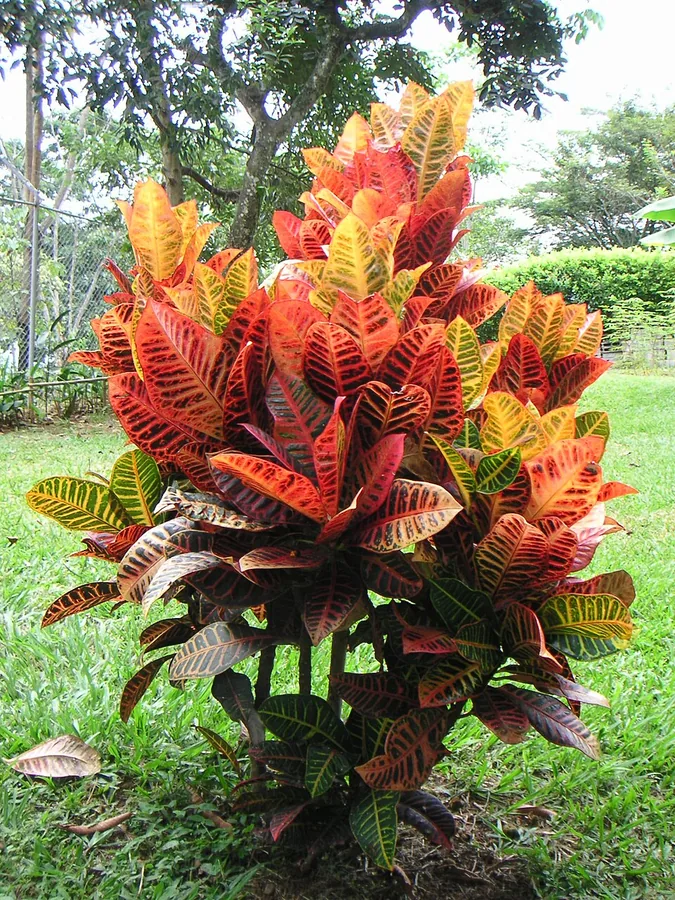
Supplied with bright light and steady, humid warmth, the croton develops leaves saturated in red, orange, and gold.
Bright indirect
50–85°F · 10–29°C
USDA 11–12
2–8 ft · 0.6–2.4 m
Overview
A croton earns its place through foliage alone, marked with red, orange, yellow, and green in combinations that vary from plant to plant. The species in cultivation is Codiaeum variegatum, a woody evergreen in the Euphorbiaceae whose native range runs from Malesia into the southwest Pacific. Under interior conditions it forms a substantial, leathery-leaved shrub that gains height with age.
Pigment expression in this plant is driven by light. Provide a bright position with some direct sun and the colors intensify, because low light favors green tissue and pushes new leaves back toward plain green. Its tropical origin explains the demand for warmth and humidity, and its habit of shedding a flush of leaves after relocation or a cold draft reflects how poorly it tolerates abrupt change.
This is not a low-input plant, yet it grows predictably once established. Hold it warm, water as the soil surface dries, and keep the milky sap off skin and away from pets, since every part of the plant is an irritant.
Care
The short version: supply bright light with some direct sun for full color, maintain warmth above 50°F (10°C), keep humidity high, and water only as the top half-inch to inch of soil dries.
Light
Light governs color in this species, so output rises with the intensity it receives. Target bright indirect light with some direct sun, because shaded positions favor green pigment and drain the variegation. Intense, all-day sun overwhelms the tissue and scorches it gray, which is why filtered or shifting sun gives the most reliable color.
Water
Water once the top half-inch to one inch of soil dries, then irrigate thoroughly and let the surplus drain. Reduce the frequency in winter, when slowed growth lowers water demand. The plant responds badly at both extremes and abscises leaves when the medium stays saturated or dries hard for an extended period.
Soil
Use a well-drained, humus-rich mix with a high proportion of organic matter. Drainage is the limiting factor here, because saturated medium starves the roots of oxygen and invites rot in a plant that nonetheless prefers to remain evenly moist.
Temperature
Hold the plant between 50°F and 85°F (10°C to 29°C) and keep it from dropping below 50°F. Cold drafts, chilled glass, and rapid temperature shifts all trigger leaf abscission, so a warm, stable position best supports continuous growth.
Humidity
Croton requires high humidity, consistent with its tropical origin, and dry interior air desiccates the leaf margins until the tips brown. Raise ambient moisture by grouping plants, standing the pot on a pebble tray, or running a humidifier through the heating season.
Feeding
Apply a general-purpose fertilizer through the growing season, spring into autumn, while the plant is actively producing foliage and can use the nutrients. Reduce feeding to a light application in winter, when growth nearly halts and surplus fertilizer serves no purpose.
Pruning
Croton tolerates a hard cut in early spring, before new growth resumes, which is the point at which to rehabilitate a leggy specimen. Cutting back at this stage releases lower buds and stimulates branching from the base. Wear gloves, since pruning exposes the irritant sap.
Repotting
Repot every 1 to 2 years, or earlier once rootbound, advancing into a slightly larger container in spring. Roots circling out of the drainage holes, water passing straight through unabsorbed, and stalled growth all indicate the rootball has outgrown the pot.
Size & spacing
Indoors the plant commonly reaches 2 to 8 feet (61 to 244 cm) tall and 2 to 6 feet (61 to 183 cm) across, with greater height possible in tropical conditions. Allow clearance so air circulates through the canopy and the foliage is not crowded.
Troubleshooting
Croton signals stress almost entirely through its leaves, and the underlying driver is generally light, water, humidity, or an environmental change it could not absorb. Read the symptoms below against the cause so the response addresses the mechanism rather than the appearance.
Wilt with softened stems and malodorous, saturated soil
Wilting in a saturated medium indicates root rot, caused by overwatering or a container that fails to drain, which suffocates and decays the roots until they turn brown and mushy rather than firm and pale. Suspend watering, repot into fresh, well-drained, humus-rich mix in a pot with drainage, excise the rotted roots, and resume watering only once the soil surface dries.
Fix:
- Stop watering and allow the soil to dry to the appropriate level
- Repot into fresh, well-drained, humus-rich mix in a pot with drainage, trimming rotted roots
- Resume watering only when the top half-inch to inch of soil dries
Rapid leaf loss following relocation or a temperature swing
Rapid leaf abscission traces back to a relocation, a cold draft, or a temperature swing, the changes this species absorbs least well. Exposure below 50°F (10°C) and a medium that alternates between saturated and bone dry produce the same response. Establish it in one warm, stable position, hold watering even, and it refoliates.
Fix:
- Settle the plant in one stable, warm, draft-free spot and avoid further moves
- Keep temperatures above 50°F / 10°C and away from cold windows, doors, and vents
- Maintain consistent moisture, watering only when the top half-inch to inch of soil dries
Delicate webbing with stippled, dust-flecked foliage
Hot, dry conditions favor spider mites, whose feeding produces fine webbing and a stippled, dusty cast on the lower leaf surfaces. Rinse the foliage and raise humidity to suppress the population, then apply insecticidal soap or horticultural oil and repeat as directed. Isolate the plant to limit spread.
Fix:
- Rinse foliage and increase humidity
- Treat with insecticidal soap or horticultural oil, repeating as directed
- Isolate the plant to limit spread
Cottony masses, immobile bumps, and honeydew film
Cottony masses in the leaf axils identify mealybugs, while immobile brown bumps along the stems indicate scale, and both excrete a sticky honeydew. Remove the visible insects with an alcohol-moistened swab, then treat with insecticidal soap or horticultural oil and repeat as directed. Keep the plant isolated until the infestation clears.
Fix:
- Wipe off or dab visible pests with an alcohol-moistened swab
- Treat with insecticidal soap or horticultural oil, repeating as directed
- Isolate the plant until the infestation is cleared
Variegation reverting to uniform green
Under insufficient light the plant favors green pigment, so new leaves emerge duller and the variegation recedes. Move it to a brighter position, ideally with some direct sun, and color returns on subsequent growth. Where a sunny window is unavailable, 'Petra' retains its color comparatively well in interior light.
Fix:
- Move to a brighter spot with bright indirect light, ideally with some direct sun
- For best color give the brightest light the plant can tolerate without scorching
Bleached, gray foliage from excess direct sun
Sudden exposure to harsh, all-day sun overloads the most exposed tissue, which turns gray, dull, or scorched. The remedy is bright but filtered light, or sun that moves across the day rather than dwelling for hours. Increase light gradually so the plant acclimates rather than burns.
Fix:
- Provide bright but filtered/indirect light or shifting sun rather than intense all-day direct sun
- Acclimate gradually when increasing light
Lower leaves yellowing and dropping off
Loss concentrated low on the plant, in the shaded interior, points to a position that is simply too dim to support that foliage. Raise the light level and rotate the plant so illumination reaches it more evenly. Remove fully spent leaves once they release.
Fix:
- Increase light levels
- Remove fully spent leaves and reposition for more even light exposure
Brown, crispy tips and leaf edges
Crisp brown margins follow dry interior air, since croton needs high humidity to keep its leaf edges intact, and a medium that dries too far between waterings compounds it. Raise humidity by grouping plants, using a pebble tray, or running a humidifier, and keep the soil evenly moist by watering once the top half-inch to inch dries.
Fix:
- Raise humidity with a pebble tray, grouping plants, or a humidifier
- Keep soil evenly moist (not wet), watering when the top half-inch to inch dries
Toxicity
Approach the croton as an irritant plant. Its milky latex contains irritant diterpene esters that inflame oral and gastrointestinal tissue in animals and provoke contact dermatitis in people, and no part is edible. Use gloves whenever you cut it, and keep foliage and trimmings away from animals and children.
Toxic to
Cats · Dogs · Horses · Rabbits · Livestock · Birds · People
Cats Mild
A cat that chews a leaf typically drools and may vomit or develop loose stools, and the milky sap can irritate the mouth and skin.
Dogs Mild
A dog that gnaws the plant tends to drool, develop an upset stomach, and sometimes diarrhea, while sap on the muzzle or paws can redden the skin.
Horses Caution
The same irritant sap stings the mouth and gut, so a horse should be kept from grazing or mouthing the foliage and any cut stems.
Rabbits Caution
A small grazer should not be nibbling this plant, because the diterpene esters in the sap inflame the mouth and digestive tract, so keep it well out of reach.
Livestock Caution
Goats, sheep, and cattle should be kept from the plant and any prunings, since the caustic sap irritates the mouth and stomach when eaten.
Birds Caution
A curious bird can be harmed by the irritant sap, so keep it away from the foliage and any chewed or fallen leaves.
People Caution
No part of the croton is edible. The milky sap is a caustic skin and eye irritant capable of causing contact dermatitis, so wear gloves when cutting it and keep the leaves away from children.
Wear gloves when cutting or propagating; the milky sap can irritate skin and mucous membranes and may stain. Keep cut surfaces and fallen leaves away from pets and children
Helpline numbers

United States
ASPCA Animal Poison Control: (888) 426-4435 (fee applies)
Poison Control: (800) 222-1222



Canada
Poison Centres: 1-844-764-7669
Varieties
The named cultivars are distinguished chiefly by leaf form and the distribution of color across the lamina. Those described below are the selections most often offered.
'Petra'
The most widely grown cultivar, bearing dark green leaves veined in yellow, pink, and orange-red, and the selection UF/IFAS identifies for retaining color well under interior light.
'Gold Dust'
It bears rounded, oval bright green leaves flecked throughout with golden yellow.
'Mammy'
It is recognized by narrow, twisting leaves in a bright assortment of colors.
'Eleanor Roosevelt'
It carries medium green leaves dotted with golden yellow that deepens to dark red.
'Andreanum'
It presents broad oval yellow leaves edged and veined in gold.
'Spirale'
It twists its red and green leaves into a loose spiral.
'Majesticum'
It produces long leaves, around nine inches, banded in yellow and red.
How to propagate
Croton is propagated vegetatively, by cuttings or by air-layering, and both methods preserve a named cultivar because they bypass the genetic recombination of seed. Wear gloves throughout, since the sap is an irritant.
Stem cuttingsModerate
Summer · Several weeks to root
Collect softwood or tip cuttings in summer and root them in a moist medium, a process that occupies several weeks. Wear gloves, since the milky sap is an irritant. Cuttings reproduce the cultivar faithfully, whereas seedlings segregate and bear no resemblance to the parent.
Air layeringModerate
Spring · Several weeks
Croton air-layers readily in spring, forming roots on the intact stem over several weeks before the layer is severed and potted. Wear gloves for this as well, since the sap irritates skin.
Myths
The cultivated houseplant is a genuine species within genus Croton.
The naming is misleading, because the cultivated plant is Codiaeum variegatum, not a species of the genus Croton. Both belong to the Euphorbiaceae, yet Kew's Plants of the World Online records Codiaeum variegatum as the accepted name within its own genus. The common name persists as a historical carryover.
Substantial leaf loss signals a croton in terminal decline.
Heavy abscission is a stress response to change rather than terminal decline. Relocation, a draft, cold below 50°F, or inconsistent watering can each trigger it. Once the conditions stabilize the plant generally recovers and replaces the lost foliage.
Croton coloration persists regardless of light levels.
Color is a direct function of light. In dim conditions the leaves revert toward plain green and lose their markings, whereas bright light, frequently with some direct sun, is what develops the color. Excessive harsh sun produces the opposite fault, bleaching the tissue to gray.