Ornamental · Buxaceae
Japanese Pachysandra
Pachysandra terminalis
Sited in deep shade and rich, moist soil, pachysandra forms a glossy evergreen carpet that persists for years.
Full shade
Every 7–14 days
USDA 4–9
6–12 in · 15–30 cm
Overview
Japanese pachysandra is the standard evergreen groundcover for shaded ground where turfgrass fails. A member of the boxwood family native to Japan and China, it colonizes the forest floor by rhizomatous underground stems. Set in a garden it behaves identically, forming a low, dark green mat beneath trees and along the north exposure of a building.
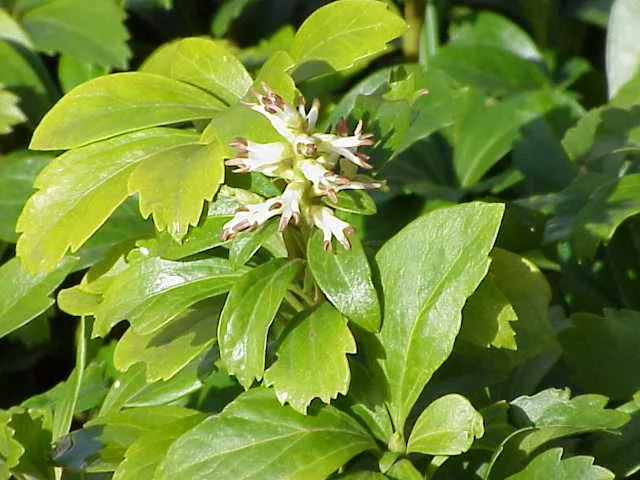
Its value lies in low demand on the grower. The foliage stays glossy through winter, mature height holds at 6 to 12 inches (15 to 30 cm), and a closed stand suppresses weeds by shading them out. Short white flower spikes emerge in early spring, but the plant is grown chiefly for evergreen foliage rather than for bloom.
Two conditions govern its performance: shade and free air movement. Placed where direct sun cannot overheat it and the canopy dries promptly after rain, it is essentially self-sustaining. Confined to damp, still air, it forfeits that reputation to Volutella blight, the single significant disease of the species.
Care
The short version: grow pachysandra in part to full shade in rich, moist, well-drained soil held slightly acidic. Irrigate through drought, keep the stand open so the canopy dries, and clear fallen debris, because those practices are what deny Volutella blight a foothold.
Light
As a true shade plant, pachysandra performs in part to full shade. Dappled light beneath a tree canopy or the shaded aspect of a building is ideal, whereas full sun bleaches and scorches the foliage and reduces plant vigor.
Water
Maintain the soil evenly moist, irrigating on the order of every 7 to 14 days during rainless spells, though an established stand tolerates dry shade. Deliver water at the base by drip rather than overhead, since foliage that stays wet supports Volutella blight.
Soil
It requires rich, moist, well-drained soil on the slightly acidic side, ideally a pH of 5.5 to 6.5. Loam or clay both suit it provided drainage is adequate, because saturated soil induces root rot.
Temperature
This is a markedly cold-hardy species, tolerating roughly -29°F to 95°F (-34°C to 35°C). It overwinters in the ground through severe cold, although drying winter wind can desiccate and scorch exposed foliage.
Humidity
Ambient outdoor humidity is sufficient, so no target range applies. Air movement is the operative factor, because it is the crowded, stagnant stand, not low atmospheric moisture, that permits leaf blight to establish.
Feeding
Pachysandra seldom requires feeding. A light balanced fertilizer in spring suffices, and heavier application aggravates disease by forcing soft, congested growth that the blight exploits.
Pruning
Maintenance is minimal. Thin or mow a crowded stand to improve air circulation, remove any diseased or scorched foliage, and rake up fallen leaves to eliminate the debris in which spores overwinter.
Repotting
Being a groundcover rather than a container subject, it is rarely potted or repotted. Once established in the ground it holds its position and extends by runners without intervention.
Size & spacing
Plants remain low at 6 to 12 inches (15 to 30 cm) tall, each spreading 12 to 18 inches (30 to 45 cm). Set new divisions 6 to 12 inches apart, and the stand closes the intervals over several seasons.
When to plant
Pachysandra is a hardy perennial that establishes slowly. Plant it in spring or early fall while the soil is cool and moist and re-rooting is favored, expect the short white flower spikes in early spring, and allow the bed about three years to close into a full groundcover.
Northern hemisphere
Southern hemisphere
Typical months for a temperate climate: start earlier in warm zones, later where spring frosts linger.
- Plant: spring or early fall
- Harvest: early to mid spring (April)
Hardiness
USDA hardiness zones: 4–9
Temperature: down to -34°C
Troubleshooting
Nearly all pachysandra disorders register first in the foliage, as either bleaching under excess sun or the lesions and dieback of disease. Recognizing the early symptoms lets you intervene before a lesion or a pest expands across the stand. Match the presentation below to your plant, then apply the correction while it remains effective.
Concentric leaf blotches, stem cankers, and patch dieback
The diagnosis is Volutella leaf and stem blight, caused by Pseudonectria pachysandricola and the most serious disorder of the species. It advances quickest in crowded, damp beds where foliage stays wet, which is why the target-ringed tan lesions, brown to black stems, and salmon-pink spore masses appear after prolonged wet weather. Excise infected tissue in dry conditions, thin the stand so the canopy dries faster, suppress scale, and irrigate at the base to deny the fungus free moisture.
Fix:
- Cut out and dispose of infected leaves and stems when dry
- Thin crowded plantings to improve air circulation
- Control scale insects
- Avoid overhead watering; use drip irrigation
- Apply fungicide during wet weather if severe
Wilt and soft blackened bases in waterlogged soil
Root and stem rot develops where drainage fails and the soil stays saturated, since waterlogged conditions starve the roots of oxygen and soften the crown. The decline predictably concentrates in the low, poorly drained zones of a bed. Correct the drainage, reduce irrigation to end the saturation, and remove plants already lost so the problem does not persist.
Fix:
- Improve drainage
- Reduce watering and avoid waterlogged sites
- Remove and discard affected plants
Stippled foliage with waxy scale on stems and leaves
The white to brown waxy crusts on stems and leaf undersides identify euonymus scale, while fine stippling and webbing point to spider mites. Both are sap feeders, so their piercing mouthparts drain the plant and leave the foliage dull and off-color. Prune out the heavily infested stems, apply horticultural oil to smother the scale, and keep after it, because scale infestation predisposes the planting to Volutella blight.
Fix:
- Prune out heavily infested stems
- Apply horticultural oil for scale
- Manage mites with appropriate miticide or oil
Foliage bleaching pale or scorching at the margins
Because pachysandra is adapted to shade, excess sun drives the bleaching that turns its dark green foliage yellow and crisps the leaf margins. Drying wind and winter exposure produce the same desiccation. Relocate affected plants to part or full shade over rich, moist soil, and the pigment recovers as the leaves are no longer overexposed.
Fix:
- Transplant to part or full shade
- Provide a moist, organically rich site
- Water during drought and avoid hot, exposed locations
Toxicity
Pachysandra is a low-risk choice around pets, livestock, and children. It does not appear on the ASPCA toxic list, and although the leaves carry Buxus-type alkaloids that can give a curious cat or dog brief gastrointestinal upset if chewed, no serious poisoning results. It can be planted freely where animals and children have access.
Safe for
People · Cats · Dogs · Horses · Rabbits · Livestock · Birds
Cats None
Cats are not at risk from pachysandra. The alkaloid content is low enough that a nibble produces at most transient drooling or mild gastrointestinal upset, nothing beyond that.
Dogs None
Dogs face no meaningful hazard. The foliage is absent from the ASPCA toxic list, and ingestion of a small amount yields only brief digestive discomfort.
Horses None
Horses are unaffected by this groundcover. No toxin known to harm equines is present, and the low, glossy foliage is not one they typically browse.
Rabbits None
Rabbits are not endangered by it. Wild and domestic rabbits browse around the planting without adverse effect, though it is not a preferred forage.
Livestock None
Cattle, goats, and sheep can graze in proximity without harm. The plant contains nothing that troubles a ruminant in the quantities it would casually sample.
Birds None
Birds incur no risk from pachysandra. Many exploit the dense mat for cover and foraging, and neither the leaves nor stems are injurious to them.
People None
People are in no danger from this groundcover. It is not a food plant and is not poisonous, which makes it a sound choice for a planting accessible to children.
Discourage pets from chewing the foliage; not listed among ASPCA toxic plants but the alkaloid-containing leaves can irritate.
Helpline numbers

United States
ASPCA Animal Poison Control: (888) 426-4435 (fee applies)

United Kingdom
Animal PoisonLine: 01202 509000 (fee applies)

Australia
Animal Poisons Helpline: 1300 869 738
Varieties
Several named selections circulate alongside the wild species. The following are the ones worth recognizing at purchase.
Green Carpet
A compact, lower-growing selection valued for its distinctly dark, glossy green foliage.
Variegata (Silveredge)
Distinguished by white leaf margins, it grows more slowly and with less vigor than the plain green species.
Pachysandra procumbens (Allegheny spurge)
A clumping native species bearing matte blue-green foliage mottled purple and white, notably less aggressive in spread than P. terminalis.
How to propagate
Pachysandra is readily increased by vegetative means from existing stock, and growers almost invariably choose that path over raising it from seed.
DivisionEasy
Spring or early fall · About three years to fill in as a groundcover
Division is the standard means of propagating the species. Lift established clumps or rooted runners during spring or early fall, when temperatures favor re-rooting, space the divisions 6 to 12 inches apart, and expect about three years for the stand to close into a continuous groundcover.
Stem cuttingsEasy
Late spring to summer · Several weeks to root
Tip cuttings collected from late spring through summer root readily in a moist medium, forming roots within a few weeks because the tissue is actively growing. It is an efficient method for increasing a planting from existing stock.
SeedModerate
Spring · Slow and seldom used
Spring sowing is feasible but slow, and it is seldom practiced. Nearly all plantings are raised vegetatively from division or cuttings, which reproduce the parent true and establish considerably faster than seed.
Myths
Pachysandra grows well in full sun.
The species is obligately a shade groundcover. Exposed to full sun and high wind, the foliage yellows, bleaches, and scorches, and that same photostress predisposes it to Volutella blight. Site it in part to full shade to hold the deep green coloration for which it is grown.