Vegetable · Brassicaceae
Mizuna
Brassica rapa var. nipposinica
Sow it in cool weather, keep it watered, and cut it often, and mizuna keeps feeding you for weeks.
Full sun
Every 2–4 days
39–75°F · 4–24°C
20–45 days
Overview
Mizuna is a Japanese mustard green in the cabbage family, distinguished by feathery, deeply dissected leaves and a mild peppery flavor that falls between arugula and young mustard. Its growth rate is fast, moving from seed to a first cutting in roughly three weeks. In the kitchen it goes raw into salads and is added to stir-fries and soups near the end of cooking, where brief heat preserves its texture.
Its value in the garden rests on tolerance. As a cool-season crop it withstands light frost, regenerates after each cutting, and needs little beyond consistent soil moisture. Heat is the limiting factor, because warm, long days shift the plant toward flowering and drive bitterness into the leaves.
Managed as a cut-and-come-again crop, one sowing yields over several weeks as the plant replaces harvested outer leaves from the growing point. Sowing in early spring and again in late summer keeps the crop within the cool windows it favors, so successive cuttings stay tender.
Care
The short version: grow mizuna in full sun to part shade during cool weather, hold the soil evenly moist, plant it in rich, well-drained ground, and cut the leaves often so the growing point keeps replacing them.
Light
Mizuna yields best under full sun, about 6 or more hours daily, though it performs acceptably in partial shade. In warm periods that afternoon shade is useful precisely because lower leaf temperatures slow the transition to bolting that heat otherwise triggers.
Water
Held evenly moist, the soil supports the fast, turgid leaf growth that keeps the greens tender. The plant survives leaner, drier ground, but flavor and quality decline, so water every 2 to 4 days. Consistent moisture is what keeps the leaves mild rather than concentrating the sharper compounds that stress brings out.
Soil
Plant into well-drained ground rich in organic matter, amended with ample compost to hold moisture while draining freely. A soil pH between 6.0 and 7.0 keeps nutrients available, and that range spans most garden soils without adjustment.
Temperature
Mizuna is adapted to cool conditions, performing best between 39°F to 75°F (4°C to 24°C). It tolerates light frost at the lower bound, while heat near the upper bound induces flowering and the bitterness that follows.
Humidity
Average humidity, roughly 40% to 70%, meets its needs, so there is no target to manage outdoors. Air movement is the greater factor, because still, humid air around crowded leaves favors the pests and rots that dense foliage invites.
Feeding
Incorporate aged compost or a balanced, nitrogen-rich fertilizer before sowing, then feed monthly through the growing season. Nitrogen supports the leafy production the crop is grown for, but moderation matters, since the soft, nitrogen-rich tissue of overfed plants is what draws aphids.
Pruning
Harvest is the pruning operation. Cutting the leaves about 2 inches (5 cm) above the crown, or removing outer leaves individually, leaves the growing point intact to regenerate. That cut-and-come-again response is the mechanism by which a single sowing produces for weeks.
Size & spacing
The plants are compact, reaching 8 to 18 inches (20 to 45 cm) tall and a comparable width. Allowing each its full 10 to 18 inch (25 to 45 cm) spread maintains the air movement around the foliage that keeps the leaves clean.
When to plant
Mizuna performs at the cool ends of the season rather than through midsummer, and timing follows its physiology. Sow in early spring once the soil is workable, then again in late summer for a fall crop as temperatures fall. Its tolerance of light frost extends the productive window well beyond the first cold nights.
Northern hemisphere
Southern hemisphere
Typical months for a temperate climate: start earlier in warm zones, later where spring frosts linger.
- Sow: 4-6 weeks before last spring frost, or direct sow
- Plant: early spring and again in late summer; cool-season and frost-tolerant
- Harvest: baby leaves about 21 days, full leaves about 40 days; cut-and-come-again
Hardiness
USDA hardiness zones: 4–9
Temperature: down to -34°C
Troubleshooting
Nearly all mizuna problems reduce to a few brassica pests and to the heat that drives bolting, both predictable from the plant's family and cool-season nature. Reading the early signs on the foliage usually lets you intervene before real damage sets in. Match the symptom below and act while the response still changes the outcome.
Root tunneling behind unexplained seedling collapse
Seedlings that wilt without a soil-moisture explanation often have roots tunneled by cabbage maggot larvae, which sever the tissue that moves water up the plant. Lifting and destroying affected plants removes the larvae, and row covers exclude the adult flies before they can lay eggs at the base. Rotating brassicas and avoiding recently manured beds both matter because the flies are drawn to decaying organic matter in cool soil.
Fix:
- Remove and destroy affected plants
- Use row covers to exclude egg-laying flies
Reproductive switch driving stalk and bitterness
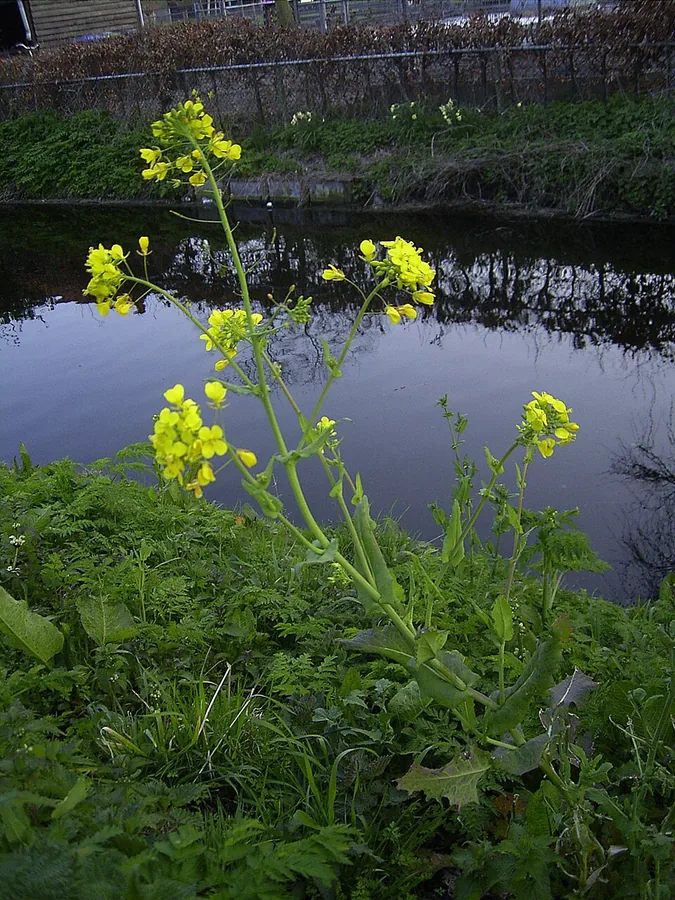
Rising heat and lengthening days trip mizuna's shift into flowering, or bolting, and as the plant redirects resources to a central stalk the leaves grow bitter. Harvest while the flavor holds, because the change accelerates once temperatures approach 90°F (32°C) and will not reverse. A late-summer sowing puts the crop back into cooling conditions, and afternoon shade through warm spells keeps leaf temperatures lower.
Fix:
- Harvest promptly before flavor declines
- Resow in late summer for a fall crop
Shot-hole feeding concentrated on seedling foliage
The rash of small round holes traces to flea beetles, dark beetles that spring away on disturbance and press hardest on seedlings, whose limited leaf area makes the loss most damaging early on. Floating row cover set over the bed at sowing forms a physical barrier before the beetles arrive, which is why timing it to sowing matters. Siting new plantings away from brassica beds that were infested last year reduces the local population that carries over.
Fix:
- Cover plantings with floating row cover at sowing
- Relocate plantings away from previously infested brassica beds
Soft-bodied colonies feeding on tender growth
Green or gray colonies on the undersides and growing tips are aphids, and the sticky residue is the honeydew they excrete as they feed on sap. A firm jet of water dislodges the colony mechanically, and insecticidal soap follows up on any that reestablish. Because aphids favor the soft, sappy tissue that excess nitrogen produces, easing off the feed removes the growth they target.
Fix:
- Rinse plants with a strong jet of water
- Apply insecticidal soap to affected foliage
Toxicity
Mizuna is a food crop and safe across the board, cultivated for the table and posing no toxic risk to cats, dogs, or the other animals on the farm. No part of the plant is toxic, so there is nothing to keep out of reach. The one qualification is the glucosinolate goitrogens common to the cabbage family, which become relevant only under heavy, prolonged brassica grazing by livestock.
Safe for
People · Cats · Dogs · Horses · Rabbits · Livestock · Birds
Cats None
Cats face no toxic compound in mizuna. A sampled leaf carries no risk, and only a disproportionate quantity of any leafy green would prompt loose stools.
Dogs None
Dogs are unaffected, since the plant holds nothing toxic to them. Small amounts of plain leaf are tolerated well as an occasional addition.
Horses Safe
Horses can graze mizuna without adverse effect. As a member of the mustard family it is best kept a minor component of the ration rather than a staple forage.
Rabbits Safe
Rabbits digest the tender leaves well, and they supply a sound leafy green. Any new fresh food, this one included, should be introduced by degrees.
Livestock Mild
Cattle, goats, and sheep tolerate mizuna at normal intake. The goitrogenic effect common to brassica forage emerges only under heavy, sustained grazing, so it should be balanced with other pasture.
Birds Safe
Poultry and other birds can consume the leaves without concern. The greens contribute useful dietary variety to their feed.
People Safe
Mizuna is cultivated as food and eaten raw in salads or lightly wilted. It presents nothing a healthy person needs to avoid.
Like other brassicas it contains glucosinolate goitrogens, which are mainly a concern for heavily grazed livestock rather than household pets.
Varieties
Mizuna is offered in only a couple of common selections, and the practical difference between them is pigment. Both share essentially the same growth habit and flavor.
Mizuna (green)
The standard green selection bears deeply serrated, feathery foliage on slender white petioles and reads mildly peppery on the palate.
Red Kingdom / purple mizuna
A burgundy-pigmented selection with purple stems, grown chiefly for the color contrast it lends to a salad blend.
How to propagate
Mizuna is raised from seed alone and ranks among the easiest greens to establish. Sown directly into the ground, it is only a few weeks from the first cutting.
SeedEasy
Direct sow in early spring and again in late summer; succession sow for continuous harvest · Germinates in about 4-8 days at 55-75°F; baby leaves ready in roughly 21 days
Mizuna is propagated by direct-sown seed almost without exception, since as a fast annual it establishes in place rather than transplanting. Sow 1/4 to 1/2 inch deep into cool, moist soil, where germination follows in about 4 to 8 days and baby leaves reach cutting size in roughly 21 days. Succession sowings every couple of weeks, grown cut-and-come-again, maintain continuous supply from a rolling series of plantings.
Myths
Mizuna is a pungent, sharp mustard that requires cooking before eating.
Its flavor registers as mild, a gentle peppery note rather than the heat of a hot mustard. Raw use in salads shows it at its best, and it braises cleanly as well, so cooking is elective and not a condition of eating it.
Mizuna is a warm-season green dependent on summer heat.
It is in fact a cool-season crop with tolerance of light frost and a slow tendency to bolt. Its productive windows are spring and fall, whereas summer heat is precisely the trigger that forces flowering and bitterness.