Vegetable · Basellaceae
Malabar Spinach
Basella alba
Warmth, consistent moisture, and vertical support keep this twining Basellaceae vine in leaf rather than in seed.
Full sun
Every 2–4 days
59–95°F · 15–35°C
50–70 days
Overview
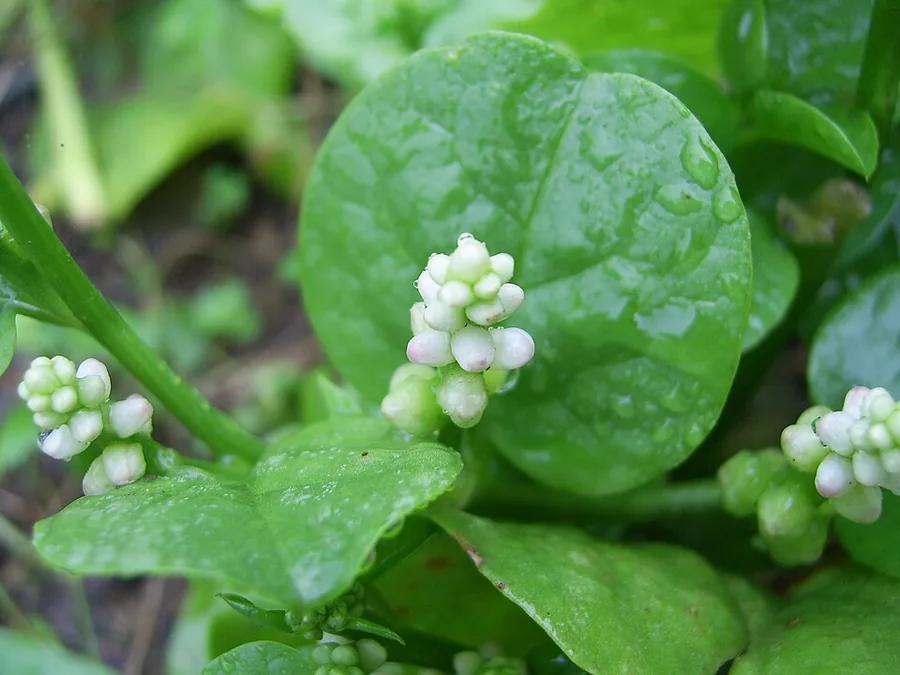
Malabar spinach earns its place as a warm-season substitute for true spinach, and the distinction is botanical rather than culinary. It belongs to a twining vine in the family Basellaceae, a tropical species unrelated to true spinach, which is why it holds quality through the heat and humidity that push cool-season greens to bolt.
Growth is fast and indeterminate, so a plant will run 6 to 10 feet (1.8 to 3 m) up a trellis within a single warm season. The thick, glossy leaves carry a mild, faintly citrusy flavor and serve two ways: raw in salads, or cooked down like spinach, where their mucilaginous quality gives a slight thickening to soups and stir-fries.
Culture is undemanding once the vine establishes. It needs sun, consistent soil moisture, and vertical support, with regular tip pinching to sustain fresh leaves. The recurring task is removing flower spikes, because once the plant transitions to reproductive growth the leaves become smaller and tougher.
Care
The short version: full sun and genuine warmth with sturdy vertical support. Hold the soil evenly moist, feed through the season to sustain leafy growth, and pinch the tips to delay the reproductive shift into flowering.
Light
Site the vine in full sun, which drives the strongest growth, though it tolerates light afternoon shade in the hottest gardens. Greater light directly increases leaf production and rate, which is the objective when growing it for foliage.
Water
Hold the soil evenly moist, on the order of every 2 to 4 days and more during heat. Moisture is not incidental: drought stress advances flowering, and once the plant flowers the leaves shrink and toughen, so consistent water is what preserves leaf quality.
Soil
Grow it in rich, well-drained loam with high organic matter, which supports fast leafy growth while draining freely. A pH of 6.0 to 6.8, slightly acidic, keeps nutrients available and the foliage tender.
Temperature
Heat governs performance here. The vine grows best between 59°F and 95°F (15°C to 35°C) and stalls in cold, which is the reason it should not go out before the soil has warmed.
Humidity
Unlike cool-season greens, this species performs in humid air, favoring 60% to 90% relative humidity. That tropical tolerance for high moisture is precisely why it holds up through muggy summers that cause true spinach to fail.
Feeding
Feed monthly through the growing season with a balanced, nitrogen-forward fertilizer. Nitrogen is the driver of vegetative growth, so the emphasis sustains the leaf production the crop is grown for.
Pruning
Pinch the growing tips often to force bushy branching and maintain a supply of tender leaves. Removing flower spikes as they form is equally important, because the reproductive transition is what reduces leaf size and increases toughness.
Repotting
Grown as an annual, it rarely warrants repotting, though a container plant should be potted up once roots fill the pot. The signs to watch are roots circling the container, rapid wilting between waterings, and stunted new growth.
Size & spacing
On a trellis the vine reaches 6 to 10 feet (1.8 to 3 m) in height and spreads 12 to 35 inches (30 to 90 cm) wide. Provide strong vertical support and adequate spacing so air moves through the canopy.
When to plant
This is a heat-driven crop, and it will not develop until the soil is warm. Start seed indoors in late winter, transplant only after the last frost once the ground has warmed, and then harvest leaves continuously through the warm season as the vine grows.
Northern hemisphere
Southern hemisphere
Typical months for a temperate climate: start earlier in warm zones, later where spring frosts linger.
- Sow: 6-8 weeks before the last expected spring frost
- Plant: after all danger of frost has passed and soil is warm (above ~18°C / 65°F), trained onto a trellis or other vertical support
- Harvest: harvest leaves continually once vines are established through the warm season
Hardiness
USDA hardiness zones: 7–12
Temperature: down to -18°C
Troubleshooting
Problems concentrate in two places: the foliage, and any stall in fresh growth. Reading the early symptoms lets you sustain tender leaves for months. Identify the sign below, then intervene while the correction still changes the outcome.
Stunted, wilting plants with knotty galls on the roots
Knobby swellings on the roots identify root-knot nematodes, soil pests that damage the root system and impair water and nutrient uptake. A heavily infested plant cannot be recovered, so remove and destroy it, then rotate the bed to a non-host crop. Raising organic matter supports the beneficial soil organisms that suppress them over time.
Fix:
- Remove and destroy heavily infested plants
- Rotate to non-host crops
- Amend soil with organic matter to support beneficial organisms
Flower spikes appear and the leaves turn small and tough
Spikes of small flowers and dark berries signal the transition to seed production, after which leaf size and quality decline. Shortening days along with heat and moisture stress drive that shift. Remove the flower spikes as they appear, keep the soil evenly moist to reduce the stress cue, and harvest the tips frequently to hold the plant in vegetative growth.
Fix:
- Pinch out flower spikes promptly
- Keep soil evenly moist
- Harvest tips frequently
Small brown spots with dark edges on the leaves
These lesions indicate Cercospora leaf spot, a fungal disease favored by warm, wet, humid conditions. Remove the marked leaves, widen trellis spacing to improve airflow through the canopy, and water at the soil line so the foliage does not stay wet, since leaf wetness is what the pathogen needs.
Fix:
- Remove and dispose of affected leaves
- Improve air circulation and trellis spacing
- Water at the soil line to keep foliage dry
Vines sprawling and tangling along the ground
The habit here is a twining climber, which ascends by wrapping around a support rather than by tendrils or adhesive roots. Without a structure to grip, the stems run along the soil and self-tangle, so install a sturdy trellis, fence, or stake at planting and train the young shoots onto it, since the vine can exceed 6 to 10 feet (1.8 to 3 m).
Fix:
- Install a sturdy trellis, fence, or stake
- Gently train young shoots onto the support
Toxicity
The verdict here is straightforward: this is an edible vegetable, not a toxic plant. It is safe around cats, dogs, livestock, and children, and the leaves are eaten. The one caveat is dietary rather than toxicological, since the leaves are high in oxalates, as true spinach is, a consideration for people prone to kidney stones.
Safe for
People · Cats · Dogs · Horses · Rabbits · Livestock · Birds
Cats None
No concern for cats. A leaf sampled by a cat might cause a mild, short-lived digestive upset at most, no different from any unfamiliar green.
Dogs None
Safe for dogs. The foliage and stems contain no toxin, so a dog that chews the vine is not at risk.
Horses Safe
Not hazardous to horses. As a leafy vegetable rather than a poisonous plant, it presents no problem to a grazing horse.
Rabbits Safe
Suitable for rabbits, which can take the fresh leaves without risk. As with any green, introduce it gradually so it remains a small part of a balanced diet.
Livestock Safe
No danger to cattle, goats, or sheep. The foliage contains nothing toxic and is in some regions grown as fodder.
Birds Safe
Safe for pet and backyard birds to sample. The plant holds no compounds capable of harming them.
People Safe
An edible vegetable, taken raw or cooked. The single qualification is the high oxalate content of the leaves, relevant to anyone prone to kidney stones.
Leaves are high in oxalates (as with true spinach), a dietary consideration for people prone to kidney stones, not a pet-poisoning concern.
Varieties
Gardens grow only a couple of forms, separated mainly by stem pigmentation. Culture is identical between them, and the flavor is much the same.
Basella alba (green)
The standard green-stemmed type is identified by its green stems and thick, succulent green leaves.
Basella alba 'Rubra'
This selection shows red-to-purple pigmentation in the stems and leaf veins, which makes it suitable as an ornamental in addition to a green.
How to propagate
Propagation is easy by two routes, seed or stem cuttings, each drawing on the vine's fast, vigorous growth.
SeedEasy
Start indoors 6-8 weeks before last frost or direct sow after soil warms · Germination in roughly 10-21 days; soaking or scarifying the hard seed coat speeds emergence
Sow seed indoors 6 to 8 weeks before the last frost, or direct sow into warm soil once the cold has passed. The seed coat is hard, so an overnight soak improves emergence, with seedlings appearing in roughly 10 to 21 days.
Stem cuttingsEasy
During the warm growing season · Roots form in about 1-3 weeks in warm, moist conditions
Stem cuttings taken during the warm growing season are the quickest way to increase stock. A healthy stem set in water or moist media forms roots in about 1 to 3 weeks, yielding a vine identical to the parent.
Myths
Malabar spinach is a form of true spinach.
The connection is by name and use only, not by lineage. Malabar spinach is a twining vine in the family Basellaceae, taxonomically separate from true spinach (Spinacia oleracea, in the Amaranthaceae), and it functions as a warm-season substitute for the times when real spinach bolts in heat.
A spinach-like flavor means it avoids spinach's drawbacks.
One drawback carries over directly. The leaves run high in oxalates, just like true spinach, a dietary point worth noting for anyone prone to kidney stones.