Shrub · Rosaceae
Loganberry
Rubus × loganobaccus
In full sun, rich soil, and on a firm trellis, the loganberry sets a long crop of tart-sweet summer fruit.
Full sun
Every 5–7 days
USDA 5–9
5–7 ft · 1.5–2 m
Overview
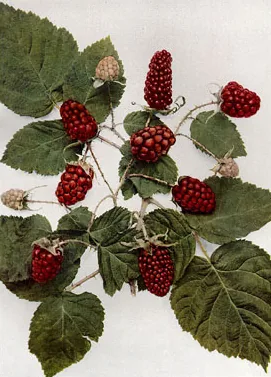
The loganberry is a cross between a blackberry and a raspberry, a hybrid raised long ago and grown since for its large, deep red fruit. It belongs to the rose family alongside its bramble relatives, and like a blackberry it retains its core when picked, which reflects its blackberry parentage. In flavor it falls between the parents, sharper than a raspberry and fuller than a blackberry.
In habit it is a trailing perennial, producing long, fast-growing canes that require a fence or trellis rather than supporting themselves. The crown is perennial and long-lived, but the canes are biennial in function: they grow vegetatively one season and fruit the next, then decline. Understanding that biennial cane cycle is what makes correct pruning straightforward.
This is an open-garden plant, hardy across USDA zones 5 to 9 and best given room to sprawl. It is undemanding, yet its cold-tenderness and its readiness to form a thicket where cane tips root are the two traits that shape its siting. A sheltered, sunny position and ongoing cane management keep both tendencies in check.
Care
The short version: full sun, rich and well-drained soil, and a consistent 1 to 2 inches of water a week. Train the canes to a trellis, feed once in early spring, and remove each cane the year after it fruits, because it will not crop again.
Light
Site the plant in full sun, since light drives the sugars that sweeten the fruit. It tolerates light partial shade, but reduced light means fewer flowers and smaller berries, so shade costs you yield directly.
Water
Supply 1 to 2 inches of water a week, raising the volume through flowering and fruit development when demand peaks. Hold the soil evenly moist but never waterlogged, because saturated ground starves the roots of oxygen and invites rot.
Soil
Grow it in rich, well-drained loam high in organic matter, which supplies both nutrients and structure. A pH between 5.5 and 6.5 keeps nutrients available, and the free drainage protects the roots from standing water.
Temperature
It withstands a broad span, roughly 5°F to 86°F (-15°C to 30°C), placing it in USDA zones 5 to 9. Its cold-tenderness is the limiting factor, so the canes need shelter or covering where winter lows run severe.
Humidity
Ambient outdoor humidity in the 40% to 70% range is unremarkable for this plant. Air movement matters more than the reading, because stagnant, damp air within a crowded canopy is precisely the microclimate that gray mold and purple blotch exploit.
Feeding
Fertilize in early spring as growth resumes, using a nitrogen-rich balanced product such as 10-10-10 supplemented with compost. Nitrogen at this point fuels the flush of primocanes that will carry next year's crop, so a single seasonal feed suffices.
Pruning
Prune on the cane cycle. Remove the spent floricanes at ground level after harvest, since they will not fruit again, then train the primocanes onto the trellis and tie and tidy them in late winter.
Repotting
This is a ground crop and seldom potted. Where a container is used, refresh it or move it up every 1 to 2 years in late winter, and read roots circling the pot, water running straight through, or stunted cane growth as signs it is rootbound.
Size & spacing
Mature plants reach 5 to 6.5 feet (150 to 200 cm) tall and spread 6 to 10 feet (1.8 to 3 m) along the trellis. Allocate that width, because the long trailing canes need the run to crop and stay ventilated.
When to plant
As an outdoor bramble, the loganberry answers to the season rather than an indoor calendar. Establish new plants in early spring once the danger of hard frost has passed, or in late fall in mild-winter regions. It flowers in late spring, and the fruit ripens from late June through August.
Northern hemisphere
Southern hemisphere
Typical months for a temperate climate: start earlier in warm zones, later where spring frosts linger.
- Plant: Early spring after the danger of hard frost has passed, or late fall in mild-winter regions
- Harvest: Blooms late spring; harvest late June through August
Hardiness
USDA hardiness zones: 5–9
Temperature: down to -29°C
Troubleshooting
Most loganberry problems concentrate on the canes and the ripening fruit, and moisture is the common driver behind them. Because these fungi spread fastest in still, wet conditions, early detection lets you intervene before inoculum builds along the row. Match the symptom below, then act while the intervention still changes the outcome.
Purple-brown blotches enlarging along the canes
These lesions signal purple blotch, the fungus Septocyta ruborum, which colonizes caneberry canes and advances fastest under wet weather and crowding. It begins as small marks at the nodes that enlarge and coalesce. Prune out and destroy the infected canes, thin the planting to open the canopy and lower humidity, and apply a labeled fungicide only where infection is severe.
Fix:
- Prune out and destroy infected canes
- Thin canes to open the canopy
- Apply a labeled fungicide if infection is severe
Ripening berries coated in gray mold
The fuzzy coating is gray mold, Botrytis cinerea, which flourishes in wet, humid conditions as the fruit ripens. Infected berries soften and collapse beneath the growth. Remove and discard affected fruit, harvest ripe berries promptly and often so none lingers, and improve airflow around the canopy to shorten the periods of leaf and fruit wetness the pathogen needs.
Fix:
- Remove and discard infected fruit
- Harvest ripe berries promptly and frequently
- Improve airflow around the canopy
Canes that fail to leaf out after winter
Trailing brambles carry low cold-hardiness, so winter injury can leave dead canes even when the more protected crown survives. The diagnostic is brown, brittle wood that snaps rather than bends. Cut the killed canes back to live tissue or the ground, and in cold sites mulch the crown and lower or cover the canes beforehand, since the injury traces to exposure the plant cannot tolerate.
Fix:
- Prune dead canes back to live tissue or the ground
- Protect canes over winter in cold sites
Toxicity
For households with pets and children, the record is clear: the loganberry contains nothing toxic. Its berries are edible and no part of the plant poses an ingestion hazard. The only genuine risk is mechanical, since standard canes bear sharp prickles, so glove up to prune and select a thornless cultivar where scratches are a concern.
Safe for
People · Cats · Dogs · Horses · Rabbits · Livestock · Birds
Cats None
There is no toxicity to cats, so a leaf nibbled in passing does no harm. The prickles on thorned canes are the only hazard, since they can scratch an investigating nose.
Dogs None
The plant contains no toxic compounds, so a dog can safely take a few ripe berries. A large volume of ingested leaves may produce transient gastrointestinal upset and nothing further.
Horses Safe
Horses may graze around the canes without risk of poisoning. Only the thorns warrant attention, as a prickle can scratch the muzzle.
Rabbits Safe
Rabbits can browse the leaves and fruit without restriction. The plant holds nothing poisonous, so it qualifies as safe forage.
Livestock Safe
Cattle, goats, and sheep can graze the foliage with no poisoning risk. The prickles on the stems are the sole concern.
Birds Safe
Birds feed on the ripe berries without harm. They take the crop and disperse the seed in the process.
People Safe
The berries are edible fresh or cooked, and the entire plant is non-toxic to handle and eat. On standard forms the thorns are the only real hazard, so wear gloves when pruning.
Thorned forms bear sharp prickles that can scratch pets and handlers, while thornless cultivars exist; wear gloves when training or pruning canes.
Varieties
The loganberry offers only a couple of forms of practical interest, separated chiefly by the presence or absence of cane thorns. The two below are the ones a grower is most likely to encounter.
Thornless Loganberry (L654)
Its smooth, spineless canes remove the prickles that otherwise slow picking and training on the thorned form.
Loganberry LY59
It is the standard thorned, heavy-cropping clone that has been grown commercially for years.
Companions
The loganberry shares soil diseases with a few common crops, so the smarter move is knowing what to keep it away from rather than what to plant beside it.
Keep apart
Solanaceous crops (tomato, potato, pepper, eggplant): Share Verticillium wilt; avoid planting brambles where these crops recently grew
Wild brambles: Can harbor viruses and diseases that spread to cultivated canes
How to propagate
Loganberries propagate readily at home because their trailing habit primes them to root at the cane tip, so the plant effectively does the work once a tip contacts moist soil.
LayeringEasy
Late summer to early fall · Roots in about 4 to 8 weeks; transplant the rooted tip the following spring
Tip-layering is the standard, low-effort route for trailing brambles, exploiting their natural tendency to root at the tip. In late summer or early fall, bend a growing cane tip to the ground and bury it, and it will root in about 4 to 8 weeks. Leave it undisturbed and lift the rooted tip to its permanent position the following spring.
Stem cuttingsModerate
Summer (softwood) or late winter (hardwood) · Several weeks to a few months to root and establish
Cuttings are less common than tip layering but effective for increasing the thornless clones. Take softwood cuttings in summer or hardwood cuttings in late winter, allowing several weeks to a few months for them to root and establish before you treat them as independent plants.
Myths
The loganberry is simply a form of raspberry.
It is in fact a cross between a blackberry and a raspberry, and it groups with the trailing blackberries rather than the raspberries. Like a blackberry, it holds onto its core when you pick the fruit, and that retained core is the reliable field mark separating the two.
All loganberry plants are thorned.
Both thorned and thornless cultivars are in cultivation, so prickles are cultivar-dependent, not universal. Choose a spineless form and the picking and pruning get much easier, since there are no prickles to obstruct the work.