Vegetable · Brassicaceae
Kohlrabi
Brassica oleracea Gongylodes Group
Grown fast and cool and harvested small, kohlrabi yields a crisp, sweet swollen stem held above the soil.
Full sun
Every 3–7 days
64–75°F · 18–24°C
45–60 days
Overview
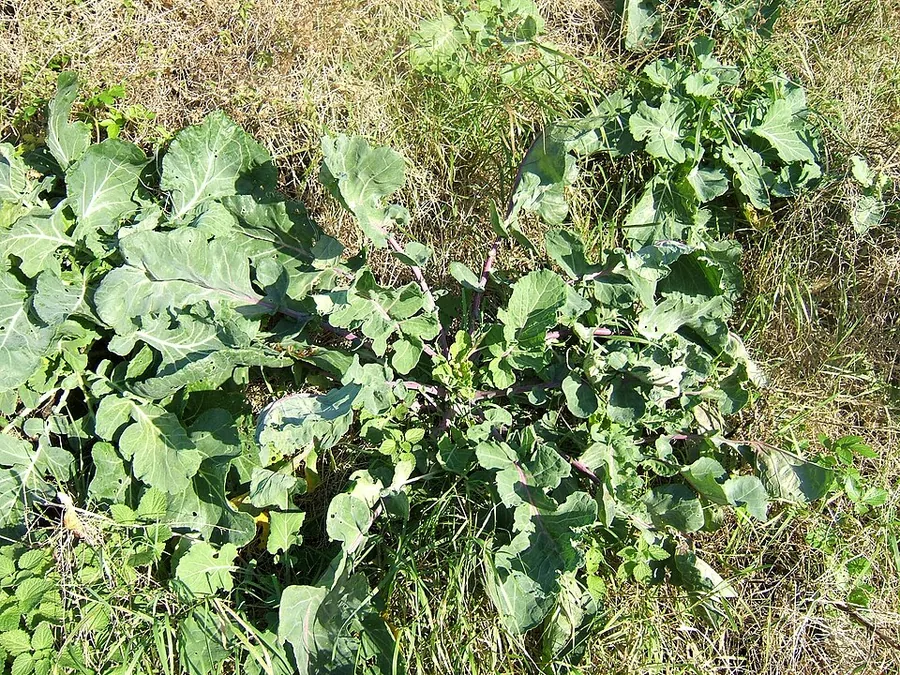
Kohlrabi is a swollen-stem brassica, botanically the same species as broccoli, kale, and cabbage but selected to thicken its stem rather than form a head or a leaf rosette. The result sits on the soil surface as a pale or purple globe with leaves radiating from it. Raw, its flavor falls between a mild turnip and a broccoli stem, crisp and faintly sweet, because the harvested tissue is young, water-rich stem parenchyma.
It performs as a cool-season crop, sizing best through the mild temperatures of spring and fall. Maturity is quick, commonly under two months, which allows two crops within one season. That speed governs quality: rapid, uninterrupted growth keeps the stem tissue tender, whereas heat or a growth check drives lignification and the tissue turns tough and bitter.
The plant repays limited time and space. It stays compact, tolerates light frost, and needs little more than consistent moisture and a fertile, well-structured soil. Sound timing is the main lever, and with it the crop yields crisp bulbs with minimal intervention.
Care
The short version: full sun and cool weather, consistent moisture of about an inch of water a week to keep the tissue tender, a rich well-drained soil, and harvest young at 2 to 3 inches across.
Light
Kohlrabi grows most evenly in full sun, meaning at least six hours daily, which drives the steady photosynthesis a fast crop needs. It accepts partial shade, and in hot weather that shade is useful, because it lowers plant temperature and slows growth just enough to delay bolting.
Water
Maintain even, consistent moisture at roughly an inch of water a week, since this is the dominant factor in stem quality. Uninterrupted hydration builds tender, mild tissue, whereas a dry-then-wet cycle triggers the stress response that leaves the stem tough, woody, and bitter.
Soil
Use a loamy, well-drained soil amended with ample organic matter to feed the rapid growth. A pH of 6.0 to 7.5 is ideal, and holding toward the upper end raises soil conditions that suppress clubroot, the persistent disease of the cabbage family.
Temperature
The crop favors cool air between 64°F and 75°F (18°C to 24°C), the range in which stem tissue stays succulent. It withstands light frost, but heat is the limiting stress, since warm spells induce bolting and coarsen the stem.
Humidity
Ambient outdoor humidity is sufficient, so there is no target percentage to manage. The variable that governs quality is soil moisture, which sustains the turgid tissue that keeps the bulb crisp.
Feeding
Incorporate a balanced or low-phosphorus fertilizer at planting, guided by a soil test where possible, to match the crop's actual needs. Side-dress with nitrogen once plants reach about 4 inches tall, supporting the sustained vegetative growth that fast bulbing requires.
Pruning
The crop requires no pruning, as it forms no structure that benefits from cutting. Remove only lower leaves that have been damaged by pests or disease, discarding them to reduce inoculum rather than leaving them on the plant.
Size & spacing
Plants remain small at 6 to 12 inches (15 to 30 cm) tall and a comparable spread. Spacing standard varieties near 4 inches (10 cm) apart gives each stem room to expand while keeping the planting efficient.
When to plant
Kohlrabi is a cool-season crop intolerant of summer heat, which forces bolting. Sow in early spring for a late-spring harvest, then sow again in July so the bulbs mature in the cooling temperatures of fall. Each crop reaches size in well under two months.
Northern hemisphere
Southern hemisphere
Typical months for a temperate climate: start earlier in warm zones, later where spring frosts linger.
- Sow: early spring, 4 to 6 weeks before transplanting outdoors
- Plant: mid-April to early May for spring crop, or July for fall crop
- Harvest: harvest when the swollen stem reaches 2 to 3 inches in diameter
Hardiness
USDA hardiness zones: 3–9
Temperature: down to -40°C
Troubleshooting
Most kohlrabi problems trace to timing and to the brassica-family pests the crop shares with its relatives. Early detection makes them straightforward to manage. Match the symptom below, understand what drives it, and intervene before the stem or foliage sustains lasting injury.
Wilt and stunting from root disorders
Unexplained wilting and stunting point to the roots, where either cabbage maggots tunnel through the tissue or clubroot swells it into club-shaped galls that block water uptake. Neither injury is curable in an affected plant, so rogue and destroy it. A four-year brassica rotation breaks the maggot and pathogen cycle, and holding soil pH toward the upper end suppresses the clubroot organism.
Fix:
- Remove and destroy affected plants
- Practice a 4-year rotation away from brassicas
Woody, bitter bulbs from checked growth
A bulb turns woody when growth stalls, so an overgrown, over-mature stem is the usual driver, along with heat or drought that interrupts steady expansion. A cut cross-section confirms it: fibrous, stringy tissue rather than crisp flesh. Harvesting at 2 to 3 inches (5 to 8 cm) across and holding the soil evenly moist keeps cell walls from lignifying, so the stem stays tender and sweet.
Fix:
- Harvest at 2 to 3 inches in diameter for best quality
- Keep soil evenly moist to maintain fast, uninterrupted growth
Foliage chewed into ragged holes
Green larvae feed on the leaves, most often imported cabbageworms, cabbage loopers, or diamondback moth larvae, all brassica specialists drawn to the crop. Their presence, confirmed by caterpillars and dark frass on the leaf undersides, marks the diagnosis. Handpicking reduces numbers, Bt kills young larvae by disrupting their gut, and a floating row cover applied early denies the adult moths the chance to oviposit.
Fix:
- Handpick caterpillars
- Apply Bacillus thuringiensis (Bt) where appropriate
- Use floating row covers
Shot-hole pitting on seedling leaves
The fine pitting is the signature of flea beetles, which leap from the foliage the moment the plant is disturbed. Seedlings show the injury most because their small leaf area magnifies each bite, yet a vigorous plant compensates and grows past it. A row cover at planting excludes the beetles, and steady feeding sustains the growth rate that outpaces their feeding.
Fix:
- Use floating row covers at planting
- Maintain vigorous growth so plants outgrow damage
Toxicity
Kohlrabi is entirely non-toxic, a food crop that carries nothing harmful to people or animals. Because both the swollen stem and the leaves are edible, an exploratory bite from a pet is of no concern. The single caveat is quantity, since brassicas produce gas in volume and a large feed is unwise for horses.
Safe for
People · Cats · Dogs · Horses · Rabbits · Livestock · Birds
Cats None
Kohlrabi poses no toxic risk to cats. A stray bite of leaf or stem is harmless, though the plant holds little appeal for an obligate carnivore.
Dogs None
Dogs tolerate kohlrabi without issue, whether the pieces are raw or plainly cooked. The only likely effect is flatulence after a large portion, a product of the brassica fiber load.
Horses Mild
Small amounts suit a horse, but a heavy feed of any brassica can disturb the hindgut and, with sustained intake, act on the thyroid through goitrogenic compounds. Confine it to an occasional treat.
Rabbits Safe
Both the foliage and the swollen stem are suitable for rabbits. Introduce it in small, increasing amounts so the cecal flora adapt to the new forage.
Livestock Safe
Cattle, goats, and sheep can graze kohlrabi without harm. As with any brassica, a gradual transition avoids the digestive upset of an abrupt dietary change.
Birds Safe
Poultry and other birds forage the leaves and stem readily. The plant carries no compound that endangers them.
People Safe
Kohlrabi is cultivated as human food, eaten raw or cooked at any age. Both the crisp swollen stem and the leafy tops are edible and nutritious.
As a brassica, large quantities can cause gas or mild goitrogenic effects; horses should not be fed large amounts.
Varieties
Seed catalogs list only a small set of kohlrabi cultivars, separated mainly by skin color and mature size. The following are the ones worth recognizing.
Purple Vienna
An heirloom identified by anthocyanin-pigmented purple skin over pale greenish-white internal flesh.
White Vienna
The standard pale green form, valued for crisp, mild-flavored flesh.
Kossak
A large storage cultivar that resists lignification and stays tender well beyond the size at which ordinary kohlrabi turns woody.
How to propagate
Kohlrabi is propagated exclusively from seed, and its dependable germination makes it one of the simpler crops to raise from scratch.
SeedEasy
Sow indoors in early spring 4 to 6 weeks before transplanting, or direct sow mid-April to early May and again in July for fall · 7 to 14 days to germinate, with bulbs ready 45 to 60 days from sowing
Kohlrabi propagates only by seed, and germination is reliable enough that it rarely disappoints. Start seed indoors in early spring roughly 4 to 6 weeks ahead of transplanting, or direct-sow from mid-April through early May and again in July to schedule a fall crop. Sow at a depth of 1/4 to 1/2 inches (5 cm) and thin standard plants to 4 inches (10 cm) so each has room to size its stem. Emergence follows in 7 to 14 days, and the bulbs reach harvest 45 to 60 days from sowing.
Myths
Kohlrabi is a root vegetable like a turnip.
The edible organ develops above the soil surface, not below it. Botanically it is a swollen stem, a thickened section that enlarges at the base of the plant rather than a true root descending into the ground. The vernacular name German turnip misleads, because kohlrabi is a brassica far more closely allied to cabbage than to any genuine turnip.